


Employee vs Independent Contractor: Key Differences in 2026
 By
Employee vs independent contractor comes down to one question: who controls the work? The answer decides how you're paid and who handles your taxes. It sets your benefits and legal protections. It even shapes the pay stubs and papers you'll show a landlord or lender as proof of income. Below, we'll cover how the IRS draws the line, what changes on your paycheck and tax bill, and how to avoid a costly misclassification mistake.
Key Takeaways
- Control is the main test. Employees follow the company's direction; contractors run their own business.
- Employees get a W-2 and pay stubs with taxes withheld. Contractors get a 1099-NEC and pay their own taxes.
- Contractors pay 15.3% self-employment tax, while employees pay 7.65% and the employer pays the rest.
- Misclassification can lead to back taxes, penalties, and lawsuits.
- What Is the Difference Between an Employee and an Independent Contractor?
- What Is an Independent Contractor?
- What Is a Contract Employee?
- How the IRS Decides Employee vs Independent Contractor Status
- Employee vs Independent Contractor Taxes and Pay Stubs
- Hiring Contractors vs Employees: Pros and Cons
- What Happens If a Worker Is Misclassified?
What Is the Difference Between an Employee and an Independent Contractor?
The key difference is control. An employee works under the company's direction, gets a W-2, and has taxes withheld from each paycheck. An independent contractor runs their own business and controls how the work gets done. They receive a 1099-NEC and pay their own income and self-employment taxes.
The job title doesn't settle it. Neither does a signed agreement. What matters is how the working relationship actually runs day to day.
Here's how employees and independent contractors compare side by side.
| Factor | Employee | Independent Contractor |
|---|---|---|
| Control | Company sets hours, methods, and rules | Worker decides how, when, and where |
| Tools | Usually provided by the company | Worker brings their own |
| Pay | Hourly wage or salary on a set schedule | Per project, hourly rate, or retainer, by invoice |
| Tax withholding | Employer withholds income tax, Social Security, and Medicare | No withholding; worker pays estimated taxes |
| Tax forms | W-4 at hire, W-2 each January | W-9 at hire, 1099-NEC each January |
| Benefits | Often health insurance, retirement plans, paid time off | None from the client |
| Legal protections | Minimum wage, overtime, unemployment, workers' compensation | Mostly contract law |
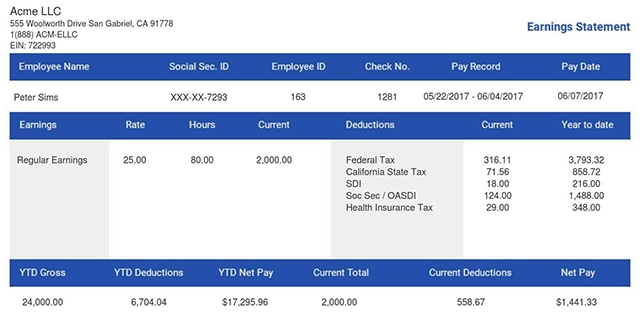
| Pay stubs | Issued with every paycheck | None unless the worker makes their own |
No single row decides the employee vs independent contractor question. The IRS weighs the whole picture.
What Is an Independent Contractor?

An independent contractor is a self-employed person who sells services to clients under an agreement. They set their own hours, use their own tools, and often work for several clients. Clients don't withhold taxes, so the contractor pays income tax and 15.3% self-employment tax.
Common examples include freelance writers, graphic designers, photographers, consultants, roofers, and rideshare drivers. Most bring specialized skills to a defined project, then move on.
A subcontractor is simply a contractor hired by another contractor. A general contractor might bring in an electrician for one phase of a build. The employee vs subcontractor test works the same way. If the electrician controls the work and sends an invoice, they're not an employee.
What Is a Contract Employee?
A contract employee is a W-2 worker hired for a fixed term or project, often through a staffing agency. Unlike an independent contractor, they're on someone's payroll: the agency or company withholds taxes and issues pay stubs. The contract sets the end date, not the tax status.
Say a staffing firm places you at a bank for six months. You work the bank's hours, but the firm pays you. You're the firm's employee, with Social Security and Medicare taken out of every check.
Job boards blur this. A listing marked "contract vs employee" usually means temporary vs permanent, not 1099 vs W-2. Before you accept, ask whether you'll get a W-2 or a 1099.
How the IRS Decides Employee vs Independent Contractor Status

The IRS uses common law rules to determine whether someone is an employee. It looks at three groups of facts.
Behavioral Control
Does the business control what the worker does and how? Detailed instructions, required training, and set schedules point to an employee. A contractor gets a goal and picks the method.
Financial Control
Who controls the money side? Contractors invest in their own equipment, cover their own costs, and can make or lose money on a job. Employees get a regular wage no matter how a project turns out.
Type of Relationship
Is there an open-ended relationship, with benefits like health insurance or a retirement plan? Is the work performed a key part of the business? Those facts point to an employee.
Other federal and state agencies use their own tests to determine worker status. The Department of Labor uses an economic reality test for wage laws. In February 2026, it proposed a new rule that puts two core factors first. Those are the degree of control and the chance for profit or loss. Some states go further. California's ABC test treats a worker as an employee unless the business proves all three of its parts.
Employee vs Independent Contractor Taxes and Pay Stubs
Taxes are where the gap hits your wallet hardest. Here's the 2026 math on $60,000.
- Employee: You pay 6.2% Social Security and 1.45% Medicare, so $4,590 comes out of your pay. Your employer pays another $4,590.
- Contractor: You pay both halves. Self-employment tax is 15.3% on 92.35% of net earnings, about $8,478. You can deduct half of it on your return.
Social Security tax applies to the first $184,500 of earnings in 2026. Contractors also make quarterly estimated payments, since nobody withholds for them.
Paperwork for a contractor and an employee differs too. Employees fill out a W-4 and get a W-2. Contractors fill out a W-9. Businesses send a 1099-NEC when they pay a contractor $2,000 or more in 2026, up from $600.
Proof of income is the hidden catch. Employees hand over recent pay stubs. Contractors usually show proof of income with 1099s, bank statements, and tax returns. Freelancers who invoice regularly can turn those invoices into clean records with a pay stub template.
For owners, the rule runs in reverse. Employers must track taxes and benefits for each employee. Staff need pay stubs that show every deduction. Contractors need clean payment records and a W-9 on file.
Hiring Contractors vs Employees: Pros and Cons
For a business owner, the choice is a trade between flexibility and control.
Contractors offer:
- Lower cost, with no payroll taxes or employee benefits to fund.
- Special skills for a short project.
- Easy to scale up or down.
Employees offer:
- Direct control over hours, methods, and quality.
- Company know-how that builds over time.
- Loyalty and lower turnover.
Workers face the same employee vs contractor trade from the other side. Employee status brings steady pay, benefits, and protections like unemployment insurance. Contractor status brings freedom to set rates, pick clients, and deduct business costs. It also brings irregular income and a bigger tax bill.
Cost shouldn't drive the choice, though. The facts of the job decide the label.
What Happens If a Worker Is Misclassified?
If the IRS decides a contractor was really an employee, the business can owe back payroll taxes, penalties, and interest. The worker may also claim unpaid overtime, benefits, and workers' compensation coverage. Either side can file Form SS-8 to ask the IRS for an official determination.
States can add fines of their own, especially for missing workers' compensation coverage. Some businesses also face lawsuits over denied wages and benefits.
Businesses that got the employee vs independent contractor call wrong have options. The IRS Voluntary Classification Settlement Program lets employers treat workers as employees going forward. In return, they pay a reduced amount for past years. It's only open to businesses that aren't already under an employment tax audit.
The difference between employee and contractor status isn't a box you tick once. Review it when a role changes.
You Might Also Like
- Should Independent Contractors Receive a 1099 Pay Stub?
- How to Create a Self-Employed Pay Stub
- How to Read a W-2 Like a Pro
- How to Mail 1099-NEC Forms to the IRS
- Payroll Tax vs Income Tax
Conclusion
The employee vs independent contractor line is drawn by control, not by a contract or job title. Employees get withholding, benefits, and pay stubs. Contractors get freedom and handle their own taxes and records. Need clean pay records for yourself or your team? Use our paystub generator to create accurate pay stubs in minutes.
- 1. Enter Your Information

- 2. Select Your Favorite Theme

- 3. Download Your Stub!

 By
 By


