What Are Social Security Wages? 2026 Guide With Examples
 By
What are Social Security wages, and why is Box 3 on your W-2 often bigger than Box 1? They're the slice of your pay the 6.2% Social Security tax applies to, not your gross pay. Here's what counts, what doesn't, and how to check the math on real pay stubs.
Key Takeaways
- Social Security wages are earnings subject to the 6.2% Social Security tax.
- The 2026 wage base is $184,500. Pay above it isn't taxed for Social Security.
- 401(k) deferrals count as Social Security wages, but pre-tax health insurance doesn't.
- That's why Box 3 on a W-2 is often higher than Box 1.
What Are Social Security Wages?
Social Security wages are the part of your pay that's subject to the 6.2% Social Security tax. They include salary, hourly pay, bonuses, and most other earnings, minus certain pre-tax benefits. In 2026, only the first $184,500 counts. Your employer withholds 6.2% and pays a matching 6.2% on the same amount.
In payroll, the social security wages meaning is narrow. It's the tax base for one part of FICA, not a measure of what you earned. The tax funds retirement, disability, and survivor benefits. The Social Security Administration raises the cap, called the wage base, most years.
For workers, this number shapes future benefits. For owners, it sets the tax you match on every paycheck.
What Is Included in Social Security Wages?

Nearly all cash pay counts: regular wages, overtime, bonuses, commissions, vacation and sick pay, and reported tips. Your own 401(k) or 403(b) deferrals count too, even though they lower your income tax. Taxable fringe benefits and group-term life insurance over $50,000 also count toward the total. Same goes for severance, holiday pay, and 457(b) deferrals.
Reported tips count once they reach $20 in a month at one job. The IRS tip reporting rules cover cash, card, and shared tips.
What Payroll Leaves Out
Common exclusions include:
- Pre-tax health insurance premiums paid through a Section 125 cafeteria plan
- Health FSA and HSA contributions made through payroll
- Dependent care assistance, up to the annual limit
- Qualified transit and parking benefits
- Your employer's 401(k) match
- Accountable-plan expense reimbursements
- Pay above the yearly wage base
Wages vs Social Security Wages

Income tax uses your FIT taxable wages. Social Security and Medicare each use their own base, shown side by side on your W-2.
| W-2 Box | What It Shows | 401(k) Subtracted? | Pre-Tax Health Subtracted? | Capped? |
|---|---|---|---|---|
| Box 1 | Wages for income tax | Yes | Yes | No |
| Box 3 | Social Security wages | No | Yes | Yes, $184,500 |
| Box 5 | Medicare wages | No | Yes | No |
So the difference between wages and social security wages comes down to which deductions each tax ignores. Box 16 shows State Wages, which usually follow Box 1. None of them equals your gross income.
Why Is Social Security Wages Higher Than Wages on W2?
Box 1 subtracts your 401(k), 403(b), and 457(b) deferrals, but Box 3 doesn't. So if you saved $6,000 in a 401(k) in 2026, Box 3 can be $6,000 higher than Box 1. Both boxes still subtract pre-tax health insurance premiums. For a box-by-box walkthrough, see Social Security wages on a W-2.
How Are Social Security Wages Calculated?
Start with gross pay for the period. Subtract Section 125 cafeteria-plan deductions such as pre-tax health insurance, FSA, HSA, and dependent care contributions. Don't subtract 401(k) deferrals. Stop counting once year-to-date pay reaches $184,500 in 2026. Multiply the result by 6.2% to get the tax.
How to Calculate Social Security Wages From Paystub Totals
Say your biweekly stub shows:
- Gross pay: $2,400
- Pre-tax medical (Section 125): $120
- 401(k) deferral: $120
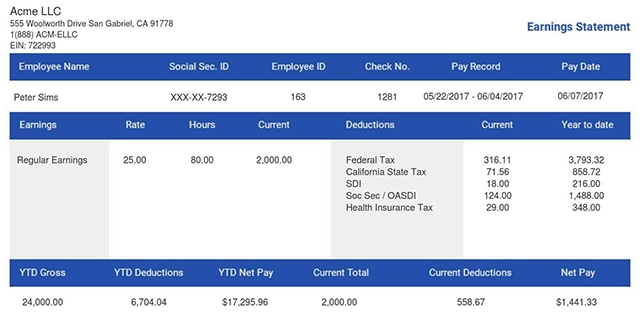
Your Social Security wages on your pay stub are $2,400 minus $120, or $2,280. The tax withheld is $2,280 times 6.2%, which is $141.36. Your income tax wages are lower, at $2,160, because the 401(k) comes out too.
At year end, calculate W-2 wages from your pay stub the same way, using gross pay YTD and your before-tax deductions YTD. It should match Box 3, and the social security wages vs wages gap will make sense. Need clean records for a lease or loan? Our pay stub templates show each tax line clearly.
Where Social Security Wages Stop in 2026
Once your pay for the year passes $184,500, Social Security withholding stops. The most Social Security tax you'll pay in 2026 is $11,439. Medicare tax keeps going at 1.45% with no cap. An extra 0.9% Medicare tax starts on wages above $200,000.
If your Box 3 looks off, check for the usual payroll slip-ups: withholding past the cap, subtracting 401(k) deferrals, or leaving out group-term life coverage over $50,000.
You Might Also Like
- How to Read a W-2 Like a Pro
- Payroll Tax vs Income Tax
- Social Security on a Pay Stub
- How to Read Pay Stub Deduction Codes
- What Is a Post-Tax Deduction?
Conclusion
Social Security wages are your pay minus cafeteria-plan benefits, capped at $184,500 in 2026. Your 401(k) still counts, which explains most W-2 surprises. Want every tax line calculated for you? Use our paystub generator to create accurate pay stubs in minutes.
- 1. Enter Your Information

- 2. Select Your Favorite Theme

- 3. Download Your Stub!

 By
 By