

Gross Up Meaning: How It Works, Formula & Examples (2026)
 By
By
You were promised a $1,000 bonus, but only $703.50 landed in your account. Nothing went wrong. Taxes came out first. A gross-up closes that gap: you're paid enough extra that the promised number survives withholding. The gross up meaning is straightforward once you see the math: your employer runs the paycheck backwards. Below you'll find the formula, the 2026 tax rates behind it, a worked example, and what a grossed-up payment looks like on your pay stub.
Key Takeaways
- A gross-up is extra pay that lets an employee net an exact promised amount after taxes.
- The formula never changes: gross pay = net pay divided by (1 minus the total tax rate).
- Most gross-ups apply to one-time payments such as bonuses, severance, and relocation expenses.
- In 2026, the federal supplemental rate is 22% and Social Security stops above $184,500 in wages.
- On a pay stub, the gross-up shows up in the earnings column, while net pay lands on the promised figure.
Gross Up Meaning in Payroll
Gross up means adding extra money to a payment so the employee keeps a specific amount after taxes. If your employer promises a $1,000 bonus and grosses it up, they pay out more than $1,000 so that a full $1,000 actually lands in your account after withholding.
So what does gross up mean for the person receiving it? You get the number you were quoted, and your employer absorbs the income taxes.
You'll see it written both ways. Payroll teams and benefits packets usually hyphenate it, but the gross-up meaning doesn't change with the punctuation. The grossed up definition is the same idea from the employee's side: a promised figure your employer agreed to protect, whether it's a bonus or an agreed net salary.
How Does a Gross-Up Work?

A gross-up runs payroll backwards. Instead of starting with gross pay and subtracting taxes to reach net pay, the employer starts with the net pay the employee was promised, identifies every tax that applies, and solves for the gross amount that leaves exactly that net behind.
In practice, payroll teams follow four steps:
- Pick the net amount the employee should receive.
- Add up every tax rate that applies.
- Divide the net figure by the remaining percentage to get the grossed up amount.
- Run the total through normal payroll.
How Do You Calculate a Gross Up?
Divide the net amount by 1 minus the total tax rate. For a promised $1,000 bonus with a combined 29.65% tax rate (22% federal supplemental, 6.2% Social Security, and 1.45% Medicare), divide $1,000 by 0.7035, which gives a grossed up payment of $1,421.46 before any state tax is added.
The gross up meaning expressed as arithmetic:
Gross pay = net pay / (1 - total tax rate)
Here's the costly mistake. When you gross up for taxes, it's tempting to multiply the bonus by the tax rate and add it, which gives $1,296.50. Run that through payroll and the employee nets $912.09, about $88 short of the promised $1,000, because the extra money gets taxed right alongside the bonus.
Dividing fixes that, but the rate you divide by still has to match the employee's real situation. The gross-up counts as taxable income too, and a threshold crossed mid-year changes what that rate should be.
Tax Gross Up Meaning: Which Taxes Are Covered?

A gross-up covers federal income tax at the 22% supplemental rate, Social Security at 6.2%, Medicare at 1.45%, plus any state income tax or local tax. Social Security stops once 2026 wages pass $184,500, and an additional 0.9% Medicare tax applies above $200,000 in wages.
When a payment is grossed up for taxes, your employer covers those withholdings. Two details change the math:
- The Social Security cap. Above the Social Security wage base, that 6.2% disappears, so a December bonus can need a smaller gross-up than the same bonus in January.
- The extra Medicare tier. The added 0.9% hits only wages past the threshold, raising the cost on large payments only.
Supplemental wages above $1 million a year are withheld at 37%, not 22%, per IRS Publication 15.
When Do Employers Offer Gross Ups?
Employers use gross ups for one-time payments where the promised figure matters: signing and year-end bonuses, severance packages, relocation expenses, and executive compensation agreements. They are rare on regular wages, because grossing up every paycheck permanently raises the employer's payroll cost with no clear end date.
Relocation is the most common trigger, since most moving reimbursements are taxable. A small business owner promising a clean $500 bonus hits the same problem. Documenting one for an employee? Our pay stub templates handle the math.
How a Grossed Up Bonus Appears on Your Pay Stub
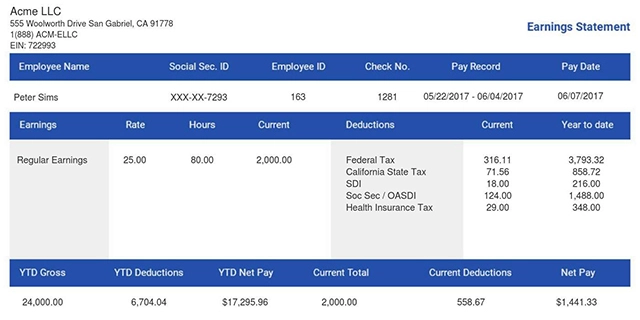
The payment doesn't appear on your stub as the promised amount. It appears as the larger figure. Look at three places:
Earnings Column
The grossed-up total appears here, often on its own line labeled "Bonus Gross Up." You'd see $1,421.46.
Deductions Column
The offsetting federal, Social Security, Medicare, and state withholding sit here among the other deduction codes.
Net Pay Line
Your take-home lands on the promised $1,000.
One warning: that inflated gross also flows to your W-2. Hand the stub to a landlord or lender as proof of income and they'll see a one-time figure that isn't recurring income.
Pros and Cons of Grossing Up Pay
For employees, the appeal is obvious. You receive the number you were quoted, one-time costs get covered, and there's no surprise at tax time.
For employers, the tradeoffs are real:
- Cost rises roughly 40% above the headline figure.
- Once offered, employees expect it, which makes it hard to withdraw later.
- In executive compensation, gross-ups can obscure the true cost of paying executives in financial statements.
Most HR teams settle this upfront in policy.
You Might Also Like
- How to Read a W-2 Like a Pro
- What Does a Pay Stub Look Like?
- Understanding Paycheck Stubs
- Payday, Pay Cycle, and Pay Period: What's the Difference?
- What Is Adjusted Gross Income and How Do You Calculate AGI?
Conclusion
The gross up meaning comes down to one move: your employer starts from the amount you should keep and works backwards to the amount they need to pay. Divide the net by 1 minus the tax rate, remember the 2026 thresholds shift the answer, and check the earnings line on your stub.
If you need professional pay documentation that reflects your earnings accurately, our paystub generator creates clean, detailed pay stubs in minutes.
- 1. Enter Your Information

- 2. Select Your Favorite Theme

- 3. Download Your Stub!

 By
By