

Healthcare Payroll Explained: Pay Types, Overtime, and Paystubs
 By
By
A pay stub from a hospital looks nothing like one from a retail store. A nurse can finish one week with four different hourly rates on the same check. That is why healthcare payroll trips up so many people, both the clinic owner who runs it and the nurse who just wants to know if her check is right. If you need clean pay records today, you can create a pay stub in minutes. Healthcare industry payroll has to cover nights, weekends, and call shifts. It also has to pay a mix of staff, per diem, and travel workers.
This guide covers the pay types that make it messy. It shows how overtime is really worked out. It walks through the rules that carry the most risk. Then it breaks down a healthcare stub, line by line. You will also find what to look for in software, how to tighten your process, and how workers prove income that changes. Everything here reflects the rules as they stand for the 2026 tax year.
Key Takeaways
- Healthcare payroll is harder than most fields because one employee can earn several rates in the same week.
- Shift differentials must be folded into the regular rate before overtime is worked out. Missing this is a leading cause of back-pay claims.
- Hospitals and residential care sites can elect the 8/80 rule instead of the standard 40-hour overtime week.
- Healthcare stubs carry codes you will not see in other fields, and a premium that never got switched on can go unnoticed for months.
- Travel and per diem staff need several stubs in a row to prove income that moves from period to period.
- What Makes Healthcare Payroll Different?
- The Pay Types That Complicate Healthcare Payroll
- How Does Overtime Work in Healthcare Payroll?
- Healthcare Payroll Compliance Beyond Overtime
- How to Read a Healthcare Paystub, Line by Line
- What to Look for in Healthcare Payroll Software
- How to Simplify Payroll for Healthcare Facilities
- Proof of Income for Healthcare and Travel Workers
- The Year-End Checklist for Healthcare Employers
- Conclusion: Getting Healthcare Payroll Right
What Makes Healthcare Payroll Different?
Healthcare payroll is harder because one employee can earn several different rates in the same week. Round-the-clock coverage adds shift differentials, weekend premiums, on-call pay and callback pay, and most facilities mix full-time staff with per diem and agency workers. Every one of those layers has to feed the overtime math correctly.
Other fields mostly pay one rate for one job. Healthcare practices rarely get that luxury. Patients need care at 3 a.m. on a holiday. So someone has to be paid extra to be there. A medical assistant may also be trained to work the front desk at a lower rate. Now that person has two base rates plus a night premium.
The staffing mix adds another layer. A 12-person clinic might have six W-2 employees, two per diem fill-ins, and a billing specialist on contract. Payroll for healthcare has to treat each one correctly. That means the right tax status, the right benefits, and the right overtime.
Size cuts both ways. A one-site dental office and a 400-bed hospital face the same rules with very different budgets. The owner of a small practice often runs payroll herself between patients.
For the person getting paid, the effect is simple but annoying. Your gross pay moves every period. You cannot eyeball it. You have to know what each line means.
The Pay Types That Complicate Healthcare Payroll

Most of the trouble comes from premiums stacked on top of a base rate. These are the pay structures you will actually see.
| Pay Type | Who Usually Gets It | How It Is Usually Set |
|---|---|---|
| Shift differential | Nights, evenings, overnights | Flat dollars per hour or a percent of base |
| Weekend differential | Saturday and Sunday shifts | Flat dollars per hour |
| On-call or standby pay | Staff who must stay reachable | Low flat rate per hour on call |
| Callback pay | Staff called in while on call | Base rate, often with a set minimum |
| Charge pay | Nurse running the unit that shift | Flat dollars per hour on top of base |
| Preceptor pay | Staff training a new hire | Flat dollars per hour while training |
| Float premium | Staff covering a unit they do not know | Flat dollars per hour |
| Certification pay | Staff who hold a credential like CCRN | Flat dollars per hour or a yearly stipend |
Differential pay comes in two forms, and the gap matters. A flat premium adds a set amount. So a $4 night rate turns $32 an hour into $36. A percent premium scales with base pay. So a 10% night rate turns $32 into $35.20. Senior staff tend to prefer the percent form. Newer staff tend to do better on the flat one. Our breakdown of how shift differential pay works covers both forms in more detail.
Complex pay gets worse once contract workers show up. Payroll solutions for healthcare contractors have to separate two very different groups. True freelancers get a 1099, and yes, contractors should still receive a pay stub. Agency clinicians are paid by their agency, which is the employer of record. Getting that line wrong is costly.
Home healthcare payroll has its own trap. Aides drive between client homes. That drive time is usually paid work time, even though no care is given during it. Miss it and you have cut both wages and hours worked.
For owners, the lesson is to write down every premium rule first. For workers, the lesson is to know which premiums you earn. A night rate that was never switched on is one of the quietest shortfalls in the field.
How Does Overtime Work in Healthcare Payroll?
Most healthcare employers owe overtime after 40 hours in a workweek. Hospitals and residential care facilities may instead elect the 8/80 rule, paying overtime after 8 hours in a day or 80 hours in a 14-day period. Shift differentials must be folded into the regular rate before the premium is applied.
The 8/80 option comes from Section 7(j) of the Fair Labor Standards Act. It applies only to hospitals and residential care sites. It needs an agreement with the worker before the shifts happen. And it is all or nothing for that pay period. It fits three-twelve schedules well. A nurse on three 12-hour shifts works 36 hours, but still earns daily overtime on the four hours past eight in each shift.
Now the part behind a lot of back-pay claims. Overtime is not 1.5 times base pay. It is 1.5 times the regular rate. And the regular rate includes shift differentials and most other premiums.
Here is the math. A nurse earns $32 an hour base. She works 48 hours. Of those, 24 are nights with a $4 night rate.
- Straight-time pay: 48 hours at $32 is $1,536
- Night pay: 24 hours at $4 is $96
- Total straight-time pay: $1,632
- Regular rate: $1,632 divided by 48 hours is $34 an hour
- Overtime owed: 8 overtime hours at half the regular rate, or 8 times $17, is $136
Total pay is $1,768. An owner who paid overtime on base alone would have paid $128. That shorts the nurse by $8 in one week. Spread that across a unit for a year and it turns into real risk.
Workers can run the same check. Add your straight-time pay plus every premium. Divide by total hours worked. That is your regular rate. Your overtime line should reflect it. An overtime calculator is a quick way to sanity-check the result.
Healthcare Payroll Compliance Beyond Overtime

Overtime gets the attention, but the rules cover far more ground than that.
Worker status comes first. You may call a clinician a freelancer. But if you control her schedule, her patients, and her methods, that label will not hold. The cost is back taxes and penalties. Per diem is about scheduling, not tax status. A per diem nurse on your schedule is almost always an employee.
Larger employers, generally those with 50 or more full-time and full-time-equivalent staff, also carry health coverage reporting duties under the Affordable Care Act. That means tracking hours closely enough to know who crossed the full-time line. It is hard to do when staff float between part-time and full-time weeks.
State law adds one more layer. Pay frequency, final paycheck timing, meal and rest breaks, and extra pay for missed breaks all vary by state. A home health agency in three states follows three rule sets at once, and state pay stub laws differ just as much. Union contracts can stack stricter terms on top. The contract wins whenever it is better than the law. Strong healthcare payroll compliance means checking all three sources, not just the federal one.
Finally, keep the records. Payroll data is sensitive. Limit access to the people who need it. Write your retention schedule down instead of making it up each year.
How to Read a Healthcare Paystub, Line by Line
Healthcare stubs use short codes that nobody explains on day one, on top of the standard payroll codes every employer uses. Here is what the common ones mean.
| Code | What It Means |
|---|---|
| REG | Regular hours at your base rate |
| OT | Overtime hours, paid at 1.5 times the regular rate |
| SHFT DIFF or NOC | Shift or night differential |
| WKND | Weekend differential |
| ON-CALL or STBY | On-call or standby hours |
| CALLBK | Callback hours after you were called in |
| CHG | Charge nurse premium |
| PRECEP | Preceptor premium |
| FLOAT | Float pool premium |
| CERT | Certification pay |
| PTO or EIB | Paid time off or extended illness bank |
Read the stub in four blocks. The earnings block lists every rate and the hours tied to it. Pre-tax items come next. Those cover health, dental, vision, and retirement savings. Taxes follow. Those include federal tax, Social Security, Medicare, and any state or local tax. Post-tax items land last. Think union dues, wage garnishments, or a Roth deposit. If a line is still unfamiliar, our guide to pay stub deduction codes decodes the rest.
Check four things every period. First, do the hours match what you worked, callback included? Second, does every premium you earned show up on its own line? Third, is your overtime rate higher than your base rate? That is the fastest tell that the regular rate was done right. Fourth, did your year-to-date totals move by the right amount?
If a premium is missing, tell payroll in writing. Include the dates and the unit. Most fixes are quick setup changes. But only if someone reports them.
Owners should treat a clear stub as a retention tool. Payroll for healthcare workers goes wrong quietly. Staff who cannot read a stub cannot flag an error before it repeats for six months.
What to Look for in Healthcare Payroll Software
Skip the feature list and test what healthcare actually breaks. Good healthcare payroll software should handle these with no workarounds. Note too that broad payroll solutions for healthcare often cost more than a small office needs.
- Many rates per employee. One person, several rates, no duplicate records.
- Automatic premium rules. The system adds night and weekend pay based on the clock, not on someone remembering.
- Correct regular-rate math. Overtime is figured on base plus premiums, on its own.
- 8/80 support. If you are a hospital or residential care site, the system can be set that way.
- Time tracking links. Your clock and your payroll system share data with no spreadsheet in between.
- Credential tracking. Certification pay starts and stops with the credential.
- ACA hour tracking. Full-time counts run all year, not in a January panic.
- Self-service access. Staff pull their own stubs and tax forms without emailing anyone.
- Multi-state support. You need it the moment one worker travels.
The best payroll software for healthcare is not the one with the longest feature list. It is the one that gets your premium rules right on day one. When you compare healthcare payroll systems, run a test pay cycle first. Include a night shift and an overtime week. Then check the output against a hand calculation. A simpler tool plus a tight process often beats a big platform.
How to Simplify Payroll for Healthcare Facilities
A messy field does not have to mean a messy process. These six payroll processes cut most of the pain.
Capture time at the source. Most payroll errors start as time errors. Clock data should record unit, role, and shift, not just start and stop. Edits made after the fact should need a reason and a manager sign-off.
Write the premium rules down once. List every premium, who earns it, and the exact hours it covers. Then set the system to match that list. Rules that live in one manager's head leave when she does.
Run a pre-close audit. Before you close each cycle, review the odd cases only. Look at anyone over 40 hours. Look at anyone with new pay rates. Look at anyone with zero hours. Look at any negative deduction. That five-minute pass catches most errors before they reach a check.
Reconcile each quarter. Match total wages to your tax filings four times a year. Fixing a gap in April is routine. Finding it in January is not.
Be honest about outsourcing. Healthcare payroll services earn their fee when you run staff in several states or grow faster than your admin team. Keeping healthcare payroll management in house works when your rules are stable and your headcount is small. Either way, payroll processing is only as good as the data you feed it.
Give staff self-service. Every stub a worker can pull herself is one less request in your inbox.
Proof of Income for Healthcare and Travel Workers
Healthcare pay moves around, and income that moves makes landlords and lenders nervous.
Travel clinicians have the hardest time. A travel package often splits into a modest taxable hourly rate plus a tax-free housing and meal stipend. The stipend is real money. But it does not show up as taxable wages. So a reviewer who looks only at taxable income can read the earnings far too low. Per diem staff hit a version of the same wall, since their hours swing from period to period.
What reviewers want is a steady pattern, not one strong month. In practice that means several pay stubs in a row, often two or three months of them, plus tax forms that back them up. For contract work, the assignment letter that shows the rate and the dates helps a great deal. There are six common situations where you will need a pay stub as proof of income.
Here is what workers should do. Save every stub as it arrives instead of hunting for them later. Keep each assignment letter with the stubs it covers. Be ready to explain the taxable and stipend split in plain words. If your income rises and falls with the season, a 12-month average tells a fairer story than any single check.
Owners can help just by making old stubs easy to pull. Staff applying for a mortgage will ask, and a fast answer means a lot.
The Year-End Checklist for Healthcare Employers
Work through this healthcare payroll year end checklist before the calendar closes.
- Recheck premiums and overtime. Spot-check a few night and overtime weeks against a regular rate you work out by hand.
- Verify employee data. Confirm legal names, Social Security numbers, and current addresses. A bad address means a returned W-2, and staff who know how to read a W-2 will spot an error faster.
- Confirm worker status. Review anyone paid as a freelancer and make sure that treatment still holds.
- True up ACA hours. Check your full-time counts and confirm that anyone who crossed the line was offered coverage.
- Review taxable fringe benefits. Items like employer-paid life cover above the tax-free limit belong in taxable wages.
- Match quarters to the year. Your four quarterly filings should add up to your annual totals.
- Hit the January 31 deadline. W-2s for the 2026 tax year must reach employees and the Social Security Administration by January 31, 2027.
- Archive the records. Store the year of payroll records under your retention schedule before the system rolls over.
You Might Also Like
- How Payroll Processing Actually Works
- How Much Overtime Is Too Much?
- How to Calculate Your Hourly, Weekly, and Monthly Income
- Common Payroll Issues and How to Fix Them
- What Does a Pay Stub Look Like?
Conclusion: Getting Healthcare Payroll Right
Payroll in this field is complicated for a real reason. Care does not stop at 5 p.m. Paying people fairly for nights, weekends, and call means stacking premiums that every later step has to respect.
The fix is the same on both sides of the check. Owners should write the rules down, set them up once, and audit before each close. Workers should learn a stub well enough to spot a missing premium in under a minute.
Either way, it starts with clear pay records. Whether you are documenting pay for your staff or building proof of income for a rental, ThePayStubs.com helps you make accurate, professional pay stubs in minutes, with the math handled for you.
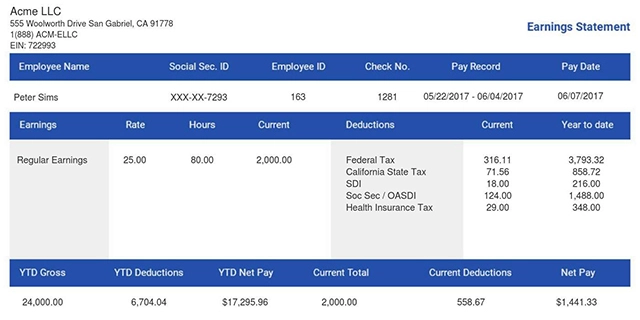
- 1. Enter Your Information

- 2. Select Your Favorite Theme

- 3. Download Your Stub!

 By
By