

What Are Pre-Tax Deductions and Contributions? (2026)
 By
By
You open your pay stub and the gross pay looks right. Then a stack of lines underneath starts chipping away at it. So what are pre-tax deductions and contributions, and why do they come out first? They are the amounts your employer takes from gross pay before any tax is figured. That order matters. It is the reason two people earning the same salary can owe very different tax. Every one of those lines belongs on the stub you get from ThePayStubs.com. This guide walks through the full 2026 list and the new limits, which taxes each one actually cuts, how the lines read on your stub and your W-2, and what an employer has to do to offer them.
Key Takeaways
- Pre-tax deductions and contributions come out of gross pay before tax is calculated, so they shrink the wages your tax is based on.
- Health premiums, HSA money and FSA money escape federal income tax and both FICA taxes. A traditional 401k deferral escapes federal income tax only.
- The 2026 caps rose: $24,500 for a 401k, $4,400 or $8,750 for an HSA, $3,400 for a health FSA and $7,500 for dependent care.
- On a stub they sit between gross pay and taxable wages. On a W-2 they show up in Boxes 1, 3, 5, 10, 12 and 14.
- Employers must run most of these through a written Section 125 plan, or the tax break does not hold up.
- What Are Pre-Tax Deductions and Contributions?
- Pre-Tax Deductions List: What Qualifies in 2026
- 2026 Limits for Pre-Tax Deductions and Contributions
- Which Taxes Do Pre-Tax Deductions Actually Reduce?
- Do Pre-Tax Deductions Reduce Taxable Income?
- How Pre-Tax Deductions and Contributions Show Up on Your Pay Stub
- Pre-Tax vs Post-Tax Deductions
- Where Pre-Tax Deductions on W2 Forms Appear
- Section 125 Rules for Pre-Tax Deductions and Contributions
- How to Set Up Pre-Tax Payroll Deductions
- Mistakes to Avoid With Pre-Tax Deductions and Contributions
- Conclusion: Pre-Tax Deductions and Contributions in 2026
What Are Pre-Tax Deductions and Contributions?
Pre-tax deductions and contributions are amounts taken out of your gross pay before tax is calculated. Common ones are health premiums, HSA and FSA money, and traditional 401k deferrals. Because they come out first, they lower the wages your tax is figured on, so you owe less tax on the same paycheck.
The savings are real but quiet. You never see a line that says "tax saved." You only see a smaller tax line.
Pre-Tax Deductions Meaning, in Plain English
The pre-tax deductions meaning is simple. Money leaves your gross pay first. Tax is figured on what is left.
Say you earn $4,000 a month. You pay $300 toward your health plan. Tax is figured on $3,700, not $4,000. The $300 never counts as income to you.
Payroll systems do not always spell it the same way. Some print the line as "pretax deductions" with no hyphen at all. ADP and several large providers use that spelling. It means the same thing.
Pre-Tax Deductions vs. Pre-Tax Contributions
The two words get used together, but they are not identical.
A deduction is money withheld to pay for something. Your share of the health premium is a deduction. It leaves and it is spent.
A contribution is money moved into an account that is held for you. Pre-tax contributions to a traditional 401k are still yours. They just sit somewhere else until you retire.
For an employee, the difference shows up later. Deducted money is gone. Contributed money grows. For an employer, the difference is paperwork: benefit premiums flow to a carrier, while contributions flow to a plan trustee on a deadline.
What Deductions Are Pre-Tax on Your Own Paycheck
Your own stub answers this faster than any list can. Read the block between gross pay and taxable wages, and you will see exactly what deductions are pre-tax for you. Pre-tax deductions and contributions are grouped there on purpose, so payroll can strike them out before it runs any of the tax math.
Most people ask "what are pre-tax deductions on my paycheck?" after a raise, when the take-home did not move as much as they expected. Nine times out of ten the answer is a benefit election, not a payroll error. A small employer should expect that question every January, when new elections start.
Pre-Tax Deductions List: What Qualifies in 2026

The pre-tax deductions examples below fall into seven families. The pre-tax deductions and contributions that qualify are set by federal rules, not by your employer, and each family has its own annual cap.
Health Insurance Premiums
Your share of an employer medical, dental or vision plan usually comes out pre-tax. Are health insurance deductions pre-tax in every case? No. The plan has to run through a Section 125 cafeteria plan first. If your employer never wrote that plan document, the premium comes out after tax instead.
Health Savings Accounts (HSAs)
An HSA pairs with a high-deductible health plan. Are HSA contributions pre-tax when they run through payroll? Yes, and they dodge FICA too, which is unusual. You own the account. Unused money rolls to next year and keeps rolling.
Flexible Spending Accounts (FSAs)
An FSA works with any health plan. Are FSA contributions pre-tax? Yes, under the same Section 125 rules. The trade-off is timing. FSA money is use it or lose it within the plan year, though many plans allow a small carryover or a short grace period.
Dependent Care Benefits
A dependent care account covers day care, after-school care and adult day care for a qualifying dependent. The money comes out pre-tax and is spent on care you were paying for anyway. The 2026 cap jumped sharply, which is worth a second look if you skipped this benefit before.
Retirement Plan Contributions
Retirement contributions follow a narrower rule than health money does. A traditional 401k, 403b or 457b deferral comes out before federal income tax. So does a SIMPLE IRA deferral at a smaller employer. Deferrals also pull down the income figure used for other tests, which is why 401k contributions lower your MAGI. Are 401k deductions pre-tax for FICA as well? No, and that catches people out. Social Security and Medicare tax still applies to every dollar you defer.
Are pension contributions pre-tax? In a governmental pension plan they usually are, through a section 414(h)(2) pick-up arrangement. Private employer plans vary, so check your own plan summary.
Commuter and Parking Benefits
Transit passes, vanpool fares and qualified parking can be paid with pre-tax dollars up to a monthly cap. Each category gets its own cap, so a rider who also parks can use both.
Group-Term Life Insurance
Only the first $50,000 of employer-paid coverage escapes tax. Anything above that line creates imputed income, which lands back on your W-2 as taxable wages.
2026 Limits for Pre-Tax Deductions and Contributions
Every figure below is the 2026 number, with 2025 beside it so you can see the change. Caps on pre-tax deductions and contributions move most years, so employers should load these into payroll before the first January run.
| Benefit | 2026 limit | 2025 limit |
|---|---|---|
| 401k, 403b, most 457b deferral | $24,500 | $23,500 |
| Catch-up, age 50 and over | $8,000 | $7,500 |
| Super catch-up, ages 60 to 63 | $11,250 | $11,250 |
| Traditional IRA | $7,500 | $7,000 |
| SIMPLE IRA deferral | $17,000 | $16,500 |
| Health FSA | $3,400 | $3,300 |
| HSA, self-only | $4,400 | $4,300 |
| HSA, family | $8,750 | $8,550 |
| Dependent care account | $7,500 | $5,000 |
| Transit and parking, each, per month | $340 | $325 |
| Adoption assistance | $17,670 | $17,280 |
| Social Security wage base | $184,500 | $176,100 |
Three of these deserve a note.
The dependent care cap rose from $5,000 to $7,500. That is its first permanent increase since 1986, and most plan documents still say $5,000. Employers have to amend the plan before anyone can elect the higher amount.
The super catch-up for ages 60 to 63 replaces the age 50 catch-up. It does not stack on top of it. Are 401k catch-up contributions pre-tax? In 2026 that depends on what you earned last year. If your FICA wages from that employer topped $150,000 in 2025, SECURE 2.0 now forces the catch-up in as Roth, taxed on the way in. Below that line, catch-up money can still go in pre-tax.
The Social Security wage base matters because pre-tax health money reduces the wages that count toward it. Full figures are published by the IRS.
Which Taxes Do Pre-Tax Deductions Actually Reduce?

It depends on the benefit. Health premiums, HSA and FSA money run through a Section 125 plan, so they escape federal income tax and both FICA taxes. A traditional 401k deferral escapes federal income tax only. Social Security and Medicare tax, 7.65% in total, still comes out of it.
That single split is the most useful thing on this page. Pre-tax deductions and contributions do not all behave the same way, so two deductions of the same size can save very different amounts.
FICA is 6.2% for Social Security plus 1.45% for Medicare. Health money skips both. Retirement money skips neither. So a $200 health premium saves you more than a $200 401k deferral does this year, even though the deferral is the bigger long-term move.
Employers gain on the same split. Section 125 amounts lower the wage base for the employer FICA match, for federal unemployment tax and usually for state unemployment insurance. Retirement deferrals do not.
Do Pre-Tax Deductions Reduce Taxable Income?
Yes. Every dollar of a pre-tax deduction comes out of gross pay before tax is figured, so your taxable wages drop by that dollar. On a $5,000 monthly check, a $250 health premium and a $500 401k deferral cut federal taxable wages to $4,250. Your tax is figured on the smaller number.
Here is the same check written out.
| Line | Amount |
|---|---|
| Gross pay | $5,000 |
| Health premium, Section 125 | $250 |
| 401k deferral, traditional | $500 |
| Wages for federal income tax | $4,250 |
| Wages for Social Security and Medicare | $4,750 |
Look at the last two rows. One paycheck produced two different taxable wage numbers, and the smaller one is your FIT taxable wages. The health premium came out of both. The 401k deferral came out of only one.
Now the tax. At a 22% marginal rate, the $750 of pre-tax money saves $165 in federal income tax. The $250 health premium also skips 7.65% in FICA, which is another $19. Total saved: about $184 on one check.
Put another way, that $250 of health coverage cost you about $176 of take-home pay. The employer saved $19 as well, on its own FICA match.
How Pre-Tax Deductions and Contributions Show Up on Your Pay Stub
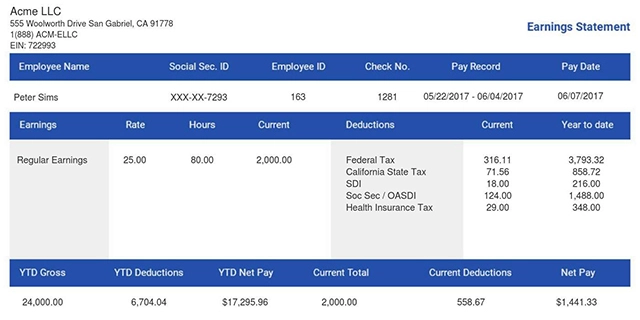
Your stub tells the story in order, from the top down. Gross pay comes first. Pre-tax deductions come next, in their own block. Then taxable wages. Then the tax lines. Then post-tax items. Net pay is what survives.
Read it that way and the math stops being mysterious. If your taxable wage line is lower than gross pay, a pre-tax deduction is the reason.
How do pre-tax deductions affect take-home pay? They lower it by the full amount of the deduction, then give part of it back as tax you never paid. A $250 premium costs you $250 of gross but only about $176 of net.
A small employer has a duty here too. Most states require the current and year-to-date amount of every deduction to appear on the pay statement. A stub that shows one lumped "benefits" line is a compliance problem waiting to be raised.
Pay Stub Abbreviations for Pre-Tax Deductions
Stub codes vary by provider, but these turn up constantly. Our full guide to pay stub deduction codes covers the rarer ones.
- SEC 125 or CAF 125 is a Section 125 benefit, usually your medical premium.
- MED, DEN or VIS are medical, dental and vision premiums.
- HSA is your health savings account contribution.
- FSA or HCFSA is a health flexible spending account.
- DCA or DEP CARE is a dependent care account.
- 401K is a traditional retirement deferral. 401K ROTH is the after-tax version.
- GTL is imputed income for group-term life above $50,000. It adds to taxable wages rather than reducing them.
- FIT is federal income tax. FICA-SS and FICA-MED are Social Security and Medicare.
If a code on your stub is not on this list, ask payroll to name it. You are entitled to know what each line is.
Pre-Tax vs Post-Tax Deductions
A post-tax deduction comes out after the tax has already been figured. Post-tax benefits, a Roth 401k being the obvious one, lower your net pay but leave your taxable wages alone. Pre-tax and post-tax items can sit on the same stub, in two separate blocks.
| Pre-tax | Post-tax | |
|---|---|---|
| When tax applies | After the deduction | Before the deduction |
| Effect on taxable wages | Lowers them | No effect |
| Common examples | Health premiums, HSA, FSA, traditional 401k, commuter | Roth 401k, union dues, garnishments, charitable giving |
| Tax at payout | Usually taxed | Usually tax free |
| Employee can decline | Yes | Yes, except garnishments |
Are Roth contributions pre-tax? No. Roth money is taxed on the way in, which is the whole point. You give up the break now to take tax-free withdrawals later.
Roth vs pre-tax contributions comes down to one question: do you expect a higher tax rate now or in retirement? If now, defer pre-tax. If later, pay the tax today and go Roth. Plenty of people split the difference and fund both.
Voluntary deductions are the ones you elect, and they can be either type. Union dues and charitable giving are voluntary but post-tax. Wage garnishments sit in the post-tax block and are not optional at all. A court order sets the amount and the employer has to follow it.
Where Pre-Tax Deductions on W2 Forms Appear
Your last stub of December and the W-2 that lands a few weeks later should agree. Pre-tax deductions on W2 forms are the reason the wage boxes disagree with your salary. A year of pre-tax deductions and contributions is baked into those boxes before they are printed.
- Box 1 shows federal taxable wages. Both health money and 401k deferrals are already out of it.
- Boxes 3 and 5 show Social Security wages and Medicare wages. Health money is out. 401k deferrals are not, so Box 1 is usually smaller than Boxes 3 and 5.
- Box 10 reports dependent care benefits.
- Box 12 carries the elective amounts with a letter code. D is a 401k, E is a 403b, G is a 457b, and W is the total HSA money from you and your employer.
- Box 14 is a memo field. Many employers park Section 125 premiums here so you can see them.
If Box 1 equals your full salary and you had benefits all year, something was set up wrong. Raise it before you file.
Section 125 Rules for Pre-Tax Deductions and Contributions
Almost all health-related pre-tax benefits depend on one thing: a written Section 125 cafeteria plan. Without it the deductions are simply after-tax, no matter what the payroll system says.
What a Written Plan Document Must Do
The plan document has to exist before the first deduction, not after. It names the benefits offered, who is eligible, the plan year and the election rules. Adopting it is a formal act, not a filing. There is nothing to send to the government.
Keep it where staff can read it. An employee handbook reference is fine, as long as the document itself is available on request.
Nondiscrimination and Eligibility
A cafeteria plan cannot favor owners and highly paid staff. The rules test eligibility, contributions and actual benefits received. Fail a test and the favored group loses the tax break, while everyone else keeps it.
Offer the benefit to every eligible employee on the same terms. That is most of the work.
Election Changes and Qualifying Life Events
Elections lock for the plan year. That is the price of the tax break. An employee can only change mid-year after a qualifying life event, such as marriage, divorce, a birth, an adoption or a change in a spouse's coverage.
Most plans give 30 days from the event. Miss it and the election stands until open enrollment. HSA elections are the exception and can usually change any month.
How to Set Up Pre-Tax Payroll Deductions
Setting up pre-tax deductions and contributions correctly takes six steps. Run pre-tax payroll deductions in this order and the year-end numbers take care of themselves.
- Adopt the plan document first. Sign the Section 125 plan before the first deduction is withheld.
- Collect a written election. Get each employee's choice in writing, signed and dated.
- Code the deduction correctly. Mark it pre-tax in payroll, set whether it is exempt from FICA, and check the result against your withholding setup.
- Check it against the cap. Compare the annual election to the 2026 limit for that benefit.
- Show it on the stub. Display the current and year-to-date amount on every pay statement.
- Reconcile at year end. Match total deductions to what lands in Boxes 1, 3, 5, 10 and 12.
Employees can check the same work in one minute. Multiply the per-period deduction by the number of pay periods. If the total tops the annual cap, tell payroll now.
Mistakes to Avoid With Pre-Tax Deductions and Contributions
Pre-tax deductions and contributions go wrong in predictable ways, and the mistakes split neatly between the employee paycheck and the employer's payroll setup.
Employees trip on three:
- Over-electing an FSA. Money you cannot spend by the deadline is gone.
- Double dipping at tax time. Are medical deductions pre-tax already? If yes, you cannot claim the same premiums again on Schedule A.
- Assuming a 401k deferral cuts FICA. It does not, so the take-home drop is bigger than expected.
Employers trip on three more:
- Withholding pre-tax with no plan document. The deduction is after-tax by default, and the correction is expensive.
- Never running the nondiscrimination tests. Owners lose the break first.
- Lumping deductions into one stub line. It breaks state pay statement rules and it destroys trust.
You Might Also Like
- What Your Paycheck Stubs Actually Show
- How to Calculate W-2 Wages From a Pay Stub
- Payroll Tax vs. Income Tax: What Is the Difference?
- Involuntary Deductions Explained
- What Dependent Care Benefits on a W-2 Mean
Conclusion: Pre-Tax Deductions and Contributions in 2026
Pre-tax deductions and contributions are the quietest tax break most people get, and the easiest one to misread. Find the block on your stub, match it to Boxes 1, 3 and 5 on your W-2, and check your elections against the 2026 caps before the year closes.
If you need a clear, itemized record of every one of those lines, create a professional pay stub at ThePayStubs.com in a couple of minutes. Each deduction is shown on its own line, with current and year-to-date totals, so nothing is left to guess.
- 1. Enter Your Information

- 2. Select Your Favorite Theme

- 3. Download Your Stub!

 By
By