

12 Common 401k Questions, Answered With 2026 IRS Numbers
 By
By
Almost everyone with a workplace retirement plan keeps a short mental list of things they have never quite gotten around to asking. How much should you put in? What happens to the money if you quit? Why does the 401k line on your pay stub look smaller than the amount you signed up for? This guide answers the twelve 401k questions that come up most often, using the limits the IRS published for 2026. It covers both sides of the paycheck: the employee reading the deduction, and the owner running the payroll that creates it.
Key Takeaways
- The 2026 employee contribution limit is $24,500, rising to $32,500 at age 50 and $35,750 between ages 60 and 63.
- A traditional deferral lowers your federal taxable wages but not your Social Security and Medicare wages, which is why the tax savings on your stub look smaller than expected.
- Employer match dollars are not yours until you are vested, and the vesting schedule is set by your plan, not by law.
- An early withdrawal before age 59 1/2 costs income tax plus a 10% additional tax.
- Required minimum distributions start at age 73, not 72, which several older guides still get wrong.
- What Is a 401k and How Does It Actually Work?
- How Does Your 401k Show Up on Your Pay Stub?
- How Much Can You Contribute to a 401k in 2026?
- How Much Should You Contribute, and How Much Should You Have?
- How Does a 401k Employer Match Work?
- What Does Vested Mean in a 401k?
- Traditional or Roth 401k: Which One Should You Pick?
- How Are 401k Funds Invested?
- Can You Take Money Out of a 401k Early?
- What Happens to Your 401k When You Leave a Job?
- When Do Withdrawals Start, and What Happens to a 401k When You Die?
- What 401k Questions Should Small Business Owners Ask?
- Conclusion: Getting Your 401k Questions Answered
What Is a 401k and How Does It Actually Work?
A 401k is an employer-sponsored retirement plan that lets you move part of each paycheck into a retirement account before taxes are calculated. Your employer withholds the amount you choose through payroll and may add a matching contribution. The name comes from Section 401(k) of the tax code, added by the Revenue Act of 1978.
That history answers two of the most common 401k questions at once. Why is it called 401k? Because that is literally the subsection of the Internal Revenue Code that permits it. And when did 401k start? It took practical effect after the IRS issued rules in late 1981. If your employer offers a plan, how to start a 401k is mostly an enrollment task. Pick a contribution percentage, name a beneficiary, and choose your investments. Many employers now enroll new hires automatically, so check whether you are already contributing.
How Does Your 401k Show Up on Your Pay Stub?

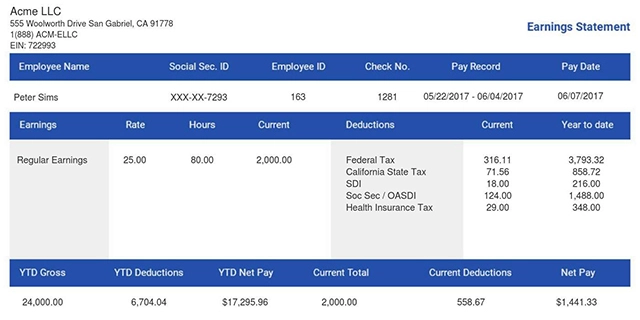
Your 401k appears as a deduction line, not a tax line. A traditional deferral lowers the federal taxable wages in Box 1 of your W-2 but not your Social Security and Medicare wages. Look for codes like 401K, 401(k) EE or DEF COMP, and check the year-to-date column against the annual limit.
This is where most confusion starts, and almost no retirement guide explains it. Is 401k pre tax? A traditional deferral is, which is why the arithmetic on your stub can look wrong at first glance. If you earn $2,000 a pay period and defer 6%, the $120 comes out before federal income tax is figured, so your federal withholding drops. Social Security and Medicare are still calculated on the full $2,000. Your take-home pay therefore falls by less than $120, and the gap is the tax you did not pay.
A few habits make the line easier to read:
- Find the deduction block, which sits separately from the taxes block on most stub formats.
- Check whether the code says 401K or ROTH, because a Roth deferral is withheld after tax and will not reduce your taxable wages. Our guide to pay stub abbreviations decodes the rest of the block.
- Read the year-to-date column, the fastest answer to how to check your 401k contributions without logging into the plan portal.
- Look for the employer match, which usually does not appear in gross pay because it is not wages.
Owners face different 401k questions here. Every deferral you withhold has to be traceable from the stub to the plan deposit, which is easier when you know how to read pay stub deduction codes. Clean, itemized pay stubs make that possible when an employee challenges a number.
How Much Can You Contribute to a 401k in 2026?
For 2026 the IRS caps employee contributions at $24,500. If you are 50 or older you can add an $8,000 catch-up contribution for $32,500 total, and if you are 60 to 63 the catch-up rises to $11,250 for $35,750. Employee and employer money together cannot exceed $72,000.
What Is Max 401k Contribution for 2026?
Here are the figures from the IRS annual limits announcement:
| Limit | 2026 amount | Who it applies to |
|---|---|---|
| Employee contribution limit | $24,500 | Everyone in the plan |
| Catch-up contribution | $8,000 | Age 50 and older |
| Enhanced catch-up | $11,250 | Ages 60 to 63 |
| Total employee contribution | $32,500 | Age 50 and older |
| Total employee contribution | $35,750 | Ages 60 to 63 |
| Overall additions limit | $72,000 | Employee plus employer money |
The last row surprises people. Your own ceiling is $24,500. But the total that can land in your account from all sources is much higher, so a generous match never eats into what you can defer yourself.
Two 401k questions save real money here. Does the limit follow you or the job? It follows the person, so if you change employers mid-year you must add both plans together yourself, because payroll at the new company cannot see what you contributed at the old one. Those deferrals also affect your adjusted income, which is why 401k contributions reduce your MAGI. And does your plan offer the ages 60 to 63 catch-up? It is new enough to be missed, so confirm it.
How Much Should You Contribute, and How Much Should You Have?

Contribute at least enough to earn your full employer match, since anything less leaves guaranteed money behind. A common target is 10% to 15% of pay including the match. Benchmarks suggest roughly one times salary saved by 30 and three times by 40, adjusted for when you started.
How much should I contribute to my 401k has the clearest answer of any question here: at minimum, whatever percentage earns the full match. Below that number you are declining part of your compensation. Above it, most guidance lands between 10% and 15% once the match is included.
People also ask how much will my 401k be worth in 10 years, and nobody can promise a number. Raising your deferral one percentage point with every raise is the simplest way to improve that projection, because you never feel the money leave.
Savings targets by age are fuzzier still. How much should I have in my 401k at 30 or 40 is usually answered with benchmarks: about one times salary by 30, three times by 40, six times by 50 and eight to ten times by retirement. Treat these as direction, not verdict; someone who started at 35 simply has a steeper rate ahead of them.
How Does a 401k Employer Match Work?
An employer match is money your company adds based on what you contribute, usually a percentage of your deferral up to a share of your pay. A common formula is 50% of the first 6% you contribute. On a $60,000 salary, contributing $3,600 earns you $1,800 in free retirement money.
So how does 401k match work when you run the numbers? Take that $60,000 earner paid twice a month. A 6% deferral is $150 per paycheck, or $3,600 a year. Under a 50% match on the first 6%, the employer adds $75 per paycheck, or $1,800 a year. Contribute only 3% and the match drops to $900. That difference is not an investment return you have to hope for. It is compensation you either collect or leave behind.
Match formulas generate more 401k questions than any other feature of the plan, and they vary more than people expect. Some employers match dollar for dollar up to 3%. Others use a tiered formula, such as 100% of the first 3% plus 50% of the next 2%. A few contribute whether you defer anything or not. Read the plan summary or ask HR. If you own the business, a formula you can sustain through a slow year beats a generous one you have to cut. It also has to show up accurately in your payroll records and employee payroll deductions.
What Does Vested Mean in a 401k?
Vested means the money is permanently yours. Your own contributions are always 100% vested. Employer match dollars may follow a vesting schedule, such as cliff vesting after three years or graded vesting that increases yearly. If you leave before you are fully vested, you forfeit the unvested employer portion.
What does vested mean in 401k terms, in dollars? Say your employer has contributed $4,000 in match over two years under a three-year cliff schedule. Leave at two years and eleven months and you keep your own contributions and everything they earned, but the $4,000 in employer money goes back to the plan. Stay one more month and all $4,000 is yours.
Vesting drives a second cluster of 401k questions, usually about timing. Graded schedules soften that edge, often vesting 20% per year over five years, so leaving at three years keeps 60% of the employer money. Knowing which schedule your plan uses can change the best month to accept a job offer. Owners should treat vesting as a retention tool that belongs in onboarding.
Traditional or Roth 401k: Which One Should You Pick?
A traditional 401k is pre-tax, so it lowers your taxable income now and you pay tax at withdrawal. A Roth 401k takes after-tax money and qualified withdrawals come out tax free. Unlike a Roth IRA, a Roth 401k has no income limit, so high earners can contribute directly.
What is a Roth 401k in practical terms: the same plan, the same investments, the same contribution limit, taxed at the opposite end. You give up the deduction today for tax-free qualified withdrawals later, the same trade-off behind any post-tax deduction. The employer match is made pre-tax in most plans, though SECURE 2.0 now lets a plan offer a Roth match if you elect it, so a Roth saver usually ends up with two buckets.
The rule that catches high earners off guard concerns Roth 401k income limits. There are none. A Roth IRA phases out as income rises, but the workplace Roth has no phase-out, making it one of the few tax-free routes still open to people who earn too much for a Roth IRA.
That raises the difference between 401k and IRA question, one of the 401k questions with the most practical consequences. A 401k comes through your employer, has a much higher limit, and can include matching money. An IRA is something you open yourself, caps at $7,500 for 2026, and offers a wider investment menu. They are not mutually exclusive, and many people fund both.
How Are 401k Funds Invested?
You pick from a menu your plan offers, typically mutual funds, index funds and target-date funds that shift toward conservative holdings as you approach retirement. Contributions stay in cash until you make a selection. Check each fund's expense ratio, because fees compound against you the same way returns compound for you.
The most expensive mistake with 401k investments is not picking a bad fund. It is picking nothing. Money that arrives before you make an election often sits in a cash default, earning very little. Some people find out years later that their contributions never went to work. Target-date funds solve this: choose the fund closest to your retirement year and it handles allocation and rebalancing. Public sector workers may instead be offered a 401(a) plan, which works differently.
Once the fund menu makes sense, the 401k questions that follow are almost always about fees, and they deserve a look you probably have not given them. An expense ratio is the annual percentage each fund charges, and the gap between 0.05% and 0.75% sounds trivial until you apply it to a balance compounding for thirty years. Your plan must disclose these, so ask for the fee disclosure. What is a good rate of return on 401k balances depends on your mix and your time horizon. What matters more is simple. Your investment strategy should match how many years you have before you need the money.
Can You Take Money Out of a 401k Early?
Usually not while you still work there, unless your plan allows hardship withdrawals or loans. An early withdrawal before age 59 1/2 triggers income tax plus a 10% additional tax. A plan loan is capped at the lesser of $50,000 or 50% of your vested balance, repaid within five years.
These are the 401k questions people ask most quietly, so here are direct answers.
Can I cancel my 401k and cash out while still employed? You can stop contributing at any time, but you generally cannot cash out an active plan just because you want the money. Most plans only permit a distribution while you are still employed if you qualify for a hardship withdrawal or reach 59 1/2. Cash out early and you owe income tax plus the 10% additional tax on early distributions. The lost growth usually costs more than the penalty does.
Will my employer know if I take a 401k loan? In practice yes, though not because anyone is monitoring you. Repayments come out through payroll, so the deduction appears on your pay stub and in your employer's records. The reason is paperwork, not judgment. Your plan administrator handles approval, not your manager. The size of the loan is set by IRS rules rather than your boss: the lesser of $50,000 or half your vested balance, though a plan is allowed to let you borrow up to $10,000 even when that is more than half.
Can you use 401k to buy a house? Sometimes, by two routes. A plan loan used to buy a primary residence can be repaid over longer than the usual five years, the only place that rule bends. A hardship withdrawal may also be allowed, but it is taxable and still carries the 10% additional tax under 59 1/2. The loan is almost always cheaper.
What Happens to Your 401k When You Leave a Job?
Your vested balance stays yours. You can leave it in the old plan if the balance is large enough, roll it into your new employer's plan, roll it into an IRA, or cash it out and pay tax plus a 10% penalty if you are under 59 1/2. Unvested employer match dollars are forfeited.
Leaving a job triggers its own set of 401k questions, and the rollover is the first. How to roll over a 401k without a tax bill comes down to one word: direct. In a direct rollover the money moves institution to institution and nothing is withheld. If the check comes to you instead, 20% is withheld and you have 60 days to replace the full amount, including the part you never received.
Before moving anything, know what are the disadvantages of rolling over a 401k to an IRA. You lose the ability to take a plan loan. You give up the rule that allows penalty-free withdrawals after you leave a job at 55 or later. Workplace plans can also offer pricing an individual account cannot match.
Job changers often need how to find old 401k accounts they have lost track of. Start with old pay stubs and W-2s, which name the plan (if you are unsure what to look for, see what a pay stub looks like), then check the Department of Labor's abandoned plan database and the national registry of unclaimed retirement benefits. If you want to convert 401k to Roth IRA money at the same time, the converted amount is taxable in the year of the conversion, so timing matters.
When Do Withdrawals Start, and What Happens to a 401k When You Die?
You can withdraw penalty free at 59 1/2, and required minimum distributions begin at age 73 unless you are still working for that employer and own less than 5% of it. When you die, the balance passes to your named beneficiary, which overrides your will.
Two 401k questions dominate the end of the story, and both have precise answers. The age 73 figure is worth repeating, because a surprising number of guides still say 72. The rule changed under SECURE 2.0. One exception before 59 1/2 gets overlooked. Leave a job in or after the year you turn 55, and money from that employer's plan avoids the 10% additional tax. It only works for the plan tied to the job you left. That is a reason to think twice before rolling everything into an IRA at 55.
What happens to 401k when you die is the question people postpone longest, and it has the simplest fix. Your balance goes to the beneficiary named on the plan form. That form outranks your will, so an ex-spouse listed years ago inherits the account anyway. Reviewing the designation takes two minutes.
What 401k Questions Should Small Business Owners Ask?
Owners need to ask what the plan costs, which employees are eligible, how fast deferrals must be deposited, and whether payroll can produce clean records. Employee deferrals must be deposited as soon as you can reasonably separate them from business money. Every deduction must also be traceable on the pay stub.
Before sponsoring a plan, work through a checklist that looks nothing like the one your employees use:
- What are the total costs, including administration, recordkeeping and the investment expenses employees pay?
- Who counts as eligible, and what waiting period applies to new hires?
- What match formula can the business sustain through a bad quarter, not just a good one?
- Which vesting schedule fits your retention goals?
- How quickly must withheld deferrals reach the plan, and does your payroll process meet that deadline?
- Who is the fiduciary, and what exactly are you responsible for?
Deposit timing causes the most trouble. It belongs near the top of any list of 401k questions to ask a provider. Deferrals become plan assets the moment you withhold them. Holding them in the business account longer than needed is a compliance problem, not a cash flow strategy. Every deferral, match dollar and loan repayment also has to reconcile between payroll records and plan statements, on top of the state pay stub laws you already follow.
You Might Also Like
- W2 vs Paystub: What Each Document Proves
- Paycheck Stubs: What Belongs on Every One
- Why Some Jobs Hold Your First Paycheck
- Social Security on a Pay Stub, Explained
- How to Create a Self Employed Pay Stub
Conclusion: Getting Your 401k Questions Answered
Three things matter more than everything else: contribute enough to earn the full match, understand what your vesting schedule requires, and leave the money alone until you are allowed to touch it. The 2026 numbers give you the targets, and most 401k questions get simpler once your pay stub confirms you are hitting them. Keep this 401k faq handy when open enrollment comes around.
That last point is the one people skip. The deduction line, the year-to-date total and the taxable wages on your stub are the running record of what you have saved. They are also the first document a lender, a landlord or your accountant will ask to see. If you need clear, accurate pay stubs for yourself or the people you employ, ThePayStubs.com generates them in a couple of minutes, with every deduction itemized where you can find it.
- 1. Enter Your Information

- 2. Select Your Favorite Theme

- 3. Download Your Stub!

 By
By