Hourly vs Salary: Pay, Overtime and Pros and Cons (2026)
 By
Two jobs can both pay about $50,000 a year and still leave you with very different paychecks. One pays you for every hour, including overtime. The other pays a fixed amount no matter how late you stay. That's the heart of hourly vs salary, and it affects your budget, your free time, and the numbers on every stub you get from payroll or a pay stub generator.
This guide explains how each pay type works, the federal rules for 2026, the pros and cons for workers, and how each one shows up on a pay stub. Small business owners will also find a simple checklist for picking the right pay structure for each role.
Key Takeaways
- Hourly workers are paid for each hour worked and usually earn overtime at 1.5 times their rate after 40 hours.
- Salaried workers get a fixed yearly amount split across pay periods.
- A salary alone does not make a job exempt from overtime; the role must also pass federal salary and duties tests.
- To convert pay, multiply an hourly rate by 2,080 or divide a salary by 2,080.
- Hourly vs Salary Basics: What Does Hourly Mean?
- What Is a Salary?
- What's the Difference Between Hourly and Salary?
- Federal Guidelines for Salaried vs Hourly Employees
- Pros and Cons of Hourly vs Salary
- Is Salary Better Than Hourly?
- Annually vs Hourly: How to Convert Your Pay
- How Hourly vs Salary Looks on a Pay Stub
- Hourly vs Salary for Employers: How to Choose
Hourly vs Salary Basics: What Does Hourly Mean?
Hourly means you're paid a set rate for each hour you work, so your gross pay equals your hours worked times your hourly rate. The standard hourly wage definition also covers overtime: under federal law, most hourly employees earn 1.5 times their regular rate after 40 hours a week.
In plain terms, the hourly wage meaning is simple. More hours mean more pay, and fewer hours mean less. If you earn $20 an hour and work 35 hours this week, your gross pay is $700. Work 42 hours next week and you'll earn $800 for the first 40 hours plus $60 for the two overtime hours.
Hourly positions are common in retail, food service, health care support, warehouses, and trades. They're also common for part-time roles, since the pay scales with the schedule. The federal minimum wage is still $7.25 an hour, but many states and cities set a higher floor.
What Is a Salary?

A salary is a fixed yearly amount of pay, split evenly across every pay period. A $52,000 salary paid biweekly means a $2,000 gross check 26 times a year, whether the employee works 38 hours or 45 hours that week, unless the role is non-exempt.
So, is salary yearly or hourly? It's quoted as a yearly figure, but you don't get it all at once. Your employer divides it by the number of pay periods: 52 for weekly pay, 26 for biweekly, 24 for semi-monthly, or 12 for monthly.
Salaried jobs tend to be office, management, and professional roles, like accountants, managers, engineers, and teachers. Many come with health insurance, paid time off, and a retirement plan. Benefits often get lumped into the hourly vs salary question, but they depend on the employer, not the pay type.
What's the Difference Between Hourly and Salary?
The main difference is how pay is calculated. Hourly workers earn a rate for every hour worked, so pay rises and falls with their schedule. Salaried workers earn a fixed annual amount. Most hourly roles are eligible for overtime, while many salaried roles are exempt from it under federal law.
Here's a side-by-side look at hourly vs salary for a typical full-time job:
| Factor | Hourly | Salary |
|---|---|---|
| How pay is set | Rate per hour | Fixed amount per year |
| Paycheck size | Changes with hours | Same each pay period |
| Overtime | Usually 1.5x after 40 hours | Often exempt, but not always |
| Time tracking | Required for every shift | Often not tracked in detail |
| Pay for short weeks | Only hours worked | Usually full salary |
| Common roles | Retail, food service, trades | Office, management, professional |
The difference between salary and hourly work also shows up in how your time is valued. An hourly worker who stays late gets paid for it. A salaried, exempt worker who stays late usually doesn't. On the other hand, an exempt worker who leaves early on a slow day usually keeps the full paycheck.
When people compare salary pay vs hourly pay, they often focus only on the rate. Look at the full picture instead: expected hours, overtime, benefits, and how steady the work is.
Federal Guidelines for Salaried vs Hourly Employees

These rules come from the Fair Labor Standards Act (FLSA). When it comes to hourly vs salary, the law doesn't care much about the labels. It cares whether a worker is exempt or non-exempt.
Non-exempt employees must get at least the minimum wage and overtime at 1.5 times their regular rate for hours over 40 in a workweek. To be classified exempt, a worker generally has to pass three tests:
- Salary basis: They're paid a fixed salary that isn't cut for small changes in hours or output.
- Salary level: They earn at least $684 per week, which is $35,568 a year.
- Job duties: Their main work is executive, administrative, or professional, as defined by the Department of Labor.
The $684 figure is the current federal line for 2026. A 2024 rule that would have raised it was struck down by a federal court in November 2024, and the Department of Labor formally rescinded it in May 2026. You can check the current rules on the DOL overtime page.
Salary Doesn't Always Mean Exempt
This is where hourly vs salary gets confusing: a salaried worker can still be owed overtime. Say you pay an assistant $30,000 a year. That's about $577 a week, which is below $684, so they must get overtime no matter what their job duties are. The same is true for a well-paid role that fails the duties test.
State Rules Can Be Stricter
Some states set a higher minimum salary for exempt workers. In California, the 2026 figure is $70,304 a year, which is twice the state minimum wage of $16.90 an hour for a full-time schedule. Always check the rules where the employee actually works.
Pros and Cons of Hourly vs Salary
Each pay type trades something for something else. The right choice depends on your hours, your budget, and how much you value a steady paycheck.
Salaried Pros and Cons
Pros:
- Predictable paychecks that make budgeting easier
- More likely to include health insurance and paid time off
- Usually paid in full for holidays, sick days, and short weeks
- Often seen as a step up for career growth
Cons:
- No overtime pay if you're exempt, even in a 55-hour week
- The line between work and personal time can blur
- A raise may be the only way to earn more
Hourly Pros and Cons
Pros:
- Paid for every minute you work, including overtime
- Clear limits on your workday once you clock out
- Easier to pick up extra shifts when you need money
Cons:
- Income can drop if your hours get cut
- Time off may be unpaid or limited
- Less predictable income can make loans and leases harder
For business owners, the trade-offs flip. A salary makes payroll costs predictable. Hourly pay costs more in busy weeks but less in slow ones, and it requires accurate time records for each pay period.
Is Salary Better Than Hourly?
Neither is better for everyone. Salary usually wins on predictable income and benefits like paid time off, which helps with budgeting and loan applications. Hourly pay wins when you regularly work over 40 hours a week, because every extra hour earns overtime instead of disappearing into a fixed paycheck.
Here's a quick way to test an hourly vs salary offer. Divide a salary by the hours you'll really work. A $60,000 salary looks like about $28.85 an hour on paper. If the job actually takes 50 hours a week, it works out closer to $23 an hour.
So is hourly or salary better for you? Hourly often makes more sense if you:
- Regularly work long or extra shifts
- Want a firm end to your workday
- Are paid enough per hour that overtime adds up fast
Salary often makes more sense if you want steady income, value paid leave, or are applying for a mortgage soon. Weighing a job offer and wondering, is it better to be hourly or salary? Compare the real hourly value, not just the headline number.
Annually vs Hourly: How to Convert Your Pay
Converting between the two is easy once you know one number: 2,080. That's 40 hours a week times 52 weeks, the standard full-time year.
- Hourly to annual: Multiply the rate by 2,080. $25 an hour is $52,000 a year.
- Annual to hourly: Divide the salary by 2,080. $70,000 a year is about $33.65 an hour.
- Monthly pay: Divide the yearly amount by 12. $52,000 a year is about $4,333 a month.
This is also the answer when someone asks, is salary hourly or yearly? A salary is stated per year, but you can always calculate your hourly, weekly, or monthly income to compare offers. Keep in mind that unpaid time off lowers an hourly worker's real yearly total, while overtime raises it.
How Hourly vs Salary Looks on a Pay Stub
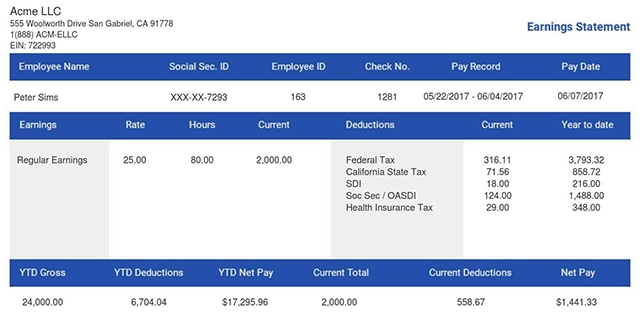
Your pay stub is where the difference becomes easy to see. An hourly stub lists hours and rate for each type of pay. For example:
- Regular: 40 hours x $20.00 = $800.00
- Overtime: 5 hours x $30.00 = $150.00
- Gross pay: $950.00
A salaried stub is simpler. It usually shows one line, such as "Salary: $2,000.00" for a biweekly period, and the hours field may show a default like 80. Either way, taxes and deductions come out of gross pay the same way. If you employ both types of workers, need clean records, or can't get a stub from your employer, a pay stub template makes it simple to show hours, rates, and salary lines correctly.
What It Means for Proof of Income
Landlords and lenders like steady numbers. A salaried stub shows the same gross pay every period, so it's easy to verify. Hourly workers with changing schedules should expect a lender to look at several recent stubs, and often a longer history, to figure out an average. Keep every stub, especially ones that show overtime, since pay stubs are one of the most common proof of income documents.
Hourly vs Salary for Employers: How to Choose
Choosing salary or hourly for a role starts with the law, not preference. Work through these questions for each position:
- Does the role pass the FLSA duties test and pay at least $684 a week, or your state's higher level?
- Do the hours change a lot from week to week?
- Can your budget handle overtime during busy seasons?
- What pay type do similar jobs in your industry use?
The most common hourly vs salary mistake is putting a worker on salary just to avoid overtime. If the role doesn't meet the exempt tests, you can owe back pay and penalties, because not paying overtime to a non-exempt worker breaks federal law. When in doubt, keep the role non-exempt and track hours.
You Might Also Like
- Wage vs Salary
- Salary and Hourly Paystubs
- Paycheck Stubs
- Gross Pay vs Net Pay Differences
- How to Calculate W-2 Wages From a Pay Stub
Conclusion
The hourly vs salary choice comes down to how your time turns into money. Hourly pay rewards extra hours. A salary rewards stability. Federal rules decide who must get overtime, not the label on the job offer. Know your numbers, keep your pay records organized, and check each stub for the right hours and rates.
Need clean pay records for a rental application, a loan, or your team's payroll? Use our paystub generator to create accurate pay stubs for hourly or salaried workers in minutes.
- 1. Enter Your Information

- 2. Select Your Favorite Theme

- 3. Download Your Stub!


 By