

Montana Paycheck Calculator: Your 2026 Tax Guide
 By
By
A montana paycheck calculator helps you find your real take home pay in Montana. Montana keeps things simple. It has only two state income tax brackets. No city in Montana charges a local income tax. So only state and federal taxes come out of your check. This guide explains the 2026 rates. It also shows how to find net pay for a nurse in Billings, a contractor in Great Falls, or a small business owner in Missoula. You can also use our online paystub generator to make a professional pay stub in minutes.
Key Takeaways
- Montana income tax has two rates: 4.70% up to $21,100 for single filers, and 5.90% above that.
- No Montana city charges a local income tax. Only state and federal taxes apply.
- The 2025 Form MW-4 now lets you pick your filing status.
- SUTA rates vary by industry. The 2026 taxable wage base is $47,300 per worker.
- Montana's minimum wage for 2026 is $10.55 per hour.
Montana Paycheck Calculator: How State Income Tax Works
Montana uses a progressive income tax. It has just two brackets. For single filers, the rate is 4.70% on the first $21,100. Income above $21,100 is taxed at 5.90%. For married filing jointly, the 4.70% rate applies up to $42,200. Income above that is taxed at 5.90%. Head of household filers use a $31,700 threshold. Montana has no local or city income tax. Only state and federal taxes come out of your pay.
A montana paycheck calculator does this math for you. You enter your filing status and your pay. The tool then shows your state income tax for 2026. A good montana tax calculator also adds federal tax and FICA. That gives you a clear take home pay number.
2026 Montana Income Tax Brackets by Filing Status
| Filing Status | Lower Rate | Threshold | Upper Rate |
|---|---|---|---|
| Single / Married Filing Separately | 4.70% | Up to $21,100 | 5.90% above $21,100 |
| Married Filing Jointly | 4.70% | Up to $42,200 | 5.90% above $42,200 |
| Head of Household | 4.70% | Up to $31,700 | 5.90% above $31,700 |
Each year, the Montana Department of Revenue posts withholding tables. Employers use these tables to set wage withholding for each worker. The tables show how much tax to hold back. They are based on gross pay, filing status, and pay frequency. Employers pair the tables with each worker's Form MW-4.
Worked Example: A Montana Paycheck Calculation
Here is a single registered nurse in Billings. She earns $62,000 per year. She is paid every two weeks.
- Gross pay per period: $2,384.62
- Social Security (6.2%): $147.85
- Medicare (1.45%): $34.58
- FICA total: $182.43
- Montana state withholding: Her salary falls in the 5.90% bracket. Her state tax is about $2,470 per year. That is roughly $95 per pay period.
- Federal income tax: This runs about $280 to $310 per pay period.
- Estimated take home pay: $1,750 to $1,900 per pay period.
Her net pay can change. It depends on her Form MW-4 and her Form W-4 choices. Many employers also offer pre-tax benefits. A 401(k) plan or health insurance lowers taxable pay. Extra withholding requests change the number too. A montana paycheck calculator gives you a quick estimate before payday. The best way to check is to read your pay stub. Our how to calculate W-2 wages from your pay stub guide shows you how.
Montana Tax Rates for 2026 Through 2028
The 2026 rates match recent years. Single filers pay 4.70% on the first $21,100. They pay 5.90% on income above that. Montana has voted to lower the top rate. It drops to 5.65% in 2027. It then drops to 5.40% in 2028. Employers should load these new rates into their payroll software each year.
Montana taxes sit in the middle for the region. Wyoming has no state income tax. North Dakota uses very low rates. Idaho uses a flat rate. Montana's planned cuts will make it more competitive with these neighbors.
FICA Taxes on Your Montana Paycheck

FICA stands for the Federal Insurance Contributions Act. It funds Social Security and Medicare. It applies to every worker in every state. A montana paycheck calculator includes both FICA taxes in its results.
Social Security tax: This is 6.2% of your gross wages. It appears on every Montana paycheck. There is a yearly wage cap. For 2026, the cap is $184,500. Once you earn that much, Social Security tax stops for the rest of the year.
Medicare tax: This is 1.45% of all wages. There is no wage cap. High earners pay more. An Additional Medicare Tax of 0.9% applies above $200,000. The threshold is $250,000 for joint filers. It is $125,000 for married filing separately.
Self-employed workers: You pay both halves of FICA. The total rate is 15.3%. You can deduct half of it on your federal income tax return.
FUTA (employers only): The Federal Unemployment Tax Act sets this tax. Employers pay it on the first $7,000 of each worker's wages. Pay your state taxes on time and you earn a credit of up to 5.4%. That brings the rate down to 0.6%. Employers report FUTA each year on Form 940. They file federal payroll tax through EFTPS. They also file Form 941 each quarter for income tax and FICA.
Montana MW-4 Withholding
The Form MW-4 sets your state wage withholding. First, you pick your filing status. You can choose single, married filing jointly, or head of household. Next, you claim your withholding allowances. The 2025 MW-4 dropped the old dependent boxes. It now works much like the federal Form W-4. You give the completed form to your employer.
Your MW-4 choices change your state withholding. A montana paycheck calculator will reflect those choices. The amount shows up on your pay stub. It sits next to your federal withholding. You can spot it by its deduction codes. The 2025 MW-4 also lets you add a fixed extra amount each pay period.
What if you skip the MW-4? Your employer will treat you as single. That means the highest tax rate. You may get a big refund later. But you give up that money during the year.
Update your MW-4 after any of these events:
- Marriage or divorce
- Having a child
- Starting a second job
- A big change in other income
- Qualifying for head of household status
Tax reciprocity: Some workers live in another state but work in Montana. They may be exempt from Montana withholding. This depends on a reciprocity deal with their home state. A military spouse stationed in Montana is also treated as a non-resident for this tax. For help, use the free IRS withholding estimator on the IRS website. The IRS bases its tables on IRS Publication 15-T.
Montana Unemployment Insurance and SUTA Rates

Montana employers pay the State Unemployment Tax (SUTA). It funds benefits for workers who lose their jobs. The state may ask for proof of income or wage records during a claim. SUTA rates vary by industry. They depend on a firm's past unemployment claims. New construction employers start at 2.0%. Other new employers pay between 1.3% and 2.0%. Experienced employers pay 0.00% to 6.12%. Employers also pay a small administrative fund tax of 0.18% on wages. A montana paycheck calculator shows employee withholding, while SUTA is a separate employer cost.
2026 SUTA rates:
- New employers: 1.3% to 2.0%, based on industry. New construction firms start at 2.0%.
- Experienced employers: 0.00% to 6.12%, based on claims history.
- AFT surcharge: 0.18% on the gross wage base for all employers.
- 2026 taxable wage base: $47,300 per worker. The 2025 base was $45,100.
For help, contact the State Unemployment Tax Division at (406) 444-2840. You can also visit uid.dli.mt.gov. The state assigns each employer a rate before November 1 each year. Rates differ by industry. Some non-profits and tribal governments can use Reimbursable Accounts instead. These employers repay the fund for the actual benefits paid to former workers.
Registered employers file the UI-5 report each quarter. Payments are due by the last day of April, July, October, and January. You must file electronically.
Montana Payroll Tax Filing Schedules Explained
Employers must send withheld tax to the state on a set schedule. The state assigns your schedule based on how much tax you withhold. There are three options. They are annual, monthly, and accelerated. A montana paycheck calculator estimates withholding, but it does not file these forms for you.
The three schedules:
| Schedule | Annual Withholding | Payment Due Date |
|---|---|---|
| Annual | Less than $1,200 | January 31 of the next year |
| Monthly | $1,200 to $11,999 | 15th of the following month |
| Accelerated | $12,000 or more | Follows the federal deposit schedule |
New employers start on the monthly schedule. After the first year, the state reviews your tax. It then sets the right schedule for you. The review uses a lookback period from July 1 to June 30.
Zero-liability periods: You may have no payroll in a period. You still must file a report. Mark it as zero. Skip it and you face a late filing penalty.
Key annual deadlines:
| Form | Purpose | Deadline |
|---|---|---|
| Form MW-1 | Withholding payment voucher | 15th of following month (monthly filers) |
| Form UI-5 | Quarterly SUTA wage report | Apr 30 / Jul 31 / Oct 31 / Jan 31 |
| Form MW-3 | Annual reconciliation of withholding | January 31 |
| Form W-2 | Employee annual wage statement | January 31 |
File online through the state portal at tap.dor.mt.gov. You can also mail paper forms to the Department of Revenue in Helena.
Codes on your pay stub can be confusing. Our payroll codes guide explains the most common ones. It helps you read the abbreviations on a Montana pay stub.
Late penalties: A late payment adds a penalty. The penalty grows over time. Unpaid tax also builds interest from the due date. The state cannot waive that interest later. Audits often start from a mismatch in wage reports. Missing reports can trigger one too. State rules require employers to keep payroll records for five years.
How to Lower Your Montana Paycheck Tax Withholding
You can lower the tax taken from your paycheck. Pre-tax deductions are the main tool. They cut your taxable income for both state and federal tax. A montana income tax calculator can show the effect. Here are the most common options.
Retirement accounts: Montana's top rate is 5.90%. Money you put in a 401(k), 403(b), or traditional IRA is pre-tax. It lowers both your state and federal taxable income. For example, $5,000 added to a 401(k) saves about $295 in state tax. It cuts your federal tax too.
Health Savings Account (HSA): HSA money is pre-tax. You use it with a high-deductible health plan. For 2026, you can add up to $4,300 as an individual. A family can add up to $8,550.
Flexible Spending Account (FSA): Many employers offer an FSA. You set aside pre-tax money for medical costs. For 2025, the single limit is $5,850. Unused money is often lost at year-end. You can use FSA funds for co-pays, prescriptions, glasses, and dental care. Applying for a loan? You may need recent paystubs or a wage report.
Update your MW-4: Big life changes affect your tax. A new marriage, child, or job may call for a new Form MW-4. The default MW-4 treats you as single with no children. That can lead to too much withholding.
IRS withholding estimator: Visit IRS.gov for the free estimator. It helps you finish a Form W-4 for federal tax. It also helps with the MW-4 for state tax. It can factor in credits and other income.
Montana Workers' Compensation Requirements
Workers' compensation is an employer cost. It is not withheld from your paycheck. It rarely shows up on a pay stub or W-2. Almost every employer with one or more workers needs a policy. The penalties for going without are severe.
Coverage options:
- Private insurance carrier: Most employers buy coverage from a private insurer. Examples include Travelers, State Farm, or Liberty Mutual. Private carriers often offer better service and rates.
- Montana State Fund: This is the state-chartered Workers Compensation carrier. It is also the insurer of last resort.
- Self-insurance: Large, stable employers can apply to self-insure. The state must approve them first.
Mandatory premium surcharges (2025 rates):
- Administration Fund: 0.8925%
- Subsequent Injury Fund: 0.4576%
- OSHA Fund: 0.3902%
A note on independent contractors: Be careful when you classify workers. The label you choose does not control the outcome. The state looks at the real working relationship. Misclassify a worker and an audit can be costly. Review your contractors each year to stay safe. Domestic workers and some self-employed people are exempt from coverage.
Montana Paycheck Calculator Compliance: Best Practices for Employers
Good payroll habits keep you compliant. Firms running payroll montana style must follow state rules from day one. A montana paycheck calculator helps you check each withholding. Here are the key steps.
Register as an employer first: You need two state accounts. One is for income tax withholding. Register it with the Montana Department of Revenue through the TransAction Portal. The other is for unemployment insurance. Register it with the Montana Department of Labor and Industry. Both accounts must be active before your first hire.
Keep payroll records: State rules require five years of records. This covers current and former workers. Keep each worker's MW-4 form and pay history. Keep proof for any workers' comp exemption too.
Check your SUTA rate each year: The state posts your rate by November 1. Confirm it before January 1. Update it in your payroll system. Fixing an error early is much easier than during an audit.
Submit MW-4 forms on time: Send exempt MW-4 forms to the state quickly. The deadline is the last day of the pay period when you receive them.
Review contractor classifications yearly: Most audits focus on construction, healthcare, and farming. Still, any industry can be audited. A yearly review keeps your records clean.
You Might Also Like
- 6 Instances You'll Need a Pay Stub for Proof of Income
- What Are Paycheck Stubs and What Do They Show?
- How to Tell the Difference Between a Real and a Fake Pay Stub
- 1099 Pay Stubs: Should Independent Contractors Receive One?
- How to Get a Pay Stub from Direct Deposit
Conclusion
Montana keeps payroll simple. It has just two tax brackets and no local income tax. The 2025 MW-4 update makes your filing status easy to set. The top state rate is 5.90%. For single filers, it starts at $21,100. The 2026 minimum wage is $10.55 per hour. A montana paycheck calculator turns these rules into a clear take home pay number. It saves you from doing the brackets by hand.
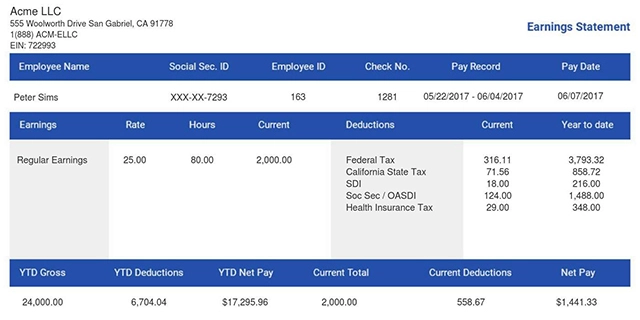
You can also make your own pay stub online. This helps self-employed workers prove their income. It is useful for a rental application or a mortgage. Our online pay stubs cover Montana income tax and FICA. Try our paystub generator to create one in minutes.
- 1. Enter Your Information

- 2. Select Your Favorite Theme

- 3. Download Your Stub!


 By
By