

What Is SUTA Tax? 2026 Rates for Workers and Employers
 By
By
You spotted three unfamiliar letters on your pay stub, or you just hired your first employee and a state agency is asking you to register. Either way, SUTA is the answer. SUTA tax is the state payroll tax that funds unemployment benefits. What it means for you depends on which side of the paycheck you are on. This guide covers what the acronym means, who pays, the 2026 rates and wage bases by state, and how to calculate and file it. If you just need the paperwork, ThePayStubs handles the stub itself.
Key Takeaways
- SUTA stands for the State Unemployment Tax Act, the state tax that funds unemployment benefits.
- Employers pay it in all 50 states. Only Alaska, New Jersey, and Pennsylvania also take a small employee contribution.
- Your bill is your assigned rate multiplied by each worker's wages up to the state wage base.
- Most states require filing and payment every quarter, with penalties for late payments.
What Is SUTA?
SUTA stands for the State Unemployment Tax Act, a state payroll tax that works differently from income tax and that employers pay to fund unemployment benefits for workers who lose a job through no fault of their own. Many states call it SUI, or reemployment tax in Florida. Rates and wage bases are set by each state, not federally.
That is the short SUTA definition. The same four letters also appear outside payroll, on a federal rural development program and a clothing label. If you are asking what does SUTA stand for in payroll, the answer is always the State Unemployment Tax Act.
The SUTA tax meaning is easiest to grasp through what it buys. When someone is laid off, their state pays temporary weekly benefits while they look for work. That money sits in a state trust fund, and employers fill that fund through SUTA payroll tax. The basic design has not changed since 1935: insurance against job loss, funded by employers.
The SUTA meaning does not change when the label does. Your rate notice may say state unemployment insurance, or SUI, but the obligation is identical.
SUTA vs. FUTA vs. FICA: How the Three Payroll Taxes Differ

People often search FICA FUTA SUTA together because all three come out of payroll. They do three different jobs.
| Tax | Level | Who pays | 2026 rate | What it funds |
|---|---|---|---|---|
| SUTA | State | Employer (plus employees in AK, NJ, PA) | Varies by state and employer | State unemployment benefits |
| FUTA | Federal | Employer only | 6.0% on the first $7,000, or 0.6% with the full credit | Federal unemployment administration |
| FICA | Federal | Split between employer and employee | 7.65% each side, up to the $184,500 Social Security cap | Social Security and Medicare |
The FUTA vs SUTA question comes up most often, so start here: you pay both. FUTA is the federal layer, capped at the first $7,000 of each worker's wages, and the full state credit drops it to 0.6%, at most $42 per employee per year. So when you compare FUTA and SUTA tax rates, FUTA is small and predictable, while SUTA swings widely by state and by your claims history.
What is FUTA and SUTA doing that FICA is not? FICA, which stands for the Federal Insurance Contributions Act, is the only one most employees actually see withheld from their pay. Asking about SUTA vs SUI is different, because those two are the same tax under different state names.
Who Pays SUTA Tax?
Employers pay SUTA in every state. Only Alaska, New Jersey, and Pennsylvania also require employee contributions: 0.50% up to Alaska's $54,200 wage base, 0.425% up to New Jersey's $44,800, and 0.07% of all gross wages in Pennsylvania, which sets no cap. When you become liable depends on your state.
Liability thresholds trip up new employers. The federal FUTA test, $1,500 in a quarter or one employee for 20 or more weeks, is the number most guides quote, but the Department of Labor reports only about half the states follow it. Alaska, Pennsylvania, and Washington make you liable the moment you hire anyone; New York starts at $300 a quarter. Check your state before your first payroll.
The New Jersey figure deserves a closer look because published rates disagree. That 0.425% is two pieces: 0.3825% for unemployment insurance plus 0.0425% for workforce development. Sources quoting 0.3825% leave out the workforce development piece.
Do employees pay for FUTA and SUTA anywhere else? No. In the other 47 states both are employer obligations, and nothing should come out of a worker's check.
Exemptions are narrow. Government employers and many 501(c)(3) nonprofits can reimburse the state for actual claims instead of contributing. Genuine independent contractors are not covered at all, though the label on the invoice does not settle it, and the rules around whether contractors receive a pay stub differ too, which is why misclassifying an employee as a 1099 contractor gets expensive. To learn who is exempt from FUTA and SUTA in your state, check with your state agency rather than assuming.
What SUTA Means on Your Pay Stub

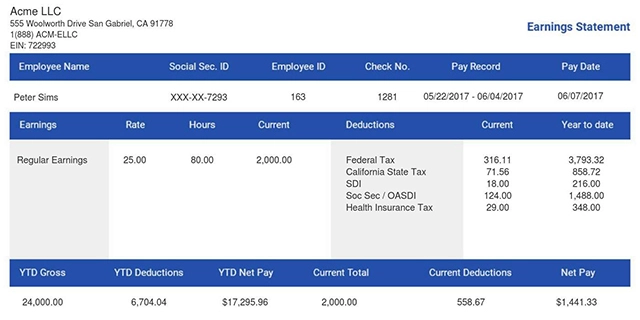
Here is the part almost nobody explains to workers: in 47 states, SUTA should not appear on your pay stub at all. It is an employer tax and never touches your gross-to-net math.
So if you are asking, what is SUTA on my paycheck? Start with your state. Work in Alaska, New Jersey, or Pennsylvania and a small unemployment line is normal and correct. Work anywhere else and a SUTA deduction is worth a question to your payroll contact, because it is usually a mislabeled state disability or family leave withholding, or a genuine error. Learning how to read pay stub deduction codes settles most of these questions.
The phrasing trips people up too. Someone asking what does SUTA stand for in payroll is often reading an abbreviation their employer chose. Stubs may show SUI, UI, or the state's own name.
If you run payroll, the fix is simple. Label employee-side withholdings clearly, separate them from involuntary deductions, and keep the employer-paid taxes off the deduction column entirely. Clear pay stubs mean fewer payroll questions on Monday morning.
How to Calculate SUTA Tax
The formula is short:
SUTA owed = your assigned rate x each employee's wages, up to the state wage base
Say you are a new employer in Arizona. The state assigns new businesses a 2.00% rate and caps the wage base at $8,000. You pay 2.00% of that first $8,000 per employee, or $160 per person per year. Whether that employee earns $20,000 or $200,000, once they cross $8,000 your SUTA bill for them stops.
That is how to calculate SUTA for a single worker. Multiply across your headcount for annual exposure. Learning how to calculate FUTA and SUTA together is the same exercise twice, since FUTA uses an identical structure on a $7,000 base.
Your SUTA tax rate is not fixed forever. New employers get a standard starting rate for roughly three years. After that, states assign an experience rating based on how many former employees have drawn benefits against your account. Lay people off and the rate climbs; keep turnover low and it falls. Some states also load rates by industry, which is why construction firms usually pay more than office employers.
SUTA Tax Rates and Wage Bases by State
Wage bases vary enormously. Florida taxes the first $7,000 of a worker's wages while Washington taxes the first $78,200, an eleven-fold difference for the same employee. Here are 2026 employer rate ranges.
| State | Wage base | Employer rate range |
|---|---|---|
| Alaska | $54,200 | 1.00% to 5.40% |
| Arizona | $8,000 | 0.03% to 8.36% |
| California | $7,000 | 1.50% to 6.20% |
| Florida | $7,000 | 0.10% to 5.40% |
| Georgia | $9,500 | 0.04% to 8.10% |
| Indiana | $9,500 | 0.50% to 7.40% |
| New Jersey | $44,800 | 0.50% to 5.80% |
| North Carolina | $34,200 | 0.06% to 5.76% |
| Pennsylvania | $10,000 | 1.419% to 10.3734% |
| Texas | $9,000 | 0.32% to 6.32% |
Texas SUTA runs on a low $9,000 base, so per-employee cost stays modest even at the top of the range, though pay stub rules in Texas are a separate obligation. Florida SUTA confuses workers most, since the state calls it reemployment tax.
Indiana SUTA and the NC SUTA rate show why the wage base matters more than the percentage. Their rate ranges look similar, but North Carolina taxes almost four times as much of each worker's pay.
These figures change annually. Confirm yours through the directory of state unemployment agencies before budgeting.
How to Register, File, and Pay SUTA
Register with your state's unemployment agency soon after your first hire. The state issues a SUTA number, and this is what new employers get wrong most often: that state account number is not your federal EIN. If you are not sure of yours, here is how to find your EIN number. You need both, and they go in different boxes.
Most states collect SUTA taxes quarterly, using a state-specific SUTA form filed electronically. The standard deadlines are April 30, July 31, October 31, and January 31, with weekends and holidays pushing to the next business day. For the federal side, IRS Topic 759 covers FUTA and Form 940.
Miss a payment and the consequences stack: fines, daily interest, a higher assigned rate next year, and potentially the loss of your FUTA credit. Lose the full 5.4% credit and FUTA climbs from 0.6% to 6.0%, or $420 per employee instead of $42.
Two traps are worth naming. Multistate and remote staff get assigned to one state using the Department of Labor's localization-of-work tests, applied in order: where the work happens, where the employee is based, where they are directed from, and where they live. The second is SUTA dumping, or shuffling payroll between entities to inherit a lower rate. It is illegal everywhere.
To lower your rate legitimately, respond to every claim on time, document separations, and read your annual rate notice against your own claim history.
You Might Also Like
- Supplemental Unemployment Benefits
- How Tax Withholding Works
- How to File Taxes With Your Last Pay Stub
- Payday, Pay Cycle, and Pay Period Explained
- Employment Verification and Proof of Income Documents
Conclusion: Staying on Top of SUTA and Your Pay Records
If you are an employee, the takeaway is short: SUTA is almost certainly not your expense, and a line that looks like it deserves a question. If you run payroll, it is a real cost you partly control, since your claims history sets your rate for years.
Both situations come back to clean pay documentation. Workers need stubs for rentals, loans, and income verification. Employers need accurate records for quarterly wage reports and audits. Generate clear, professional pay stubs in under two minutes at ThePayStubs.com.
- 1. Enter Your Information

- 2. Select Your Favorite Theme

- 3. Download Your Stub!


 By
By