

Federal Minimum Wage: State Rates, Exemptions and Annual Pay (2026)
 By
James Wilson
By
James Wilson The federal minimum wage has been $7.25 per hour since July 24, 2009, now more than 15 years without a single federal increase. The federal minimum wage 2024 looked the same as in 2016, 2014, and 2010.
While Congress has debated higher floors, the $7.25 rate has held firm through administrations, economic crises, and a global pandemic. Accurate pay stub records are essential for both workers verifying their wages and employers documenting compliance.
That doesn't mean wages have stood still everywhere. States have moved aggressively, with over 20 setting minimum wages above the federal floor by 2024 and at least 23 more scheduling increases for 2026.
Whether you're a worker checking what you're owed or a business owner keeping payroll compliant, this guide covers what the national minimum wage 2024 and 2026 actually means in practice. It includes annual income calculations, who's exempt from the federal floor, and how to verify your rate using your pay stub.
Key Takeaways
- The federal minimum wage 2024 remained $7.25/hr, unchanged since July 24, 2009, and carried into 2026
- At least 23 states raised their minimum wage on January 1, 2026. 20 states still follow the federal floor
- Full-time minimum wage workers earn $15,080/year; part-time workers (20 hrs/week) earn $7,540/year
- Tipped employees have a federal floor of just $2.13/hr; employers must close any gap to reach $7.25
- You can verify your effective pay rate by dividing your gross wages on your pay stub by the hours worked
- What Is the Federal Minimum Wage, and How Often Does It Change?
- Federal Minimum Wage 2024 by State: 2026 Rate Updates
- Which States Are Raising Their Minimum Wage in 2026?
- Minimum Wage Yearly Salary: Annual Income for Full- and Part-Time Workers
- Federal Minimum Wage Exemptions: Who Is Exempt?
- Tipped Employee Minimum Wage
- Has the Federal Minimum Wage 2024 Kept Up With Inflation?
- How To Verify Your Minimum Wage on a Pay Stub
- You Might Also Like
- Conclusion
What Is the Federal Minimum Wage, and How Often Does It Change?
The federal minimum wage 2024 is $7.25 per hour. The Fair Labor Standards Act set this rate, and it has been in effect since July 24, 2009. Only Congress can raise it. This means there is no automatic inflation adjustment. Through 2024 and into 2026, no increase has been signed into law. The $7.25 floor has not changed for over 15 years.
President Franklin D. Roosevelt signed the Fair Labor Standards Act (FLSA) on June 25, 1938. It set the first federal minimum wage at just $0.25/hr. The law created the framework for minimum wage, overtime pay rules, and child labor protections that still govern nonexempt workers today.
So, what's minimum wage today, and how often does it change? Only Congress can raise the federal rate. There is no cost-of-living adjustment built into federal law. Increases have come in clusters, with the longest gap being the current one. No change from 2009 through at least 2026. The Raise the Wage Act, which would have phased in a $15/hr federal floor, passed the House but stalled in the Senate.
What was minimum wage in 2024? The same $7.25 it has been since 2009. The minimum wage in 2024 at the federal level did not budge, even as many states set higher state minimums.
What is considered minimum wage at the federal level? The FLSA floor applies to most private-sector workers and businesses with annual sales over $500,000. Where state law sets a higher minimum wage per hour, employers must follow the higher rate.
Federal Minimum Wage 2024 by State: 2026 Rate Updates
The federal minimum wage 2024, at $7.25, had not changed since 2009. States set their own floors, and where a state minimum exists above $7.25, that rate governs. The minimum wage by state 2024 ranged from $7.25 (20 states deferring to federal) to $17.50 in Washington D.C. Here are the 2026 rates for all 50 states and D.C.:
| State | 2026 Minimum Wage | Change from 2024 | Notes |
|---|---|---|---|
| Alabama | $7.25 (federal) | No change | No state minimum wage law |
| Alaska | $11.91 | +$0.70 | Annual CPI adjustment |
| Arizona | $14.70 | +$0.65 | Annual CPI adjustment |
| Arkansas | $11.00 | No change | N/A |
| California | $16.50 | +$0.50 | Fast food workers: $20/hr (AB 1228) |
| Colorado | $14.81 | +$0.42 | Annual CPI adjustment |
| Connecticut | $16.35 | +$0.85 | Scheduled increase |
| Delaware | $13.25 | +$0.25 | Scheduled increase |
| Florida | $14.00 | +$1.00 | Amendment 2 scheduled phase-in |
| Georgia | $7.25 (federal) | No change | No state minimum wage law |
| Hawaii | $14.00 | +$2.00 | Scheduled increase |
| Idaho | $7.25 (federal) | No change | State set at federal floor |
| Illinois | $14.00 | +$1.00 | Scheduled increase |
| Indiana | $7.25 (federal) | No change | State set at federal floor |
| Iowa | $7.25 (federal) | No change | State set at federal floor |
| Kansas | $7.25 (federal) | No change | State set at federal floor |
| Kentucky | $7.25 (federal) | No change | State set at federal floor |
| Louisiana | $7.25 (federal) | No change | No state minimum wage law |
| Maine | $14.65 | +$0.60 | Annual CPI adjustment |
| Maryland | $15.00 | +$1.00 | Scheduled increase |
| Massachusetts | $15.00 | No change | N/A |
| Michigan | $10.56 | +$0.50 | Scheduled increase |
| Minnesota | $10.85 | +$0.40 | Annual adjustment (large employers) |
| Mississippi | $7.25 (federal) | No change | No state minimum wage law |
| Missouri | $13.75 | +$1.00 | Annual CPI adjustment |
| Montana | $10.55 | +$0.35 | Annual CPI adjustment |
| Nebraska | $13.50 | +$1.50 | Scheduled increase (Prop 434) |
| Nevada | $12.00 | +$1.00 | Scheduled increase |
| New Hampshire | $7.25 (federal) | No change | No state minimum wage law |
| New Jersey | $15.49 | +$0.36 | Annual CPI adjustment |
| New Mexico | $12.00 | No change | N/A |
| New York | $16.50 | +$1.00 | NYC/Long Island; upstate $15.50 |
| North Carolina | $7.25 (federal) | No change | State set at federal floor |
| North Dakota | $7.25 (federal) | No change | State set at federal floor |
| Ohio | $10.45 | +$0.35 | Annual CPI adjustment |
| Oklahoma | $7.25 (federal) | No change | State set at federal floor |
| Oregon | $14.70 | +$0.70 | Portland metro higher; annual CPI |
| Pennsylvania | $7.25 (federal) | No change | State set at federal floor |
| Rhode Island | $15.00 | +$1.00 | Scheduled increase |
| South Carolina | $7.25 (federal) | No change | No state minimum wage law |
| South Dakota | $11.50 | +$0.40 | Annual CPI adjustment |
| Tennessee | $7.25 (federal) | No change | No state minimum wage law |
| Texas | $7.25 (federal) | No change | No state minimum wage law |
| Utah | $7.25 (federal) | No change | State set at federal floor |
| Vermont | $14.01 | +$0.60 | Annual CPI adjustment |
| Virginia | $12.41 | +$0.41 | Scheduled increase |
| Washington | $16.66 | +$0.70 | Annual CPI adjustment |
| Washington D.C. | $17.50 | +$0.50 | Annual CPI adjustment |
| West Virginia | $8.75 | No change | N/A |
| Wisconsin | $7.25 (federal) | No change | State set at federal floor |
| Wyoming | $7.25 (federal) | No change | No state minimum wage law |
Rates effective January 1, 2026. Verify current rates at dol.gov/agencies/whd/minimum-wage/state.
States With the Highest and Lowest Minimum Wages
Washington D.C. leads the nation at $17.50/hr, followed by Washington State ($16.66/hr) and California and New York (both $16.50/hr). On the other end, 20 states (including Texas, Georgia, and Wyoming) have no state minimum wage law and defer entirely to the $7.25 federal floor.
States With a Minimum Wage of $15 or More
Years of legislative pressure have produced a growing high-wage tier. California, Connecticut, Hawaii, Illinois, Maryland, Massachusetts, New Jersey, New York, Oregon, Rhode Island, Vermont, and Washington all land at or above $15/hr for 2026, plus Washington D.C. This reflects years of Fight for $15 advocacy translating into state legislation.
Which States Are Raising Their Minimum Wage in 2026?

While the federal minimum wage 2024 was held at $7.25, at least 23 states raised their rates on January 1, 2026, including California ($16.50/hr), Washington ($16.66/hr), New York ($16.50/hr), Florida ($14.00/hr), and Colorado ($14.81/hr). Most of these increases are automatic cost-of-living adjustments tied to state inflation indexes, a kind of mechanism that does not exist at the federal level.
Key states making significant jumps for 2026 include:
-
California: $16.50/hr general minimum. Fast-food chain workers earning $20/hr under AB 1228 (Assembly Bill 1228, effective April 1, 2024), an industry-specific floor that now far exceeds the state minimum
-
Florida: $14.00/hr, part of a voter-approved phase-in toward $15 by 2026
-
Nebraska: $13.50/hr following Proposition 434 passage
-
Hawaii: $14.00/hr, a $2.00 jump as the state accelerates its schedule
- Connecticut: $16.35/hr, one of the highest in the Northeast
One category worth noting is the federal contractors. Executive Order 14026 set a $17.75/hr minimum for new federal contracts as of January 2024. EO 14236 (issued in 2025) reverted certain contracts back to general FLSA standards, so contractors should verify their applicable rate with their contracting officer.
If your state's rate increased on January 1, 2026, that new rate must appear on the first pay stub covering any hours worked in the new pay period. Employers cannot delay payroll updates. Since the federal minimum wage 2024 did not change, only state-level updates apply.
Minimum Wage Yearly Salary: Annual Income for Full- and Part-Time Workers
How much does $7.25/hr add up to over a year? The table below breaks down minimum wage annual income at the federal rate and for workers in high-wage states.
Many workers ask, "What is minimum wage salary for a full 40-hour week?" The answer depends on your state.
| Schedule | Hours/Week | Hourly Rate | Annual Income |
|---|---|---|---|
| Full-time | 40 | $7.25 (federal) | $15,080 |
| Part-time | 20 | $7.25 (federal) | $7,540 |
| Full-time | 40 | $14.00 (FL/HI/IL) | $29,120 |
| Full-time | 40 | $16.50 (CA/NY) | $34,320 |
| Full-time | 40 | $16.66 (WA) | $34,653 |
| Full-time | 40 | $17.50 (D.C.) | $36,400 |
The math is straightforward for any worker to calculate their own minimum wage salary:
Hourly rate × Weekly hours × 52 weeks
Workers who want to go further can use the same logic to calculate their hourly, weekly, and monthly income across different scenarios and budgeting needs. For a part-time minimum wage worker at $7.25 putting in 20 hours weekly, that works out to $7,540 gross before taxes, below the federal poverty guideline for a family of two.
These figures represent gross annual income, as it appears on pay stubs before federal income tax, FICA (Social Security and Medicare), and any state withholding. What you take home will be lower. Workers who want to understand their minimum wage annual income after deductions can check their pay stub's net pay line.
Federal Minimum Wage Exemptions: Who Is Exempt?

Not every worker is covered by the federal minimum wage 2024 rate of $7.25. The FLSA carves out several exemption categories. If you or your employees fall into one of these categories, different wage rules apply.
-
Tipped employees: Employers may pay as little as $2.13/hr in cash if tips bring the worker to at least $7.25/hr. (Full section below.)
-
Youth training wage: Workers under age 20 may be paid $4.25/hr for the first 90 consecutive calendar days of employment with any single employer. This is not tied to job type. It is an age- and time-based exemption.
-
Full-time student program: Employers with a Department of Labor certificate may pay full-time students 85% of the minimum wage, or $6.16/hr at the $7.25 federal rate. This applies to retail, service, agriculture, and college settings.
-
Student learners: Students enrolled in vocational education programs may be paid 75% of minimum wage ($5.44/hr at the federal rate) under an approved DOL certificate.
-
Workers with disabilities: The Section 14(c) certificate program allows wages based on a worker's output compared to non-disabled peers. This can result in subminimum wages. The program is under active review, and some states have phased it out.
-
Agricultural workers: Farmworkers at small farms (fewer than 500 person-days of farm labor in a quarter of the prior year) are exempt. Migrant and seasonal workers have added protections under the Migrant and Seasonal Agricultural Worker Protection Act.
-
Independent contractors: Contractors are not employees under FLSA; hence, minimum wage requirements do not apply. Whether they're owed a 1099 pay stub is a separate question many gig workers ask.
- Executive/Administrative/Professional (EAP): Salaried workers earning at least $684/week ($35,568/year) may be exempt from overtime pay (not minimum wage) if they meet the FLSA's duties tests.
Employers must post updated labor law notices whenever wage rules change. Even though the federal minimum wage 2024 did not increase, state-level changes still require updated postings.
Tipped Employee Minimum Wage
Under the federal minimum wage 2024 rules, tipped employees can be paid $2.13/hr in cash wages. This figure has not changed since 1991. The logic is the tip credit. Employers can apply tips toward the $5.12/hr gap between $2.13 and the $7.25 minimum. If a worker's tips don't close that gap in any workweek, the employer must make up the difference.
Eight states require a full minimum wage regardless of tips, with no tip credit allowed. They include:
- Alaska
- California
- Minnesota
- Montana
- Nevada
- Oregon
- Washington
- Maine
Workers in these states receive at least the full state minimum wage in cash before tips.
For payroll purposes, tipped employee tip income and tip credit must be properly documented on payroll records. The federal minimum wage 2024 for tipped workers remains $2.13/hr before tips. When states raise their minimum wage, the required cash wage floor for tipped employees may increase, too, and this should appear on updated pay stubs.
Has the Federal Minimum Wage 2024 Kept Up With Inflation?
No. The federal minimum wage 2024 has not kept pace with rising costs. Adjusted for inflation using the Consumer Price Index, $7.25 in 2009 is worth roughly $10.33 in 2026 dollars. That means its real buying power has dropped by more than 28%. If it had tracked worker productivity since 1968, today's federal minimum wage would top $26 per hour, according to the Economic Policy Institute.
The Bureau of Labor Statistics' CPI data makes the gap concrete. Workers earning $7.25/hr today have far less buying power than those earning $7.25/hr in 2009. The gap widens every year. The living wage for a single adult in most major U.S. metros ranges from $18 to $24/hr, nearly double the federal floor.
Named examples make the contrast sharp. Walmart, Amazon, and Target all now start workers at $15/hr or higher. This shift came from labor market pressure, not federal law. The Fight for $15 movement launched in November 2012, when 200 fast-food workers in New York City walked off the job demanding $15/hr and union rights.
It's now a global labor campaign that shaped wage laws in dozens of states. California's AB 1228 (which pushed fast-food chain workers to $20/hr in April 2024) is one of its most concrete wins.
How To Verify Your Minimum Wage on a Pay Stub
Your pay stub contains everything you need to confirm you're being paid at or above the federal minimum wage 2024 rate.
For Employees
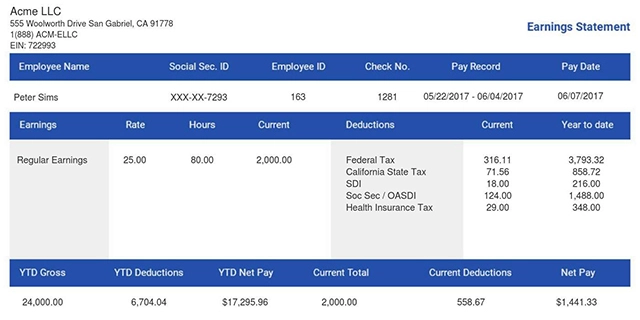
Not sure how to read a paycheck stub? Start with the gross pay field, then divide by total hours worked for the period. The result is your effective hourly rate. If it falls below your state's minimum wage (check the table above), report it to the Department of Labor's Wage and Hour Division at dol.gov/agencies/whd.
Workers may also need proof of income documentation when applying for housing or loans, and a verified pay stub serves that purpose, too.
For Employers
When the minimum wage increases, follow this four-step compliance checklist:
- Update all affected employee pay rates before the new rate's effective date
- Confirm the new rate appears on the first pay stub covering any hours worked in the new pay period
- Post updated federal and state labor law posters at your worksite
- Review exempt employee salaries against the EAP threshold ($684/week) to ensure continued exemption status
Workers and small business owners can create accurate, compliant pay stubs that reflect current minimum wage rates for each pay period. This saves time and keeps payroll records clean.
You Might Also Like
- Gross Monthly Income: How to Calculate It
- Pay Period Breakdown: Understanding Your Pay Schedule
- What Are Pay Stub Deduction Codes?
- FIT Taxable Wages Explained
- How to Calculate W-2 Wages from a Pay Stub
Conclusion
The federal minimum wage 2024 sat at $7.25, the same rate it has held since 2009. While Congress has not moved the federal floor, states have. More than 23 states raised their minimums for 2026, with Washington, California, and New York now paying workers more than double the federal rate. For any minimum wage worker putting in 40 hours a week at $7.25, that adds up to $15,080 a year, a figure worth understanding, verifying, and documenting.
The clearest way to confirm your pay is to check your pay stub. Divide gross wages by hours worked to see your effective hourly rate. If something doesn't add up, the Department of Labor's Wage and Hour Division can help. For employers updating rates after a minimum wage increase, the simplest way to keep payroll records accurate and compliant is to use a trusted pay stub generator. ThePayStubs.com makes it easy to generate professional pay stubs that reflect current rates for every pay period.
- 1. Enter Your Information

- 2. Select Your Favorite Theme

- 3. Download Your Stub!

 By
By