

Is Overtime Calculated Weekly or Biweekly? (2026)
 By
By
Most workers on biweekly payroll assume overtime starts after 80 hours in a pay period. It doesn't. Is overtime calculated weekly or biweekly? Federal law has a clear answer: weekly, based on each 7-day workweek. Your pay schedule doesn't change when the overtime clock resets. This guide covers the rule, how to calculate what you're owed, and where overtime shows up on your pay stub.
Key Takeaways
- Overtime is calculated per 7-day workweek, not across a biweekly pay period.
- Federal law requires time-and-a-half for any hours over 40 in a single workweek.
- Employers cannot average two weeks of hours together to skip overtime pay.
- California, Alaska, and Nevada add daily overtime rules on top of federal law.
- Your pay stub should list overtime hours and the overtime rate as separate line items.
Is Overtime Calculated Weekly or Biweekly?
Overtime is calculated weekly, not biweekly. Under the Fair Labor Standards Act (FLSA), overtime is based on each 7-day workweek. Any hours over 40 earn time-and-a-half pay. Even with a biweekly pay schedule, each workweek stands alone. Employers cannot average two weeks' hours together to skip overtime.
The FLSA defines a workweek as any fixed, repeating 7-day period of 168 hours. Your employer sets that window, often Sunday through Saturday or Monday through Sunday. The timing of your paycheck has nothing to do with it.
Your overtime clock doesn't know when payday is. If you work 45 hours in Week 1 and 35 hours in Week 2, you've earned 5 overtime hours for Week 1. The biweekly check amount doesn't change that.
The no-averaging rule is spelled out in federal law. An employer can't combine 45 hours from Week 1 and 35 hours from Week 2, call the average 40, and skip overtime. That shortcut is a costly mistake. Week 1 already triggered 5 overtime hours, and those must be paid at 1.5x.
Workers often wonder: how does overtime work in a two week pay period? The FLSA's answer is consistent: each 7-day window stands alone, and the biweekly check doesn't change that.
So is overtime calculated weekly or biweekly in practice? The paycheck is biweekly. The overtime obligation is weekly. Those are two separate things.
How Overtime Is Calculated on a Biweekly Pay Schedule

The formula is the same regardless of your pay schedule:
- Find your regular hourly rate. For hourly employees, it's your base wage. Salaried, non-exempt workers: divide weekly salary by scheduled work hours.
- Calculate your overtime rate. Multiply your regular hourly rate by 1.5.
- Count your overtime hours. Subtract 40 from total hours worked in that workweek.
- Multiply. Overtime hours times overtime rate equals overtime pay owed.
Example A: Hourly Employee
A warehouse worker earns $18/hr and logs 45 hours in Week 1 of a biweekly pay period. Regular pay: 40 x $18 = $720. Overtime: 5 x $27 = $135. Total earnings for Week 1: $855.
In Week 2, she works 37 hours. No overtime owed. Her biweekly gross is $855 + (37 x $18) = $855 + $666 = $1,521.
Example B: Small Business Owner Running Payroll
A team member earns $22/hr. In Week 2 of the biweekly cycle, he works 47 hours. Week 1 had only 33 hours, so no overtime that week. But Week 2 triggers 7 overtime hours regardless: 7 x $33 = $231 owed on top of 40 x $22 = $880. Week 2 total: $1,111.
Week 1's low hours don't reduce the overtime owed in Week 2. Each workweek's hours worked and overtime pay stand on their own.
Your biweekly paycheck shows both weeks combined. The overtime owed, though, was set separately for each 7-day period. That split is the whole reason the answer to is overtime calculated weekly or biweekly affects your take-home pay. Heavy overtime weeks can change your gross monthly income, so knowing the math helps you plan ahead.
What Counts Toward the "Regular Rate" for Overtime?
The regular overtime rate includes your base hourly wage plus any nondiscretionary bonuses. These are bonuses tied to performance or hours worked, like production or attendance pay. Discretionary bonuses, like holiday gifts, are left out. Workers with multiple pay rates in one workweek use a weighted average of all earnings divided by total hours.
For most hourly employees, the regular rate equals their base wage. When nondiscretionary bonuses enter the picture, the calculation changes.
Say an employee earns $18 per hour, works 45 hours, and gets a $50 production bonus that week. Add the bonus to all straight-time wages: (45 x $18) + $50 = $860. Divide by the 45 hours worked, and the regular rate rises to $19.11. That lifts the overtime rate to $28.67, a bit higher than the straight $27 base.
Multiple pay rates in one workweek? Add all earnings together and divide by all hours worked. That weighted average becomes the overtime base rate for the week.
Want to see how your overtime wages roll up to annual W-2 income? Our guide on how to calculate W-2 wages from a pay stub walks you through it.
Federal and State Overtime Rules: Who Qualifies?

Who Is Exempt from Overtime?
Two things decide it: your pay and your job duties. Most hourly wage employees and salaried workers earning under $684 per week (the 2026 salary threshold) are non-exempt, so they get overtime. Part-time status doesn't remove that protection. A part-timer topping 40 hours in a workweek earns overtime pay for those extra hours, just like a full-time worker.
Exempt status means federal law doesn't guarantee overtime pay. This group usually includes executives, managers, professionals, and administrative staff. They earn at or above $684 a week and meet specific job duty criteria. Job title alone doesn't decide exempt status; the actual work matters. Independent contractors usually aren't covered by FLSA overtime rules at all. See how 1099 independent contractor pay stubs differ from standard employee records.
State-Level Overtime Rules
Federal law sets the baseline. Some states require more:
- California: Overtime after 8 hours per day, plus double time (2x) for hours over 12 in a day or over 8 on the 7th day worked in a row.
- Alaska and Nevada: Daily overtime after 8 work hours in a day, on top of the federal 40-hour weekly rule. In Nevada, this daily rule only covers workers who earn less than 1.5 times the state minimum wage.
When state law gives employees more protection, employers must follow the stricter standard. Employers in these states track daily work hours, not just weekly totals, to follow both state and federal law. Other states, like Texas, stick to the federal rule with no extra daily overtime.
Industry-Specific Overtime Rules
Some industries follow special federal guidelines. Hospitals and residential care establishments can use the "8 and 80" system. It pays overtime for hours over 8 in a day or over 80 in a two-week period, whichever is greater. Many healthcare facilities pick this setup. Law enforcement officers and firefighters fall under their own FLSA criteria too. Their overtime starts over a longer work cycle, not a standard 40-hour week.
How Overtime Shows Up on Your Pay Stub
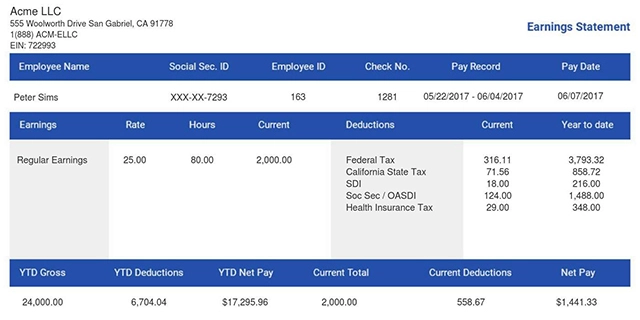
With the answer to is overtime calculated weekly or biweekly settled, your pay stub is where you verify it in practice. Overtime pay should appear as its own line item, separate from regular wages. A typical entry reads something like "OT HRS: 5 @ $27.00/hr = $135.00" listed distinctly from regular pay.
To confirm your overtime pay is correct, check three things:
- Do the overtime hours match what you tracked for that specific workweek?
- Is the overtime rate exactly 1.5x your regular hourly rate?
- Are overtime hours tied to the right 7-day workweek, not averaged across the pay period?
Self-verification tip: On a biweekly stub, split the pay period into two workweeks in your head. If you worked 43 hours in Week 1 and 37 hours in Week 2, your stub should show exactly 3 overtime hours. If it shows zero, that's underpaid overtime worth following up on.
Accurate overtime records matter beyond your paycheck. Self-employed and gig workers should also keep proof of income records that show all earnings clearly. Need to prove your income for a loan, rental application, or mortgage? Our guide on employment verification and proof of income documents explains what lenders usually require.
Conclusion: Is Overtime Calculated Weekly or Biweekly
Overtime is calculated per workweek, not per pay period. Your biweekly paycheck covers two weeks, but the overtime owed was settled separately for each 7-day period. Hourly workers: check your pay stub to confirm overtime hours and the 1.5x rate show up as separate line items. Small business owners running biweekly payroll: the pay cycle doesn't extend the overtime window. Track hours by workweek, not by pay period. The answer to is overtime calculated weekly or biweekly hasn't changed. Each workweek is its own unit, and hours over 40 earn time-and-a-half.
For pay stubs that show regular earnings and overtime as separate lines, use a paystub generator to make clean pay records in minutes.
You Might Also Like
- 1. Enter Your Information

- 2. Select Your Favorite Theme

- 3. Download Your Stub!


 By
By