

What Is a Payroll Account? Setup Guide for 2026
 By
By
Running payroll from your main business account is an accident waiting to happen. A payroll account is a separate bank account just for employee wages, payroll taxes, and related costs. It stays completely apart from your operating funds. Accurate pay stubs keep your records straight alongside it. This guide covers how to set one up and manage it in 2026. You'll get the benefits, the steps, and the tax rules you need to know.
Key Takeaways
- A payroll account is a dedicated bank account used only for employee wages, taxes, and payroll expenses.
- A separate account protects wages from accidental spending and gives you a clean audit trail for the IRS.
- Transfer funds 2 to 3 business days before payday to allow for ACH processing time.
- Keep a 10-15% buffer on hand for overtime or last-minute changes.
- Every pay stub you hand out is a payment from this account.
What Is a Payroll Account?
Two main account types work for payroll: a business checking account or a money market account. Both serve as a dedicated bank account used only for employee wages and related costs. When you set one up, keep it apart from your operating or general checking account. That way your wage funds never mix with day-to-day business money. You can open it at a bank, a credit union, or online through a platform that links to your payroll software.
Money in the account is set aside only for payroll. Once you transfer it in, it's off-limits for other expenses. That separation is what makes a dedicated bank account so valuable for a growing small business.
Benefits of a Separate Payroll Account

Running payroll from your main checking account works until it doesn't. Checks can clear in the wrong order. Funds run low before everyone is paid. Then employees go unpaid until you top up the balance.
Accidental Overspending
Say a restaurant owner puts Friday's payroll in his general checking account, then writes a check for new equipment. Days later the payroll clears and the equipment check bounces. A separate account prevents this. Those wage funds simply aren't available to spend elsewhere.
Cleaner Audit Trail
Tax law expects you to withhold payroll taxes and report them correctly. You also have to pay the federal and state government on time. That's hard to do when payroll runs through your general checking account. There's no clean way to track wage transactions or prove your tax reporting was right. A separate business checking account fixes that. It gives you one place where every payroll dollar is recorded.
Better Cash Flow Visibility
When payroll has its own account, you can see exactly how much of your cash flow is tied up in wages. Knowing what you spend on staff as a share of revenue makes future planning much easier.
Reduced Fraud Risk
You can cut fraud risk by limiting who can touch the account, such as the payroll manager or HR. A separate login, apart from your main operating account, keeps unauthorized transactions in check.
How Does a Payroll Account Work?
Two to three business days before payday, money moves from your main checking account into the account. It covers gross wages, deductions, and tax withholdings for the pay period. Besides paying employees by direct deposit, your software also prepares the required payroll tax filings.
As each payday nears, the system pulls that person's time card, salary, and benefit choices. The payroll program works out their gross wage for the period. Then it subtracts deductions like health insurance, life insurance, dental, and 401(k). Those come out along with Social Security, Medicare, and FICA. What's left is net pay, sent to the employee's bank account by ACH.
How to Set Up a Payroll Account

Setting one up takes five steps.
Step 1: Choose a Bank or Fintech Platform
Compare monthly fees, ACH transfer speeds, and software integration. Some business banks offer free payroll sub-accounts. Fintechs tend to have tighter app connections and more same-day transfers. Pick what fits your payroll size and schedule.
Step 2: Gather Your Documents
You'll need your Employer Identification Number (EIN) from the IRS, your business license or formation documents, and valid ID for each approved signer. If you don't have an EIN yet, apply at the IRS website before you open the account.
Step 3: Set Your Payroll Schedule
Biweekly and semimonthly schedules are most common for small businesses. Pick a pay period that lines up with when cash comes in, so money is ready before each transfer. Avoid scheduling payroll the same day as major operating expenses.
Step 4: Fund the Account Before Each Pay Period
Transfer from your operating account 2 to 3 business days before payday. That window covers ACH processing time, not just your bank's internal speed. Add the 7.65% employer share of payroll taxes to each transfer. That's 6.2% for Social Security and 1.45% for Medicare. That way you're not short when IRS deposit deadlines hit. A recurring transfer keeps each cycle funded on time.
Step 5: Connect Your Payroll Software
Most payroll tools link straight to your bank through an API. QuickBooks Payroll, Gusto, ADP Run, and Rippling all support this. Once linked, eligible accounts can move same-day funds in 2026, which helps when your cash flow is tight.
A sole proprietor who just draws owner's pay doesn't need one. But once you hire a W-2 employee, a separate account becomes essential. It lets you track employee wages, withhold taxes, and stay payroll compliant.
Types of Payroll Accounts
The right setup depends on your business size and payroll volume. Here's how the main options compare.
Standard Checking Account (Operating Payroll)
When your wages sit in the same place as everyday business spending, the two blur together fast. That makes your money harder to manage. You also risk spending funds you set aside for employees.
Separate Payroll Bank Account
For most small businesses, this is the go-to setup: one checking account just for employee wages and payroll taxes. You fund it before each pay cycle and send out the payments. Then the balance drops to zero until next time. That rhythm keeps you from dipping into wage money for other bills.
Payroll Clearing Account
With lots of employees or complex payouts, companies use a staging account. Funds batch there first, then go out to employees and tax agencies in separate transactions. Big employers and payroll providers like this because it keeps payroll accounting cleaner at scale.
High-Volume Salary Payment Account
Some banks offer high-volume salary accounts built for mass ACH processing, automated reporting, and tighter controls. They suit large, complex payrolls. For a smaller operation, the extra cost usually isn't worth it.
Payroll Account Taxes and Compliance
Managing payroll right means knowing your federal tax duties, not just the pay schedule.
FICA taxes. You pay the 7.65% employer share on every payday, based on that period's gross wages. It breaks down to 6.2% for Social Security and 1.45% for Medicare. Your employees pay a matching share, withheld from their checks. The exact figure depends on their taxable wages and Form W-4 choices.
IRS deposit schedules. The IRS sets how often you deposit, based on your lookback period. Report $50,000 or less in employment taxes for the prior year and you deposit monthly. Owe more than that and you deposit semi-weekly. Late deposits carry a penalty: 2% for 1 to 5 days late, 5% for 6 to 15 days, and 10% past 15 days. It climbs to 15% if the tax stays unpaid more than 10 days after the IRS's first notice. The IRS Publication 15 has the full rules.
Record retention. The IRS wants you to keep payroll, wage, and tax records for at least 4 years. Some states can audit returns up to 7 years out, so many CPAs suggest holding records that long to be safe.
State payroll taxes. Unemployment insurance, state and local income taxes, and other local levies vary by state. Check your state's department of revenue for current requirements.
Payroll Accounts and Your Pay Stubs
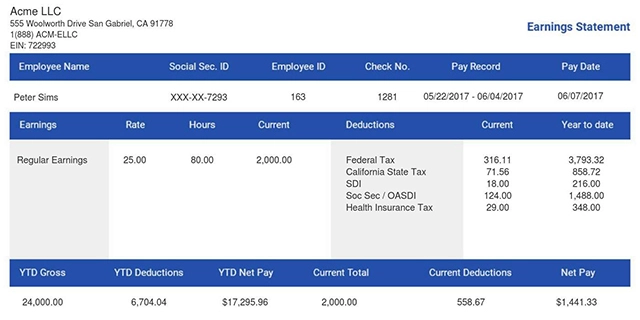
Your company's pay stubs come straight from the payments made out of the account. Each one lists gross wages, the required and optional tax deductions, and the net pay an employee takes home for the period. When those payment figures match the pay stubs, your records are clean.
If a pay stub and your records don't line up, you risk an audit, and your employees may question whether they were paid right.
If you're self-employed and need to prove your income for a rental or loan, our guide to proof of income documents walks through your options.
Best Practices for Managing Your Payroll Account
These habits keep your account running without surprises.
Monitor Your Balance Daily
Set a low-balance alert at 110% of your average payroll. That early warning gives you a full business day to move money before payday, instead of scrambling at the last minute.
Keep a 10-15% Buffer
Keep a cushion of 10-15% above your average pay period for surprise overtime, corrections, or last-minute bonuses. Say you run $10,000 every two weeks. You'd keep $11,000 to $11,500 in the account at all times.
Require Dual Approval for Transfers
Set up your account so two people sign off on every transfer. The person who starts a transfer shouldn't be the one who approves it. This one simple control blocks unauthorized withdrawals with almost no extra effort.
Reconcile Every Pay Cycle
After each payroll run, match your bank statement against your payroll register. Catching small errors now keeps them from snowballing later. Bank reconciliation after every cycle is a habit most accountants swear by.
Limit Account Access
Only the payroll manager and HR should have access online. Keep all login details separate from the company's general operating account.
You Might Also Like
- How to Get a Pay Stub From Direct Deposit
- Payroll Codes: What the Abbreviations on Your Pay Stub Mean
- Payroll vs. Compensation: Key Differences Explained
- How to Read Pay Stub Deduction Codes
- Why Jobs Hold Your First Paycheck
Conclusion
A separate checking account for payroll protects both your company's money and your employees'. Fund it 2 to 3 business days before each pay period, keep a 10-15% buffer, and reconcile after every cycle.
An accurate pay stub matters just as much as paying wages on time. Use a reliable paystub generator to create clean, professional pay stubs that match your payroll account records.
- 1. Enter Your Information

- 2. Select Your Favorite Theme

- 3. Download Your Stub!

 By
By