

Payroll Corrections: How to Fix Pay Errors Step by Step (2026)
 By
By
Finding a mistake in last Friday's payroll run feels like a crisis. It usually is not. An Ernst & Young survey of employers with 250 to 10,000 workers found the average organization runs 15 payroll corrections per pay period, at about $291 each in administrative cost. What matters is how fast you fix it, and whether the corrected pay stub proves you did.
This guide walks through the correction process in order: how to document the error, how underpayments and overpayments differ legally, when to file IRS Form 941-X, how long you actually have before penalties start, and what to do if you are the one whose paycheck came up short.
Key Takeaways
- Most payroll corrections are due by the next regular pay period, though several states require faster action.
- Underpayments must be repaid in full, while overpayment recovery usually needs the employee's written consent.
- Federal income tax withholding errors can only be corrected within the same calendar year.
- Employment tax errors are corrected on IRS Form 941-X, not through a normal payroll run.
- Employees can ask for a correction and should see it appear on the next pay stub.
- What Is a Payroll Correction?
- Common Payroll Errors That Trigger Payroll Corrections
- How to Make Payroll Corrections, Step by Step
- Off-Cycle Payroll or the Next Paycheck?
- How Long Do You Have to Correct a Payroll Error?
- What Happens If You Don't Fix a Payroll Error?
- What to Do When Your Own Paycheck Is Wrong
- How to Prevent Payroll Errors
- Conclusion: Getting Payroll Corrections Right the First Time
What Is a Payroll Correction?
A payroll correction is the process of fixing an error in a past payroll run, whether that means unpaid wages, an overpayment, or the wrong tax withheld. Most corrections are due by the next regular pay period, and employment tax errors are filed separately on IRS Form 941-X.
Three terms get used interchangeably, and they are not the same thing.
A payroll correction fixes something that was wrong in a previous run. A payroll adjustment is broader: it covers any deliberate change to pay, such as a bonus or a severance payment. A retroactive adjustment payroll entry, the kind you process after a raise is approved late, falls in that same bucket. A payroll discrepancy is the gap itself, the difference between what an employee earned and what actually reached their account.
That distinction matters because payroll corrections and adjustments generate different paperwork. The discrepancy is what you found, the correction is what you do, and the adjustment is the line on the pay stub.
Common Payroll Errors That Trigger Payroll Corrections

Most payroll errors come from the same short list:
- Miscounted hours, usually from timesheets re-typed into payroll by hand
- The wrong pay rate, often after a raise that was approved but never entered
- Missed or miscalculated overtime for non-exempt employees
- Incorrect tax withholding after a W-4 change, a move to a new state, or payroll tax rates that were never updated
- Missing or outdated deduction codes for benefits, retirement, or wage garnishment
- Worker misclassification, where an employee is treated as a contractor
One root cause sits under most of these: data moving between systems by hand. Every re-typed number is a chance for a processing error, and a single payroll mistake in a pay rate repeats every cycle until somebody catches it.
How to Make Payroll Corrections, Step by Step
Nearly every correction follows the same five steps. Knowing how to fix payroll errors is mostly a matter of not skipping one, because that is what turns a small fix into a compliance problem.
Step 1: Confirm and Document the Error
Pull the pay stub, the timesheet, and the withholding record for the affected period, then compare what was paid against what should have been paid. Line items are often abbreviated, so a list of payroll codes helps here. Write down what went wrong, when it happened, exactly how many dollars are involved, and which employees were affected.
That paper trail is what an auditor will ask for first.
Step 2: Fix an Underpayment
An underpayment is not negotiable. If someone earned the money, you owe it, regardless of how the mistake happened. Pay the difference, then tell the employee in writing what the shortfall was and when the money will arrive. A payroll error underpayment carries the shortest fuse of any correction type, since unpaid wages are what wage claims are built on.
Step 3: Handle an Overpayment
Overpayments are harder than underpayments, which surprises most employers. You generally cannot claw money back from a future paycheck without the employee's written consent, and you cannot pull funds from their bank account.
State rules narrow it further. California bars any deduction that drops pay below minimum wage. New York caps overpayment recovery at 12.5% of gross wages per pay period and requires notice first. Texas permits recovery with a written agreement.
If the overpayment happened in a previous calendar year, you also need Form W-2c to correct the wage record.
Step 4: Correct Tax Withholding Errors With Form 941-X
Wage fixes and tax fixes travel on separate tracks. Employment tax errors go on Form 941-X for the quarter where the mistake occurred, and the form offers two paths:
- Adjustment process: for underreported tax, where you pay the balance due when you file
- Claim process: for overreported tax, where you request a refund of the excess
One hard limit is worth pinning to the wall: federal income tax withholding errors can only be corrected in the same calendar year the wages were paid. Once January arrives, that window closes except for administrative errors and misclassification cases handled under section 3509 rates. Social Security and Medicare corrections have more room, as the IRS explains in its guide to correcting employment taxes.
Step 5: Record the Correction
Close the loop in writing. A payroll correction form should capture the pay period, the original and corrected amounts, the reason, the date processed, and a space for the employee to sign. A payroll adjustment form does the same for planned changes.
Under FLSA rules, keep payroll records for at least three years, and keep the records your wage calculations were based on, such as timecards and schedules, for two.
Off-Cycle Payroll or the Next Paycheck?

Run an off-cycle payroll when the shortfall is large, the employee needs the money now, or your state requires it. Otherwise, adding the correction as a retro line on the next paycheck is usually fine. Off-cycle runs cost more to process but close the gap immediately.
Payroll corrections can ride along with the next scheduled run or go out on their own. So what is off cycle payroll? It is a pay run processed outside your normal calendar, used to move money without waiting for payday.
The arithmetic is the same hourly income math you would use for any pay period. Say an employee worked 6 hours that never reached the timesheet, at $18 an hour. If you are wondering how to calculate retro pay, multiply the missed hours by the rate: 6 at $18 is $108 in gross retro pay. That is taxed as regular wages, so the net lands below $108.
On the next pay stub, that $108 appears as its own retro line rather than disappearing into regular earnings. Tell the employee to keep it, because lenders and landlords verify income from pay stubs.
How Long Do You Have to Correct a Payroll Error?
There is no single federal deadline. The safe default is to correct the error by the next regular pay period, but several states move faster: Oregon requires payment within three business days of learning about the shortfall when it reaches 5% of gross wages. Federal tax corrections should be filed as soon as you find them.
State law fills the gap the FLSA leaves open:
| State | Deadline to correct an underpayment |
|---|---|
| Oregon | Under 5% of gross wages, next regular payday. At 5% or more, within three business days of notice |
| California | Willful failure to pay final wages triggers waiting time penalties of up to 30 days of wages |
| New York | Manual workers must be paid within seven calendar days of the week worked |
| Florida | 15 calendar days after written notice, for minimum wage claims |
| Most other states | Next regular pay period |
Check your own state pay stub laws and wage deadlines before you decide to wait for the next cycle. Most payroll corrections are safe on that timeline, but the default is a floor, not a guarantee.
What Happens If You Don't Fix a Payroll Error?
Unfixed errors compound. The IRS charges failure-to-deposit penalties from 2% to 15% of the unpaid tax depending on how late it is, and unpaid back wages under the FLSA can carry liquidated damages in an equal amount, doubling what you owe. Withheld taxes can become a personal liability.
The failure-to-deposit penalty scales with delay: 2% for deposits one to five days late, 5% at six to fifteen days, 10% beyond that, and 15% once the amount stays unpaid more than ten days after the IRS demands it. The tiers do not stack on top of each other.
The Department of Labor also assesses civil penalties for repeated or willful violations, adjusted for inflation each year.
What to Do When Your Own Paycheck Is Wrong
Most advice about payroll corrections stops at the employer. If you are on the receiving end, the process is shorter, but documentation still matters.
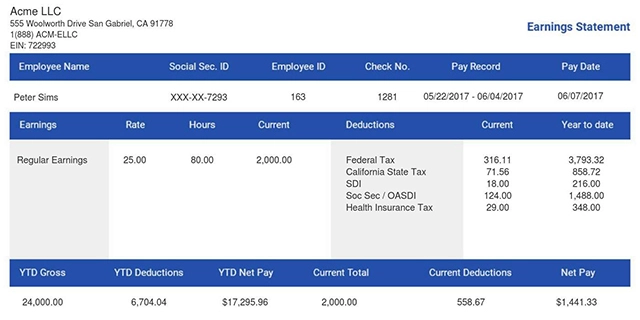
Start with the stub. Check hours, pay rate, overtime, deductions, and year-to-date totals, since a wrong rate shows up as a widening gap across periods rather than one obvious miss.
Then put it in writing. A short email naming the pay period, the amount you expected, and the amount you received gives your employer everything they need, and gives you a dated record.
Your employer has to correct a genuine underpayment. If weeks pass without an answer, your state labor agency and the Department of Labor both accept wage complaints.
Finally, keep the corrected pay stub. It proves your actual income when you apply for an apartment or submit pay stubs for loan applications.
How to Prevent Payroll Errors
Knowing how to fix payroll mistakes is useful. For small business owners without a dedicated payroll team, avoiding payroll corrections altogether is cheaper.
- Sync timekeeping to payroll so nobody re-types hours between systems
- Review the payroll register before you submit, not after the checks clear
- Update W-4s, pay rates, and direct deposit details as changes happen, not at year end
- Audit a few paychecks by hand each quarter to confirm the system does what you think it does
If you are an employee, the equivalent habit takes about a minute: read the stub every period, not only when something feels off.
Conclusion: Getting Payroll Corrections Right the First Time
The rule that keeps any correction small is straightforward. Fix it fast, put it in writing, and check your state's deadline before you decide to wait. Underpayments get repaid in full, overpayments need consent, and tax errors belong on Form 941-X while the calendar year is still open.
And when you need an accurate pay stub, whether for your team or for your own records, ThePayStubs.com generates one with the calculations already done.
You Might Also Like
- 1. Enter Your Information

- 2. Select Your Favorite Theme

- 3. Download Your Stub!

 By
By