


How Long Does Payroll Take to Process? (2026 Guide)
 By
By
You've set payday for Friday. The real question is which day you actually have to start. Ask how long does payroll take to process and most guides answer with a vague "it depends." That doesn't help when your team is counting on the money landing on time. Our paystub generator produces the pay documentation in minutes, but the payroll clock itself deserves a straight answer.
The answer comes down to three clocks that get blurred together. There's your working time, the bank's transit time, and the lead time you need before payday. Below you'll find exact ranges for each stage, a countdown you can work backward from, and what to do when you're already late. If you're an employee waiting on a deposit, there's a section for you too.
Key Takeaways
- Most businesses need about five days from the end of the pay period to money landing in employee accounts.
- Roughly one to two days of that is your internal work. The other two to three days belong to the bank.
- Payroll software cuts the calculation stage from hours down to minutes.
- Your first payroll run takes weeks, not days, because of EIN issuance and bank verification.
- Same Day ACH can rescue a late payroll if your provider supports it.
- How Long Does Payroll Take to Process? The Short Answer
- How Long Does Payroll Take to Process at Each Stage?
- How Long Does Payroll Take to Process by Payment Method?
- 6 Factors That Change Your Payroll Processing Time
- How Long Does Payroll Take to Process the First Time?
- How to Work Backward From Payday
- What to Do When Payroll Will Be Late
- Where Is My Direct Deposit? A Guide for Employees
- How to Speed Up Payroll Processing
How Long Does Payroll Take to Process? The Short Answer
Most businesses need about five days from the end of the pay period until money reaches employee accounts. Roughly one to two days covers your internal work: calculating hours, taxes and deductions. Bank transit through the ACH network takes another two to three days. Payroll software shortens the calculation stage to minutes.
Payroll processing is the full sequence of calculating what each employee earned, withholding taxes and deductions, and delivering the payment. So how long does payroll take to process in practice? That depends on how you run it.
| Method | Timesheets | Calculation | Funding | Bank transit | Total |
|---|---|---|---|---|---|
| Manual (spreadsheets) | Hours to days | 2 to 8 hours | Same day | 1 to 3 days | 4 to 7 days |
| Payroll software | Hours to days | 10 to 60 minutes | Same day | 1 to 3 days | 3 to 5 days |
| Outsourced provider | Hours to days | You submit only | 1 to 2 days | 1 to 3 days | 4 to 6 days |
The calculation stage is the only one you fully control, which is where software earns its keep. Owners can use this table to block time; employees can use it to see why hours were due Monday for a Friday payday.
How Long Does Payroll Take to Process at Each Stage?

Payroll breaks into four stages. Collecting timesheets takes hours to days and varies most. Calculating gross pay, payroll taxes and deductions takes minutes with software or hours by hand. Submitting payroll happens the same day. Bank transit then takes one to three days before funds post.
Stage 1: Collecting Timesheets (Hours to Days)
This stage swings the widest, and it's rarely a math problem. You're waiting on people. A team of ten with a digital time clock closes timesheets in under an hour. The same team on paper, with no deadline, burns two days.
Stage 2: Calculating Gross Pay, Taxes and Deductions (Minutes to Hours)
Multiply hours worked by pay rate to get gross pay, subtract pre-tax deductions, then calculate withholding. That includes 6.2% for Social Security and 1.45% for Medicare from each employee, which you match as the employer. You'll also owe FUTA on the first $7,000 of each employee's annual wages: 6% on paper, though the state unemployment tax credit brings most employers down to 0.6%. Payroll software does this in minutes; by hand, budget a few hours.
Stage 3: Submitting and Funding Payroll (Same Day)
Once numbers are approved, you submit the run and your account gets debited. This part is fast, but it's governed by a cutoff, and that cutoff is the deadline that actually matters. Miss it and your timeline slides a full banking day.
Stage 4: Bank Transit to the Employee (1 to 3 Days)
Your payroll file enters the ACH network, which batches transfers and settles them on banking days. One to three days is the full range; most direct deposits land on day two or three. This stage is out of your hands entirely, which is why lead time exists. Employees who want a record before the money posts can still get a pay stub from direct deposit.
How Long Does Payroll Take to Process by Payment Method?
Direct deposit takes one to three days, paper checks two to five days, and digital wallets or pay cards one to two days. Those windows include one to two days of internal processing. Standard ACH drives the direct deposit timeline, though Same Day ACH can compress it when your provider supports it.
| Payment method | Time to employee | Best for |
|---|---|---|
| Direct deposit | 1 to 3 days | Most teams, lowest cost |
| Paper check | 2 to 5 days | Employees without bank accounts |
| Digital wallet | 1 to 2 days | Contractors, remote workers |
| Pay card | 1 to 2 days | Unbanked employees, fast access |
Here's what most articles leave out: the two to three day window isn't a law of physics. It's the standard ACH settlement schedule. Nacha, which governs the ACH network, also runs Same Day ACH with several submission windows each banking day, and many payroll providers support it. Your bank applies its own cutoff too, usually earlier, so confirm yours before you need it.
6 Factors That Change Your Payroll Processing Time

So how long does payroll take to process at your business specifically? These six factors decide it, and each carries a real time cost.
- Manual versus software versus outsourcing. The biggest lever. Running payroll by hand costs hours; a payroll system costs minutes. Outsourcing payroll removes the work but adds a provider cutoff you don't control.
- Headcount. Manual processing scales badly. Software barely notices whether you have 8 employees or 80.
- Hourly and salaried mix. Salaried runs are nearly identical each period. Non-exempt hourly employees need overtime tracked and verified, which adds a review pass.
- Multi-state employees. Every additional state adds its own withholding rules and payday requirements. The Department of Labor publishes state payday requirements, and they vary more than most owners expect.
- Time and attendance integration. When approved hours flow straight into payroll, the manual data entry stage disappears. When they don't, you're rekeying, and rekeying means errors.
- Off-cycle items. Bonuses, commissions, garnishments and reimbursements each need separate handling, and they arrive under their own payroll codes on the stub. These cause most last-minute corrections.
How Long Does Payroll Take to Process the First Time?
Your first payroll run takes weeks, not days. You need an employer identification number from the IRS, plus state tax accounts in every state where employees work. A bank prenote to verify direct deposit details can alone take up to two weeks. Budget three to four weeks.
This is the answer new employers actually need, and almost nobody separates it out. The five-day figure describes steady-state payroll, not your first run. Banks also send a prenote, a zero-dollar test entry, to confirm account details before releasing real funds. It's also a big part of why some jobs seem to hold your first paycheck.
Run one test payroll before your first live one. Finding a problem on a practice run costs nothing; finding it on payday costs trust.
How to Work Backward From Payday
Don't plan forward from the pay period. Plan backward from payday. Knowing the difference between a payday, pay cycle and pay period makes the schedule below much easier to follow.
Here's a standard schedule for a Friday payday on a biweekly pay period in 2026.
| Day | What happens |
|---|---|
| Friday (prior week) | Pay period ends |
| Monday | Timesheet deadline for employees |
| Tuesday | Managers approve hours, corrections made |
| Tuesday or Wednesday | Run payroll, submit before your provider's cutoff |
| Friday | Funds post to employee accounts |
Two adjustments matter. Federal holidays aren't banking days, so a holiday inside your window pushes payday out a day. If payday lands on a weekend, most employers pay the Friday before, which moves everything upstream too. Map these against a 2026 calendar once and you're set for the year.
What to Do When Payroll Will Be Late
If you've missed your cutoff, you still have options, roughly in order of speed:
- Off-cycle payroll run. Most providers let you submit a correction run outside the normal schedule.
- Same Day ACH. If your provider supports same-day origination and you're inside the window, funds can land the same banking day.
- Wire transfer. Fastest and most expensive. Practical for a handful of employees, not a full payroll.
- Paper check as a stopgap. Hand-delivered checks put money in someone's hands today, even if clearing takes a few days.
Tell your employees before they discover it themselves. A short message explaining what happened and when they'll be paid prevents most of the damage. States set their own legal deadlines for paying wages, and state pay stub laws vary just as much, so a late payroll carries real exposure.
Where Is My Direct Deposit? A Guide for Employees
Your deposit usually posts to your bank account one to three days after your employer submits payroll, and banks release funds at different times of day. Weekends and federal holidays push the date later, since ACH transfers only settle on banking days. Check your pay stub to confirm the pay period and payment date.
If your pay shows as pending, the money has arrived but your bank hasn't released it yet. That's normal and usually clears within a day. Some banks post overnight, others in the early morning, and a few offer early access a day or two ahead.
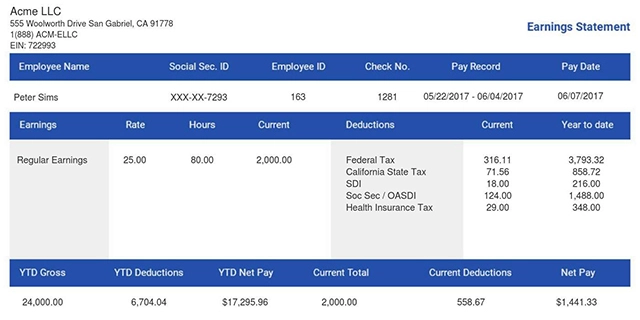
Before you contact HR, look at what a pay stub actually shows. It lists the pay period covered, the payment date, gross pay, and every deduction taken. Most "missing" pay turns out to be a pay period boundary, not a missing payment.
Need pay documentation for a rental application or loan? Here's which documents work as proof of income when a landlord or lender asks.
How to Speed Up Payroll Processing
You can't shorten bank transit. But how long does payroll take to process on your end? Processing payroll faster is almost entirely within your control.
- Build a repeatable payroll calendar. Publish timesheet deadlines and paydays for the whole year.
- Move to payroll software. The highest-impact change available, taking the calculation stage from hours to minutes.
- Integrate time and attendance. Approved hours should flow into payroll automatically, with no rekeying.
- Set your internal deadline early. One buffer day absorbs the late timesheet that would otherwise cost a banking day.
- Use a pre-submit checklist. Confirm new hires, terminations, rate changes and off-cycle items before you submit.
Most owners who feel like payroll takes forever are stuck in stage one, chasing hours. Fix that stage and the rest follows.
You Might Also Like
- How to Read Pay Stub Deduction Codes
- How to Calculate Your Hourly, Weekly and Monthly Income
- What's the Difference Between Payroll and Compensation?
- FTE Meaning Explained
- How to File Taxes With Your Last Pay Stub
Conclusion
For an established business, how long does payroll take to process usually works out to about five days from the pay period end. One to two days of that is your own work. The rest belongs to the bank. Your first run is the exception and needs three to four weeks. Build the backward-planned calendar once, integrate your time tracking, and payroll stops being a scramble.
Need professional pay stubs for every pay run? Use our pay stub generator to create accurate, ready-to-share pay stubs in minutes.
- 1. Enter Your Information

- 2. Select Your Favorite Theme

- 3. Download Your Stub!

 By
By


