

What Is Dependent Care Benefits on W2? (2026 Guide)
 By
By
You open your W-2, scan past your wages, and there it is: a number sitting in Box 10 that you don't remember earning. If you're wondering what is dependent care benefits on W2 forms and whether you owe tax on that amount, you're in good company. It's one of the most-searched W-2 questions every January, and the form itself doesn't explain a thing.
This guide covers what Box 10 reports and how to check it against your own pay stubs, plus the 2026 contribution limits that just changed, when the money turns taxable, and how it affects the child and dependent care credit.
Key Takeaways
- Box 10 of your W-2 reports dependent care benefits: your pre-tax FSA contributions plus any care your employer paid for directly.
- The annual exclusion rose to $7,500 for 2026 ($3,750 if married filing separately), up from $5,000.
- Amounts above the cap, or money not spent on qualifying care, become taxable wages.
- Form 2441 reconciles Box 10 and reduces the expense ceiling for the child and dependent care credit.
- What Is Dependent Care Benefits on W2?
- How Dependent Care Benefits Work
- Dependent Care FSA Limit 2026
- Dependent Care FSA Eligible Expenses
- Are Dependent Care Benefits on W2 Taxable?
- How to Check Box 10 Dependent Care Benefits on W2 Forms
- Box 10 and the Child and Dependent Care Credit
- Common Box 10 Reporting Mistakes
What Is Dependent Care Benefits on W2?
Dependent care benefits on W2 forms are the amounts your employer paid or reimbursed for the care of a child or dependent adult, reported in Box 10. The figure includes your pre-tax dependent care FSA contributions plus the value of any employer-provided care, such as an on-site daycare place.
So what are dependent care benefits in practice? They're employer help with the cost of caring for someone who can't be left alone while you work. Box 10 isn't a wage box; it's informational, which trips people up when reading a W-2 for the first time.
The IRS instructions for Forms W-2 and W-3 require employers to include the fair market value of employer-provided care, not just cash reimbursements. That's why dependent care benefits on W2 forms often total more than what left your paycheck, which matters when you're calculating W-2 wages from a pay stub.
How Dependent Care Benefits Work

Dependent care benefits on W2 forms reach you through one of two routes, and the route decides how much control you have over the amount.
What Is Dependent Care FSA
A dependent care FSA, or flexible spending account, is a pre-tax account you fund through payroll deductions. You pick an annual amount at open enrollment and draw on it as you pay for care. Because that money skips federal income tax and FICA, dependent care FSA benefits stretch further than ordinary take-home pay.
Employer Dependent Care Benefits
Some companies provide care directly: on-site daycare, subsidized backup care, or a reimbursement. These employer dependent care benefits land in Box 10 at fair market value even though nothing was deducted from your pay. That's why the box sometimes shows a figure you never elected.
Dependent Care FSA Limit 2026
Here's the part most guides still get wrong. The annual exclusion sat at $5,000 for decades. The One Big Beautiful Bill Act raised it, and the new dependent care FSA limit 2026 figures took effect on January 1.
| Filing status | 2025 | 2026 |
|---|---|---|
| Most filers | $5,000 | $7,500 |
| Married filing separately | $2,500 | $3,750 |
Two caveats matter more than the headline number. First, it isn't indexed for inflation, so $7,500 stays put until Congress moves it again.
Second, the higher cap is optional. Your Section 125 plan document controls the maximum you can elect, and the plan must be formally amended to allow $7,500. If open enrollment still capped you at $5,000, that's your employer's choice, not a mistake.
The dependent care FSA rules on timing didn't change: you elect once a year and can only adjust after a qualifying event like a birth, marriage, divorce, or job change.
Dependent Care FSA Eligible Expenses

The money has to fund care that lets you, and your spouse if you're married, work or look for work. That work-related test is the one people forget.
Dependent care FSA eligible expenses include:
- Daycare, nursery school, and preschool below kindergarten level
- Before-school and after-school programs
- Summer day camp, though overnight camp doesn't qualify
- A nanny, au pair, or babysitter providing child care while you work
- Adult daycare and in-home care for an incapacitated spouse or parent
- Application fees and deposits required to hold a qualifying spot
Tutoring and K-12 tuition don't qualify.
Who Counts as a Qualifying Person
A qualifying person is your child under 13, or a spouse or other dependent who is physically or mentally incapable of self-care and lived with you for more than half the year. Family members like an elderly parent living in your home can qualify. One living in their own home generally can't.
Are Dependent Care Benefits on W2 Taxable?
Dependent care benefits on W2 forms are usually tax-free up to the annual exclusion, which is $7,500 for 2026 and was $5,000 for 2025. Anything above that cap, or any amount not spent on qualifying care, becomes taxable wages and is added to Boxes 1, 3 and 5.
Two things push part of Box 10 into your taxable income:
- Going over the cap. Your plan let you elect more than the exclusion, or you had benefits from two employers in the same year.
- Not spending it on care. Dependent care FSA money is use-it-or-lose-it, so if you set aside $5,000 and claimed $3,800, the leftover $1,200 gets treated as wages.
The taxable slice of dependent care benefits on W2 forms is added to Box 1 for federal income taxable wages, Box 3 for Social Security, and Box 5 for Medicare. Box 10 still shows the full amount, which is why the figures look wrong until you work through Form 2441.
So are dependent care benefits taxable by default? No, only to the extent you went over the cap or didn't spend the money on care.
How to Check Box 10 Dependent Care Benefits on W2 Forms
Payroll systems make mistakes. Verifying the box 10 dependent care benefits figure takes five minutes:
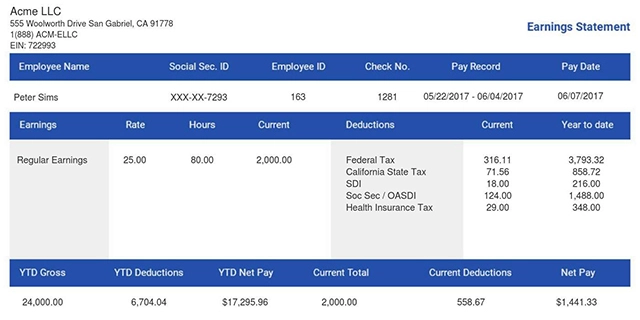
- Pull your pay stubs for the year and total the dependent care deduction line, usually one of the pay stub deduction codes labeled "DCA", "DCFSA", or "Dep Care".
- Add anything your employer contributed directly, including the value of on-site care.
- Compare that total to the box 10 W2 amount.
When the two don't match, the usual culprits are a mid-year election change that never got applied, or a deduction that kept running after you left. Ask payroll to review it before you file. If they confirm an error, they'll issue a Form W-2c to file with.
Keeping your own pay records makes this check simple. If you need clean, itemized stubs, our pay stub templates make it easy.
Box 10 and the Child and Dependent Care Credit
Box 10 flows into Form 2441, where the child and dependent care tax credit is calculated. Part III reconciles your benefits.
The credit covers up to $3,000 of dependent care expenses for one dependent, or $6,000 for two or more. Those ceilings didn't change for 2026, but every dollar excluded through Box 10 reduces them.
Say you have two children, $9,000 in daycare costs, and $5,000 excluded in Box 10:
- Expense ceiling for two dependents: $6,000
- Less the Box 10 exclusion: $5,000
- Expenses still eligible for the credit: $1,000
You'd claim the credit on that $1,000, not the full $9,000. The exclusion already covered the first $5,000.
For 2026, the top credit rate rose from 35% to 50%, stepping down as income rises and bottoming out at 20%. The exact breakpoints sit in the Form 2441 instructions.
Dependent Care FSA vs Tax Credit
You can't claim both on the same dollar, so the choice comes down to your bracket. The dependent care FSA vs tax credit math usually favors the FSA for higher earners, since the exclusion dodges income tax and FICA while the credit offsets income tax alone and phases down to 20%. Households sitting at the 50% rate may do better with the credit.
Common Box 10 Reporting Mistakes
If you run payroll, dependent care benefits on W2 forms are easy to get wrong, and errors mean W-2c corrections.
- Reporting only cash reimbursements and omitting the fair market value of employer-provided care
- Leaving the taxable excess out of Boxes 1, 3, and 5 while still showing the full amount in Box 10
- Applying the $7,500 cap before amending the Section 125 plan document to allow it
- Skipping nondiscrimination testing when highly compensated employees dominate the plan
On the employee side, the most common mistake is never filing Form 2441. Without it, the IRS treats the whole Box 10 amount as taxable, much like not filing a W-2 statement does. Your employer already sent the same dependent care benefits W2 data to the Social Security Administration, which passes it to the IRS, so Box 10 is on file whether or not you reconcile it.
You Might Also Like
- How to Request a W-2 From a Previous Employer
- How Do You Get Your W-2 Online
- What Does a W-2 Income Statement Look Like
- Freelancing for Beginners: 1099 vs W-2
- Employment Verification and Proof of Income Documents
Conclusion
Box 10 answers one narrow question: how much dependent care assistance your employer gave you this year. Stay under the 2026 cap of $7,500, spend it on qualifying care, and file Form 2441 so the IRS can see what was legitimately excluded.
When the dependent care benefits on W2 forms don't match your own records, your pay stubs are the fastest way to prove it. Need to create accurate W-2 forms for your employees? Our paystub generator handles the calculations for you.
- 1. Enter Your Information

- 2. Select Your Favorite Theme

- 3. Download Your Stub!

 By
By