

What Are Payroll Liabilities? Types, Examples & How To Manage Them
 By
By
Most business owners focus on paying staff on time. But each pay run also creates new bills that haven't been paid yet. That's where payroll liabilities come in.
Maybe you run a small business with ThePayStubs.com, or you just want to read your own pay stub. Either way, you need to know what payroll liabilities are.
This 2026 guide covers the key types and how to pay them. It also shows how they look on a pay stub and tips to stay on the right side of the IRS.
Key Takeaways
- Payroll liabilities are the amounts your business owes after running payroll but has not yet paid.
- They include withheld taxes, FICA contributions, accruals, and benefit deductions.
- Federal payroll taxes go through EFTPS. You file Form 941 quarterly and Form 940 each year. FUTA also pays an annual fee.
- Late payments trigger IRS penalties from 2% to 15% based on how many days the deposit is late.
- Pay stubs prove that wages and tax withholdings were processed correctly.
- What Are Payroll Liabilities?
- Types of Payroll Liabilities
- Payroll Liabilities vs. Payroll Expenses
- What Payroll Liabilities Look Like on a Pay Stub
- How To Pay Your Payroll Liabilities
- How To Track and Manage Payroll Liabilities
- Common Payroll Liability Mistakes To Avoid
- Best Practices for Managing Payroll Liabilities
- You Might Also Like
- Conclusion
What Are Payroll Liabilities?
Payroll liabilities are what an employer owes after each payday. The employer is obligated to pay these amounts, meaning the cash has not yet left the books. They are listed on the balance sheet as current liabilities. The total covers wages owed to staff. It also covers taxes withheld from their pay and the employer's share of FICA, benefits, and workers' compensation.
Most balance sheet liabilities are short-term. Cash is due within 30 to 60 days. Some, such as deferred compensation plans, may be long-term based on the plan terms.
Payroll liabilities affect both sides of the books. For the employer, they are part of cash flow planning. For the employee, they show up as the usual deductions on a pay stub. When workers know which deductions are normal, they can spot whether their employer is handling funds the right way.
Types of Payroll Liabilities
The exact mix of payroll liabilities is based on your workforce, pay structure, benefits, and tax rules.
Each workforce is different. Wages, benefits, state tax laws, and required withholding all change the totals you owe. Late payment penalties also apply.
Employee Wages and Salaries
Pay is the cash an employee earns before the employer cuts the check. The employer owes it at the end of the pay period. Until paid, this wage amount is a payroll liability. Some books refer to this line as accrued wages.
Wage math depends on worker type:
- Salaried employees: Annual salary divided by the number of pay periods. For example, $52,000 paid every 2 weeks comes to $2,000 per pay period over 26 cycles.
- Hourly employees: Hours worked times the hourly rate. Add overtime at 1.5 times the hourly rate for any hours over 40 in a workweek under federal law.
- Extra pay: Bonuses, commissions, shift pay, and other incentives are wage liabilities until you pay them out.
The gross pay line on a pay stub shows the wage amount before any deductions. That total is the employer's wage burden before tax withholdings. Independent contractors and freelancers are not subject to employer wage liability. They pay their own income taxes each quarter using a 1099 form. Learn more in "Do 1099 employees get pay stubs?"
Payroll Taxes: FICA, Federal, and State
Payroll tax liabilities are some of the most regulated in business. Each pay run creates new tax bills. These cover the amounts withheld from worker pay and the employer's own share. Sound payroll compliance starts here.
Federal income tax is deducted from each worker's wages. The amount depends on the worker's Form W-4, which lists filing status, dependents, and any extra withholding. The employer holds these funds until they go to the federal treasury through the Electronic Federal Tax Payment System (EFTPS).
FICA Taxes
Under the Federal Insurance Contribution Act fund Social Security and Medicare:
- Social Security: 6.2% from the worker and 6.2% from the employer on wages up to the 2026 wage base of $176,100.
- Medicare: 1.45% from each side with no wage cap.
- Additional Medicare tax: 0.9% extra withheld from workers' earnings above $200,000 (single) or $250,000 (married filing jointly). The employer does not match this amount.
FUTA (Federal Unemployment Tax Act)
Employers pay 6.0% on the first $7,000 of each worker's wages. Most employers get a 5.4% credit for paying state unemployment taxes. The effective rate is 0.6%, or about $42 per worker each year.
SUTA (State Unemployment Tax Act)
Rates vary by state and are based on the employer's claim history. FICA and federal income tax payments go to the IRS through EFTPS. If the lookback period total taxes exceed $50,000, deposits are due semiweekly. Smaller employers deposit monthly.
Paid Time Off (PTO) and Accrued Leave
Accrued PTO is unused vacation, sick, or personal time that employees have earned. It's listed on the books as a liability in dollars. To find the value, multiply the unused hours by the worker's hourly rate.
Here is a simple example:
A worker earns $25 per hour. He has 40 unused PTO hours. The accrued liability is $25 times 40, which equals $1,000. The employer owes that amount if the worker quits or is laid off in a state that requires PTO payout.
Do PTO Payout Rules Apply to Your Business?
Many states treat unused PTO as earned wages that must be paid at termination. California, Colorado, Illinois, and others have such rules. If your business uses an unlimited PTO policy or does not let PTO carry over, you may not need to track this liability. Freelancers and contractors do not earn PTO and set their own work hours.
Wage Garnishments
Sometimes a court orders the employer to withhold extra amounts from a worker's pay. These can cover child support, creditor judgments, student loan defaults, or tax levies. Until the employer sends the money to the right party, the held amount is a payroll liability.
A garnishment is taken out after required tax withholdings and before voluntary deductions. The Consumer Credit Protection Act caps most garnishments at the lower of two amounts. The first is 25% of disposable earnings. The second is the amount by which weekly disposable earnings exceed 30 times the federal minimum wage. Child support orders can take up to 60% of disposable earnings.
The employer must follow garnishment orders to the letter. If you fail to withhold the right amount, you can be on the hook for the difference.
Workers' Compensation Insurance
Workers' compensation insurance is paid by the employer, not the worker. It covers medical care and lost wages for workers hurt on the job. Most states require this coverage for any business with employees.
Workers' comp premiums can be paid each year based on a payroll estimate or each pay period based on actual payroll. Pay-as-you-go billing helps avoid high upfront costs and end-of-year audit surprises.
Base rates depend on job type (such as retail or food service) and the state. A company's experience modification rate also changes the premium based on claims history.
Employee Benefits and Voluntary Deductions
Benefit costs give rise to two kinds of payroll liabilities. The portion withheld from worker pay is owed to the benefit carrier. The required employer share is also a liability.
Common benefit-related payroll liabilities include:
- Health, dental, and vision insurance: The portion withheld from worker pay and the employer share are owed to the carrier. Premiums are often deducted from pay on a pre-tax basis.
- Life insurance: Any group term life coverage above $50,000 paid for by the employer counts as taxable income to the worker.
- Retirement plans: Worker 401(k) contributions and any employer match are owed to the plan provider.
- FSAs and HSAs: Worker and employer contributions are liabilities until the funds reach the FSA or HSA account.
Union dues, when used, are taken out after taxes. The employer withholds them and sends the money to the union. There are no tax savings on union dues.
Payroll Liabilities vs. Payroll Expenses

These two terms are easy to mix up. They sit on different sides of the books.
Payroll Liabilities
These are amounts you owe but have not yet paid. They sit on the balance sheet as current liabilities. An example is $3,200 in withheld federal taxes still in your payroll account.
Payroll Expenses
These are amounts you have already paid out. They cover wages, the employer's share of payroll taxes, and the cost of benefits. They sit on the income statement as operating expenses. Once that $3,200 in withheld taxes is sent to the IRS, it becomes a payroll expense.
The same dollar can be both. The timing is what changes. You need a clear handle on the difference to keep your books, your cash flow, and your tax returns in order. Under accrual accounting, the expense is recorded the moment wages are earned. The matching liability stays on the books until you pay it.
What Payroll Liabilities Look Like on a Pay Stub
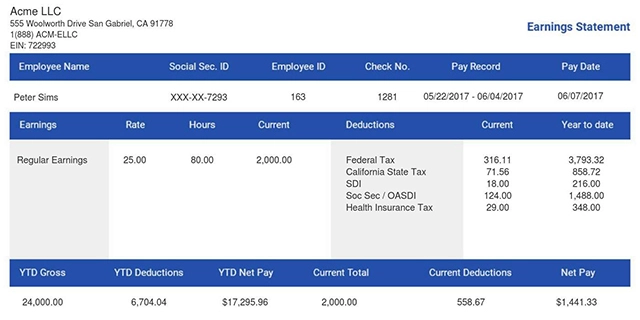
Pay stubs show payroll liabilities in two ways. Some appear as payroll deductions on the worker side. Others show up only on the employer's books.
Take a worker who earns $4,000 every 2 weeks. The pay stub might list these worker-side withholdings:
Employee Deductions (Withheld Liabilities)
- Federal income tax withheld: $440 (varies by W-4 elections)
- State income tax: Varies by state
- Social Security tax: $248 (6.2% of $4,000)
- Medicare tax: $58 (1.45% of $4,000)
- Health insurance premium: $200 (pre-tax)
- 401(k) contribution: $160 (4% of pay)
Employer-Side Liabilities (Not Shown on the Worker’s Stub)
- Employer Social Security match: $248
- Employer Medicare match: $58
- FUTA: $8.40 (0.6% on the first $7,000 of wages)
- Workers' comp premium: Varies by job class
- Employer health insurance share: Varies by plan
For each pay run, this single worker creates about $960 in extra employer tax and benefit liability on top of the wage amount.
Clear pay stubs are a key piece of payroll documentation. Here is a quick guide to what a pay stub looks like and how to read common pay stub deduction codes.
How To Pay Your Payroll Liabilities

Each item has its own payment path and due date. Workers get their wages by paycheck or direct deposit. Federal income tax and FICA payments go to the IRS through EFTPS using Form 941. FUTA is reported on Form 940 and filed each year. State income tax goes to your state revenue department.
Knowing the payroll tax deadlines for each form keeps you out of trouble with the IRS.
Here's a quick reference guide:
| Liability | Payment Method | Form | Due Date |
|---|---|---|---|
| Gross wages | Direct deposit or check | None | End of pay period |
| Federal income tax (withheld) | EFTPS | Form 941 | Monthly or semiweekly |
| Social Security and Medicare (FICA) | EFTPS | Form 941 | Monthly or semiweekly |
| FUTA | EFTPS | Form 940 | Annually (quarterly if over $500) |
| State income tax | State revenue portal | Varies | Varies by state |
| Workers' comp | Insurance carrier | N/A | Annual or per payroll |
| Benefits (health, 401k) | Carrier or plan | N/A | Per pay period or monthly |
| Wage garnishments | Court or agency | Varies | Per pay period |
Your EFTPS deposit schedule (monthly or semiweekly) is set by the lookback period. That period covers the 12 months ending June 30 of the prior year. If reported taxes were $50,000 or less, you are a monthly depositor. Above that, you are a semiweekly depositor. New employers start as monthly depositors for the first year.
How To Track and Manage Payroll Liabilities
Good tracking is part software and part habit.
1. Open a Separate Payroll Bank Account
Avoid mixing payroll funds with your main business account. Each pay period, deposit enough to cover net pay plus all required employer taxes and fees. This setup prevents you from accidentally spending payroll funds.
2. Set up a Payroll Liability Account in Your General Ledger
Payroll software will debit the right expense account. It will then credit the right liability account, such as wages payable or taxes payable. When you pay for each item, the software debits the liability and credits cash.
3. Use Payroll Software
Modern payroll tools handle wage math, tax filings, and deposits with built-in features. They also produce reports that show open liability balances at any point. Those reports help during audits. A trusted payroll service provider can take this work off your plate.
4. Reconcile Each Month
Match your payroll records to your general ledger and bank statements. Look for missing deposits, double posts, and missing withholdings. Monthly checks make these errors easy to find and fix.
5. Track Tax Law Changes
Federal and state tax rates, wage bases, and deposit rules change each year, including in 2026. Check the IRS website and your state revenue department often. Many payroll services update client accounts for these changes as part of their service. Sign up for IRS and state email lists to get alerts.
Numerical Example: One Pay Period, One Worker
A worker earns $4,000 biweekly. After payroll runs, the books show:
- Wages payable: $2,894 net pay
- Federal taxes payable: $440 (FIT withheld)
- FICA payable (worker): $306 (Social Security and Medicare)
- FICA payable (employer): $306
- Benefits payable: $360 ($200 health + $160 401k)
- FUTA payable: $8.40
- Total payroll liabilities: About $1,420 (not counting net wages)
Each of these balances must be paid in full and on time, or extra penalties will apply.
Common Payroll Liability Mistakes To Avoid
Even seasoned payroll staff make costly errors. Here are the big ones to watch for:
Misclassifying Employees as 1099 Contractors
Some employers label a worker as a contractor to avoid employer taxes, such as the FICA match, unemployment, and workers' comp. If the IRS finds the worker was misclassified, the employer can owe back taxes, penalties, and interest.
Missing the EFTPS Deposit Deadline
The IRS does not give much leeway on late deposits. Penalties stack up fast:
- 1 to 5 days late: 2% of the unpaid amount
- 6 to 15 days late: 5%
- More than 15 days late: 10%
- More than 10 days after a delinquency notice: 15%
Mixing Payroll and Operating Funds
Using payroll tax withholdings to pay regular bills is a fast track to the Trust Fund Recovery Penalty (TFRP). The IRS can hold owners, officers, and accountants personally liable for 100% of unpaid worker withholdings.
Ignoring W-4 Updates
Workers should update their W-4 after big life events, such as marriage, divorce, a new dependent, or a major income change. If the W-4 is outdated, withholding will be wrong and so will your payroll liabilities.
Best Practices for Managing Payroll Liabilities
- Know your deposit schedule. Before you run your first payroll for federal tax withholding, find out if you are a monthly or semiweekly EFTPS depositor. New employers start as monthly depositors. Mark each due date on your calendar with reminders.
- Keep cash on hand. Payroll never stops. Save enough to cover one full payroll cycle, plus a buffer for errors, and related taxes, such as SUTA and FUTA. Seasonal businesses need a bigger cushion.
- Segregate payroll funds. Keep IRS funds in a payroll account that is not used for any other purpose. Move funds from your operating account to the payroll account on each payday. Plan ahead for the last payday of the year.
- Keep records for four years. The IRS requires employers to retain W-4 forms, wage records, and tax payment confirmations for four years from the tax due date. Some states require longer.
- Run quarterly payroll audits. Each quarter, review your payroll liability accounts. Check deposit amounts, payroll software output, and any open balances. Fix small errors before they grow into big ones.
- Use full-service payroll software. A solid payroll processing tool runs payroll, tracks liabilities, files Form 941 returns, and updates rules as tax laws change. That keeps errors low.
- Document everything with proper pay stubs. Provide each worker with a stub listing the pay period, gross pay, all deductions, and net pay. Many states require this, and clear stubs serve as proof that wages and withholdings were processed correctly.
You Might Also Like
- Payroll vs. Compensation: What's the Difference?
- Payroll Management Tools for Small Business
- State Pay Stub Laws: What Employers Need to Know
- Pay Period Breakdown: How to Understand Your Pay Schedule
- Payroll Tax vs. Income Tax: What's the Difference?
Conclusion
Payroll liabilities are part of doing business when you have staff. As long as they are tracked, paid, and recorded on time, they should not cause stress. Maybe you run a small business with many tax due dates. Maybe you are a worker trying to read your own paycheck. Either way, knowing what each line means makes the whole process clearer.
Clear pay stubs that show income, withholdings, and what each side owes are one of the smartest steps you can take in 2026. You can create an accurate pay stub in minutes with the tool at ThePayStubs.com. Whether you are self-employed, an employer, or just need proof of income, it's a strong place to start.
- 1. Enter Your Information

- 2. Select Your Favorite Theme

- 3. Download Your Stub!

 By
By