

What Does Annual Salary Mean? A Clear 2026 Guide
 By
By
Job offers and loan forms often list a yearly pay number. But what does annual salary mean in plain words? It is the fixed pay your boss agrees to give you each year, before taxes.
This guide breaks it down. We will compare it to gross pay, net pay, and yearly income. If you need to show your pay in 2026, ThePayStubs.com can help.
Key Takeaways
- Your annual salary is the fixed yearly pay set in your employment contract. The number is before tax.
- Gross salary is the full amount before tax. Net salary is your take-home pay after deductions.
- For hourly work, the salary calculation is hourly rate times hours per week times 52.
- An annualized salary shows the full-year rate. It applies even when you work part of the year.
- Your pay stub shows your yearly pay, payroll taxes, and year-to-date earnings each pay period.
- Key Takeaways
- What Does Annual Salary Mean?
- What Are Gross Salary and Net Salary?
- What Does Annual Salary Mean vs. Annual Income?
- How To Calculate Your Annual Salary
- What Is Annualized Salary?
- Why Does Your Annual Salary Matter?
- How Annual Salary Appears on Your Pay Stub
- You Might Also Like
- Conclusion
What Does Annual Salary Mean?
Your annual salary is the total fixed pay your boss owes you each year. The number shows on your employment contract. It can cover a calendar year or a fiscal year. It does not count cash bonuses, sales perks, or overtime pay. This is your base pay. Payroll taxes and other items get pulled out later.
Your employer splits this yearly pay into monthly checks. So, what does annual salary mean for your real take-home pay? It means your gross pay, not your net pay. Net pay is what you keep after tax.
What Is Base Salary?
Base salary is the core pay your employer promises. It does not include bonuses, tips, or overtime pay. It is the heart of your total compensation package. You may see it shown as a range, like "$55,000 to $65,000." This range often sits on the offer letter or pay stub.
What About Prorated Salary?
Prorated salary kicks in when you start mid-year. The pay scales for the months you work. Let's say a job pays $60,000 a year. If you start on October 1, you only work three months that year. So, your pay for that year would be $15,000. That is one-quarter of the full $60,000 rate.
What Are Gross Salary and Net Salary?

Gross salary is the full pay you earn before any deductions. Net salary is your take-home pay after all deductions. Gross is what your boss promises. Net is what your bank gets.
Your gross annual income is your full pay before tax. Your net annual income is what you keep after taxes. Loan and rental forms often ask for gross income. Your offer letter shows the gross number, too.
A 2026 pay stub lists each withholding line. Federal tax comes off first. Social Security tax is 6.2% on pay up to $176,100. Medicare tax is 1.45%. Most states add their own tax as well. Health plans and retirement contributions to your 401(k) also come out. After all these deductions, you get your net pay.
Your gross yearly pay also drives your Adjusted Gross Income. The IRS uses AGI for tax filing. AGI helps set your tax credits and your final tax owed.
What Does Annual Salary Mean vs. Annual Income?
So, what does annual salary mean next to annual income? They are not the same. An annual salary is fixed pay from a single job. Annual income is all the cash you bring in.
Annual income covers more sources. It adds up base pay, bonuses, rent income, and self-employment income. It can also count Social Security checks and stock gains. Salary is one slice, while income is the whole pie.
People often mix up these two terms. Lenders and landlords care about annual income. They want the full picture. Let's say you earn $55,000 at your main job. You also pull in $8,000 from freelance work. Your annual income is $63,000. Report it right on the loan forms. Solid proof of income helps you get to yes.
How To Calculate Your Annual Salary

For salaried staff, your annual wage is set out in the employment contract. Each check shows a slice of it. The slice size depends on how often you get paid.
| Pay Frequency | Paychecks Per Year | Pay Per Check |
|---|---|---|
| Weekly | 52 | Yearly pay divided by 52 |
| Biweekly | 26 | Yearly pay divided by 26 |
| Semi-monthly | 24 | Yearly pay divided by 24 |
| Monthly | 12 | Yearly pay divided by 12 |
Here is a quick example:
A $60,000 job paid biweekly gives 26 checks. So, $60,000 split by 26 is $2,307.69 per check. But that is gross pay. After Social Security at 6.2% and Medicare at 1.45%, the check shrinks. Add federal and state tax on top. Your real take-home is much less. Read more in our guide on pay period breakdown.
For hourly workers, the math has more steps. First, find your hourly wage. Then multiply by your weekly hours. Then multiply by 52 weeks. Say you earn $20 an hour. You work 40 hours a week. Your gross yearly pay is $20 x 40 x 52, or $41,600.
Our guide on how to calculate your hourly and monthly income walks through more cases. It helps if your hours change week to week.
What Is Annualized Salary?
So, what is annualized salary? It is the full-year rate of pay. It applies even when you do not work the full year. Think of teachers who work 9 months or seasonal staff who work 6 months. Their pay rate is set as if they worked all 12.
Here is a simple case:
A teacher earns $54,000 as an annualized salary. She works 9 months out of the year. Her real take-home for those months is $40,500. But her annualized rate stays $54,000. Payroll uses this rate to set tax and benefit math. The annualized salary keeps pay fair and steady across short jobs.
The annualized salary on your offer letter shows the full-year picture. It tells you your true pay rate. It is not the same as total compensation. Annual compensation folds in bonuses, perks, and other extras.
Why Does Your Annual Salary Matter?
Your yearly pay shapes your money life. It sets your tax bracket and caps your 401(k) match. It also gates your loan, mortgage, or rental odds.
Most landlords ask for proof of pay. They want at least 2.5 to 3 times the rent in savings. So, a $1,500 rent often calls for $45,000 in the bank. Lenders want the same kind of proof. Your pay stub is the main paper they ask for.
Workers and families need to track yearly pay as well. It guides budgets and saves for goals. For HR teams, it drives clean payroll. The pay stub must show the right yearly figure. Year-to-date totals also flow from this number. Wrong numbers cause tax fights at year-end.
How Annual Salary Appears on Your Pay Stub
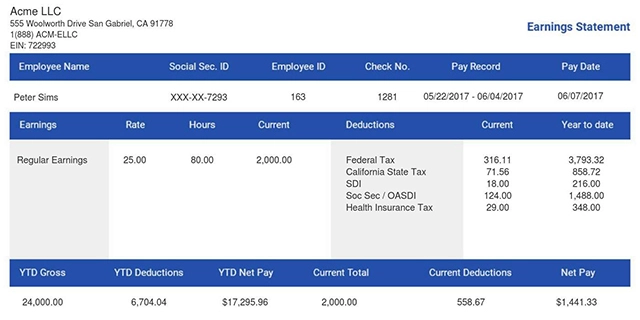
Your pay stub groups pay by cycle, like weekly or biweekly. Each stub shows current pay and year-to-date pay. Current pay is just for that period. Year-to-date pay is the total so far this year.
Take that $60,000 yearly pay paid biweekly. Each stub shows $2,307.69 in gross pay. Tax and other cuts come next. The net pay is what you take home. At year-end, your boss uses your gross total to fill out your W-2. The W-2 then drives your tax return. Read our guide to calculate W-2 wages from your pay stub.
Most offices keep pay stubs for years. Stubs help workers prove their income for rent or loan applications. They also back up tax forms during an audit. Self-employed folks often need stubs, too. A clean record of pay makes life easier all around.
You Might Also Like
- 6 Times You'll Need a Pay Stub as Proof of Income
- Paycheck Stubs: A Complete Guide
- How to File Taxes With Your Last Pay Stub
- Payroll Codes Explained
- How to Read a W-2 Like a Pro
Conclusion
Your annual salary drives your money life. It sets your taxes, your loans, and your rent options. Your gross yearly pay is the fixed amount before tax. Each pay period takes a slice of that pay. Tax and other cuts come off next. What you keep is your net pay. Hourly workers can find their yearly pay with simple math, too. Just use hourly rate times weekly hours times 52.
Need a clean pay stub for proof of pay? Try our pay stub creator at ThePayStubs.com. You can build a stub that shows your yearly pay, gross pay, and year-to-date totals. The stub looks just right for landlords, lenders, and tax forms.
- 1. Enter Your Information

- 2. Select Your Favorite Theme

- 3. Download Your Stub!

 By
By