

What Is a Payroll Register? Definition, Example & Best Practices (2026)
 By
James Wilson
By
James Wilson A payroll register tracks how much you pay each worker. It also lists tax withholdings and other payroll deductions taken from each paycheck.
This report is often used to file quarterly tax filings, check payroll expenses, and meet federal payroll recordkeeping rules. Self-employed workers can use a simple version to log income and build pay stubs.
This guide explains what goes into a payroll register, how to read it, and how to use it effectively.
Key Takeaways
- A payroll register lists each worker's gross pay, tax withholdings, employee deductions, and net pay for one pay period.
- Businesses use it to file Form 941, Form W-2, and other payroll tax reports each year.
- The Fair Labor Standards Act (FLSA) requires you to keep payroll records for at least three years.
- Freelancers and contractors can use the same format to log income and build a paycheck history.
- Key Takeaways
- What Is a Payroll Register?
- What Information Is on a Payroll Register?
- Payroll Register Example: A Step-by-Step Walkthrough
- How a Payroll Register Compares to Other Payroll Documents
- How to Use a Payroll Register
- FLSA Payroll Recordkeeping Rules
- How to Create a Payroll Register
- Using a Payroll Register for Income Verification
- Common Payroll Register Mistakes to Avoid
- You Might Also Like
- Conclusion
What Is a Payroll Register?
A payroll register is a list of pay details for every worker in one pay period. It shows hours worked, gross pay, tax withholdings, benefit deductions, and net pay. It also gives a total for the whole team. You need it to file payroll tax reports, plan payroll expenses, and follow federal payroll recordkeeping rules.
Some people call it the payroll register report. Others lean on the payroll register definition for short. Either way, it helps you answer the question "What is a payroll register?" It is a clear record of where wages go each pay period. It links the time each employee worked to the pay they took home.
You can build it in many ways. Some use a simple spreadsheet in Excel or Google Sheets. Others rely on payroll software that builds it for you. The register is more detailed than a payroll journal because it lists every line item. It is also broader than a pay stub, since a stub covers one worker for one pay period.
What Information Is on a Payroll Register?

Each row covers one worker for one pay period, and each column lists one piece of pay data. Together, they form a clear ledger of payroll expenses for the period.
- Employee name and ID: Names the worker the pay row is for.
- Pay period and pay date: Shows the dates the pay covers and when it was sent.
- Regular hours and overtime hours: Overtime pay is paid at 1.5 times the regular rate for most pay schedules.
- Pay rate: The hourly wage or salary used to figure pay.
- Gross pay: Total wages before any tax withholdings or deductions.
- Social Security withholding: 6.2% of gross wages, up to the 2026 wage base.
- Medicare withholding: 1.45% of gross wages, plus 0.9% on wages over $200,000.
- Federal income tax: Based on each worker's W-4 form and taxable wages.
- State income tax: Withheld if the state has an income tax.
- Employee deductions: Includes health premiums, 401(k) contributions, and other voluntary benefits.
- Net pay: Take-home pay after all payroll deductions.
- Employer contributions: Employer share of FICA, plus FUTA and state unemployment taxes.
The bottom row totals each column. Many reports also group payroll deductions by code, which helps you audit payroll faster.
Payroll Register Example: A Step-by-Step Walkthrough
Here is a small hardware store in Ohio. It has three workers and runs one payroll register each week.
- Sarah (full-time, $22/hour, 80 hours): Gross pay $1,760.
- Mike (part-time, $15/hour, 40 hours): Gross pay $600.
- Jordan ($18/hour, 40 regular hours plus 5 overtime hours at $27): Gross pay $855.
Jordan's row in the register reads:
- $720 regular
- $135 overtime pay
- $53.01 Social Security
- $12.40 Medicare
- $98 federal income tax
- $454.59 net pay after all deductions
The totals row sums up the team. In this case, total gross pay is $3,215. The total employer share of payroll taxes is around $246. The owner uses these totals for quarterly tax filings, including Form 941, which is sent to the IRS each quarter.
How a Payroll Register Compares to Other Payroll Documents

A payroll register, a pay stub, and a payroll journal all track pay, but they serve different needs.
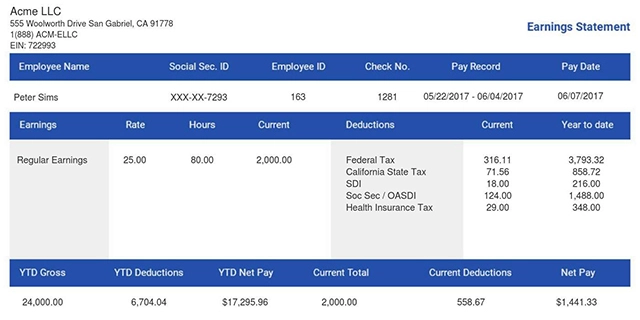
The payroll register report shows pay data for every worker. A pay stub shows the same fields, but for one worker, in one pay period. A payroll journal records how each pay event posts to the general ledger. Owners and HR staff use payroll registers. Workers use pay stubs to verify pay. Accountants use the payroll journal to track entries in the general ledger.
| Document | Covers | Primary audience |
|---|---|---|
| Payroll register | All workers, one pay period | Owners, HR, payroll staff |
| Pay stub | One worker, one pay period | Individual workers |
| Payroll journal | Accounting entries | Accountants, bookkeepers |
Some payroll software also builds a payroll details report that combines elements from all three.
How to Use a Payroll Register
Review your payroll register at the end of each pay period. Check it before you send direct deposits or print checks. Fixing a number on paper is far easier than fixing a wrong direct deposit.
Here is what to check each time:
- Verify gross pay. Make sure all hours worked are correct. Confirm salary amounts have not changed.
- Check tax withholdings. Social Security should be 6.2% of gross pay. Medicare should be 1.45%.
- Balance the math. Net pay should equal gross pay minus tax withholdings and other payroll deductions.
- Compare to last period. Look for big shifts in net pay before you approve them.
At the end of each quarter, run a payroll reconciliation. Check that the totals on your payroll register match the totals on Form 941 before you file. If they do not match, find the gap before you send the report.
Pro tip: Audit payroll on every pay run, not just at quarter end. Small errors add up fast. Five minutes of review now can save hours during quarterly tax filings or a Department of Labor audit. It also helps you catch issues before workers spot them on their pay stubs.
FLSA Payroll Recordkeeping Rules
The Fair Labor Standards Act requires every covered employer to keep payroll records for at least three years. The Department of Labor enforces this rule. It applies to most for-profit and non-profit groups with more than $500,000 in yearly sales. It also covers most firms that ship goods across state lines.
Many states ask for longer retention. California asks for three years of pay stub data. New York asks for six years. The pay stub generator at ThePayStubs.com makes it simple to store digital pay stubs without paper files.
Employers and workers should also keep tied records, such as time sheets, W-4 forms, benefit enrollment forms, and Form W-2 copies. These help you respond fast to an IRS notice or a Department of Labor audit.
How to Create a Payroll Register
You have two main options:
1. Manual (Spreadsheet)
You can build a simple payroll register in Excel or Google Sheets. Set up columns for employee name, hours worked, pay rate, gross pay, federal income tax, state tax, other deductions, and net pay. The upside is that it is free and flexible. The downside is that it takes time and risks math errors. For teams of 10 or more people, you may waste 40 hours a year on manual work.
2. Payroll Software
Most payroll software builds the payroll register report after each pay run. Tax rates update on their own. Direct deposit can run from the same screen. The cost is small for the time it saves. It also makes payroll reconciliation easier at quarter-end.
A blank payroll register template is also sold at office supply stores and can be copied as needed.
Using a Payroll Register for Income Verification
Owners use payroll register data to share business health with lenders, auditors, and workers' compensation carriers. The same payroll register template works for freelancers and contractors, too.
Self-employed workers can log income, payroll taxes, and deductions for each pay period. They can use these payroll records to plan quarterly tax filings and file estimated taxes. They also help when you need proof of income for an apartment, a mortgage, or a personal loan.
If you do not have access to your employer's payroll software, ThePayStubs.com can build authentic pay stubs that lenders and landlords accept.
Common Payroll Register Mistakes to Avoid
- Outdated withholding tables: Tax rates change on January 1. Update tables before the first pay run of the new year.
- Missed open enrollment: When health benefit deductions change, update them in the register before the next pay date.
- Skipping payroll reconciliation: Match register totals to the Form 941 totals each quarter. A gap can mean an IRS penalty.
- Adding new hires too late: Enter new workers in payroll before their first pay period, not after.
- Ignoring small errors: Even small gaps in tax withholdings can grow into big issues at year-end on Form W-2.
You Might Also Like
- Payroll and Compensation: What's the Difference?
- How to Request a W-2 from a Previous Employer
- Why Do Jobs Hold Your First Paycheck?
- FTE Meaning: What Full-Time Equivalent Means for Payroll
- Payroll Tax vs. Income Tax: Key Differences Explained
Conclusion
Clean payroll records protect your team, your taxes, and your time. A clear payroll register helps you check pay each period, file quarterly tax filings on time, and pass any audit with no stress.
You can build fast, professional pay stubs in minutes with ThePayStubs.com, your trusted online paystub generator.
- 1. Enter Your Information

- 2. Select Your Favorite Theme

- 3. Download Your Stub!

 By
By