

Payroll Software for Hospitality: 2026 Buyer's Guide
 By
By
Running payroll for a hotel or a restaurant isn't like running payroll anywhere else. You've got servers earning a $2.13 cash wage topped up by tips. There's a bartender who covered the door last Friday, and seasonal hires who won't be here in March. Meanwhile your POS holds the numbers that prove you paid everyone legally. Payroll software for hospitality exists to handle that mess. If you need clean records right now, our pay stub templates cover it. Most buyers, though, pick a platform without ever testing the parts that matter.
This guide skips the vendor rankings. Instead, you'll see what separates real payroll software for hospitality from software that merely runs payroll. We'll cover the features worth paying for and the tip rules your system has to enforce. Then the integrations that stop anyone retyping data, what it actually costs, and the questions that expose a weak platform.
Key Takeaways
- The federal tip credit lets you pay $2.13 an hour in cash wages, but only if tips bring the employee to $7.25
- Overtime is calculated on the full minimum wage, not the reduced cash wage
- Good software tracks hours by job code, not just by employee
- Your POS or property management system should feed payroll directly, or someone is retyping the numbers that prove compliance
- Keep the five tip records the Department of Labor requires
- What Does Payroll Software for Hospitality Actually Do?
- Key Features to Look For in Hospitality Payroll Software
- Tip Credit Rules Payroll Software for Hospitality Must Handle
- POS and PMS Integrations That Matter
- How Much Do Hospitality Payroll Services Cost?
- Hospitality HR Software vs Payroll-Only Tools
- Security, Support, and How to Vet a Vendor
- What Payroll Software for Hospitality Should Show on a Pay Stub
- How Do You Choose Payroll Software for Hospitality?
- Conclusion: Getting Hospitality Payroll Right
What Does Payroll Software for Hospitality Actually Do?
Payroll software for hospitality automates pay for tipped, hourly and multi-role staff. It pulls declared tips and clocked hours from your POS or property management system. Then it applies the right rate to each job code and calculates the tip credit and overtime. It also files payroll taxes and produces readable pay stubs.
That's a bigger job than it sounds, because hospitality payroll breaks the assumptions most payroll products are built on. Standard payroll assumes a salaried person doing one job at one location across a predictable pay period. Almost nothing in a hotel or restaurant looks like that.
Four things make the industry harder. First, pay arrives from two directions: what you pay directly, and what customers hand over as tips. Second, your hourly employees often work more than one role, and the pay rules change with the role. Third, labor costs swing hard by season and by week, so the headcount you priced your software against in January might double by July. Fourth, turnover in accommodation and food services runs far above the national average. That makes onboarding and final pay constant work rather than occasional events.
Put together, that's why generic restaurant payroll software tends to leak in this sector. The software calculates something plausible and nobody catches the error for months. The first sign of trouble is a wage claim, or an auditor asking for records nobody kept.
Key Features to Look For in Hospitality Payroll Software

Feature lists all look the same on a vendor website. These are the four areas where payroll software for hospitality either works or quietly doesn't, and they're the ones worth testing before you sign anything.
Tip and Gratuity Handling
The system needs to accept declared tips, apply the tip credit, and top up any workweek where the math falls short. It should also handle tip pools and keep credit card tips separate from cash, because they arrive on different timelines. Ask how the platform treats a shortfall week. If the answer is that a manager gets an alert and fixes it by hand, you've found a weak spot.
Time Tracking, Scheduling, and Shift Differentials
Time tracking has to run at the level you actually operate: by employee, by job code, by location, by day. The payroll codes behind those hours should be consistent across every property. Most vendors sell this as a time and attendance module, so check whether it's bundled into the quote or billed as a separate line. Shift differentials for overnight audit or holiday coverage should apply automatically rather than as a manual adjustment. If your employee scheduling lives in a separate tool, confirm that approved hours flow into payroll without an export and re-import.
Multi-Location and Multi-Rate Support
One person working two properties at two pay rates in one week is normal in the hospitality industry. It also breaks a surprising amount of payroll software. Check that pay rates attach to the role, not just the person, and that a multi-location group can run one payroll rather than five.
Tax Filing and Reporting
Payroll taxes should be filed for you, across every state where you operate, and pay stub requirements by state are not identical. You'll also want reports built for this industry. Think labor costs as a percentage of sales, overtime by department, and the tip summaries you'll need at year end. Generic products rarely ship these, which is a large part of why payroll software for hospitality exists as a category at all.
Tip Credit Rules Payroll Software for Hospitality Must Handle
This is where hospitality payroll gets genuinely legal, and it's the part vendors gloss over. The rules below come straight from the Department of Labor and the IRS. Any payroll software for hospitality you're considering has to enforce them.
The Tip Credit Math
Under the Fair Labor Standards Act, a tipped employee is someone who customarily and regularly receives more than $30 a month in tips. You must pay that person a direct cash wage of at least $2.13 an hour. The federal minimum wage is $7.25, so the largest tip credit you can claim is $5.12 an hour. If tips plus your cash wage don't reach $7.25 in a given workweek, you make up the difference. That top-up is assessed per person and per workweek, so tipped employees working slow shifts are where the exposure quietly builds.
There's a second number people mix up with the first. That $30 monthly figure is the FLSA test for whether someone counts as a tipped employee. The IRS uses a separate threshold. Employees must report cash tips to you once they hit $20 in a month, by the 10th of the following month. Two agencies, two numbers, two obligations. The Department of Labor's tipped employee fact sheet is worth reading in full before you sign with anyone.
State labor laws complicate this further. Where state law is more protective, the more protective standard wins, and several states require a higher cash wage or ban the tip credit outright.
Overtime When You Take a Tip Credit
Here's the error that costs operators the most money. When you claim a tip credit, overtime is calculated on the full $7.25 minimum wage, not on the $2.13 you actually hand over. The Department of Labor lists this among its typical problems, which tells you how often it happens.
Ask any vendor to show you the overtime calculation on a tipped employee's paycheck. If the base rate looks like $2.13, walk away. Run the numbers yourself with an overtime calculator before the meeting.
Service Charges Are Not Tips
A mandatory service charge, say the 15% you add to a banquet contract or a party of eight, isn't a tip under the FLSA. Money you distribute from service charges counts toward your minimum wage and overtime obligations. It also has to go into the regular rate when you calculate overtime.
If you run banquets, you're running two different pay mechanics through one payroll. Your system needs to know which is which.
Who Can Be in a Tip Pool
You can require tipped staff to share tips, but the pool has limits. If you take a tip credit, only employees who customarily and regularly receive tips can participate. Servers and bussers are in, and the kitchen isn't. Managers and supervisors can never take a share, and that includes owners holding at least a 20% equity stake who actively manage the business.
POS and PMS Integrations That Matter

Every vendor claims integrations. What matters is which direction the data flows and what breaks without it. Your POS system is the system of record for tips, so that one connection matters more than the rest combined.
Your declared tips and your hours by job code originate in the POS or the property management system, not in payroll. If those numbers don't move across automatically, someone is retyping the exact figures that evidence your tip credit. That's not a convenience problem, it's an accuracy problem, because the retyped version is the one you'll be defending if anyone asks. Weak integration is the single biggest source of avoidable error in payroll software for hospitality.
A workable PMS integration should carry hours, job codes, declared tips and department allocation into payroll processing without a manual export. Check the accounting side too. Payroll should push a journal entry to your general ledger with labor costs split the way your accountant already reports them.
One practical warning: an integration listed on a website isn't the same as an integration that's supported. Ask which specific version you'd be on, who maintains it, and what happens when the POS vendor ships an update.
How Much Do Hospitality Payroll Services Cost?
Most hospitality payroll services price one of three ways: per employee per month, per location, or a monthly base fee plus a per-person charge. Budget for extras too, including off-cycle runs, year-end filings and implementation. Price every quote at your real seasonal headcount, not your winter minimum.
That last point catches people out. A per-employee price that looks fine with 18 staff reads differently at 45 in August, and hospitality payroll services rarely prorate the way you'd hope.
Two tax forms belong in this conversation because they move real money.
Form 8027, the Employer's Annual Information Return of Tip Income and Allocated Tips, is required if you run a large food or beverage establishment. That means a business in the 50 states or DC where tipping is customary. It also has to normally employ more than 10 employees on a typical business day, measured by whether all your employees together average more than 80 hours a day. If reported tips come in under 8% of gross receipts for a payroll period, you have to allocate the shortfall.
Form 8846 runs the other way. It lets eligible food and beverage employers claim a credit for the Social Security and Medicare taxes they paid on employee tips. It's money back rather than another line of cost, and it's worth confirming your provider produces the figures you'll need to claim it.
Hospitality HR Software vs Payroll-Only Tools
Payroll is one purchase. Hospitality HR software is a bigger one, covering hiring, onboarding, document storage, scheduling and performance alongside pay.
Payroll alone is usually enough if your headcount is stable, your paperwork is manageable, and you're not hiring constantly. Most hospitality businesses sit somewhere in between, and the answer shifts the moment you start taking on seasonal employees in volume. The calculation changes when employee turnover picks up. Are you onboarding new staff most months, chasing tax forms and I-9s by email, or running a seasonal ramp every year? At that point the admin around payroll costs more than payroll itself.
| Your situation | Payroll-only is enough | You need a fuller HR suite |
|---|---|---|
| Headcount | Stable year round | Seasonal ramp every year |
| Hiring | Occasional | Onboarding most months |
| Documents | Handled in house | Chasing tax forms and I-9s by email |
| Scheduling | A separate tool is fine | Has to feed payroll directly |
A middle path exists: payroll with self-service. Staff update their own details, grab their own pay stubs, and stop routing every request through a manager. For many independent operators that solves 80% of the problem at a fraction of the price of a full suite.
Security, Support, and How to Vet a Vendor
Any payroll software for hospitality you shortlist will hold Social Security numbers, addresses and bank details for everyone who works for you. Ask where that data is stored and who internally can see it. Check whether the provider carries a recognized security audit, and what their breach notification process looks like. A vendor that can't answer plainly is telling you something.
Support matters more in this industry than most, because your busiest hours are when everyone else has gone home. Find out the actual support hours and the response time commitment. Ask if you get a named contact or a general queue. A payroll provider running weekday business hours is a poor fit for an operation whose payroll questions surface on Saturday night.
On reputation, read reviews for patterns rather than scores. Repeated complaints about support response or hidden fees tell you more than an average rating. Then ask for two references running a similar operation to yours, at similar size. A provider who won't connect you with a comparable customer is worth a second look.
Finally, use the trial properly. It should let you run a real payroll cycle on your own staff, your own job codes and your own tip data, not a sanitized demo account. If the only thing on offer is a guided walkthrough, you're buying on faith.
What Payroll Software for Hospitality Should Show on a Pay Stub
The output is the part people forget to evaluate. Every pay period, payroll software for hospitality has to produce a document that satisfies you, your employee, and anyone who audits either of you.
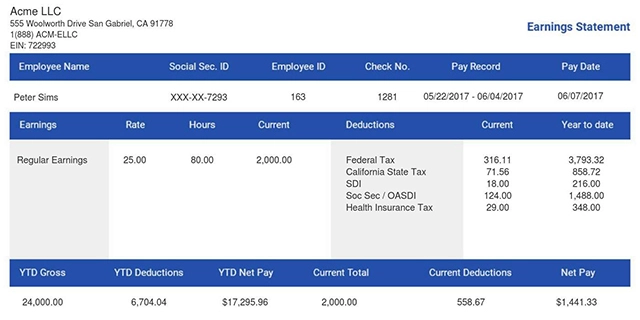
If you're unsure what a pay stub should look like in this industry, start here. A tipped employee's pay stub should clearly show:
- Hours worked, broken out by job code where someone worked more than one role
- The direct cash wage paid, at the rate actually used
- The tip credit claimed for the period
- Declared tips, separated into cash and credit card
- Overtime hours and the rate used to calculate them
- Deduction codes, taxes withheld, and net pay
If you take a tip credit, the Department of Labor requires you to keep five specific records:
- Each employee whose wage is partly determined by tips
- The tip amounts they reported to you
- The amount by which their wages were increased by tips
- Hours worked in non-tipped roles, with straight-time pay for those hours
- Hours worked in tipped roles, with the straight-time earnings for those
Good software generates these as a report. Weak software leaves you assembling them from three places at year end, alongside W-2 preparation.
There's a second audience here. Hospitality staff move frequently, and a clear pay stub is what a landlord or lender asks for. When employees can pull their own records through self-service or direct deposit statements, that's one less request landing on a manager mid-service.
How Do You Choose Payroll Software for Hospitality?
Work through six steps. List every pay type you run and write down each job code. Confirm the platform integrates with your POS or PMS, then price it at peak headcount. Test one real payroll during the trial and call two references in hospitality. Ask each vendor to demo one employee working two job codes in one week.
That last request is the sharpest tool you have, and it comes from a rule most buyers have never heard of. The Department of Labor's own example involves a hotel maintenance worker who also serves. That person is a tipped employee only for the server hours. No tip credit can be taken against the maintenance hours.
So the demo request writes itself: one employee, one week, two job codes, tip credit applied to one of them and not the other. Watch what happens.
- Inventory your pay types. Hourly, tipped, salaried, service charge distributions, shift differentials, bonuses.
- List your job codes. Anyone who works more than one is a test case.
- Confirm the integrations. Named, supported, current version.
- Price at peak. Use August headcount and every add-on fee.
- Run a real payroll in the trial. Your data, your edge cases.
- Call two references. Same industry, similar size.
If a platform handles the dual-role scenario cleanly and the references check out, you're most of the way to a decision. Plenty of vendors sell payroll software for hospitality in 2026. Far fewer can run yours.
You Might Also Like
- How to Get a Pay Stub From Direct Deposit
- How to Read a W-2 Like a Pro
- Employment Verification and Proof of Income Documents
- Should Independent Contractors Receive a 1099 Pay Stub?
- Pay Period Breakdown: How Pay Periods Actually Work
Conclusion: Getting Hospitality Payroll Right
Three decisions carry most of the weight. Get the tip mechanics right, because that's where the legal risk sits. Fix the integration, because manual re-entry is where accuracy goes to die. Then keep the records, because they're what protects you and what your staff need when they're applying for an apartment.
Everything else is preference. Payroll software for hospitality that nails those three will serve a 20-seat cafe and a 200-room hotel equally well. A platform that misses them will cost you more in corrections than you ever saved on the subscription.
Need professional pay records right now? Our paystub generator creates accurate, professional pay stubs in minutes. It's useful for documenting your own income, or for covering a gap while you switch providers.
- 1. Enter Your Information

- 2. Select Your Favorite Theme

- 3. Download Your Stub!

 By
By