

Vermont Paycheck Calculator: How Your Take-Home Pay Works (2026)
 By
By
A vermont paycheck calculator shows how much of your pay you actually keep. Vermont has some of the highest income tax rates in the Northeast. The top rate is 8.75%. This guide explains every number a vermont paycheck calculator uses. You will see how Vermont income tax, FICA, and tax withholding shape your take home pay. Need clean records fast? Our pay stub generator builds accurate Vermont pay stubs in minutes.
Whether you check your own pay or run payroll, the math is the same. This vermont paycheck calculator guide covers tax brackets, FICA, employer taxes, and ways to lower your withholding. Each section uses simple steps and real numbers. Your paycheck deductions include several taxes, and we break down each one.
Key Takeaways
- Vermont uses a progressive tax. It has 4 income tax brackets for 2026, from 3.35% to 8.75%.
- FICA takes 7.65% of your gross pay. That is 6.2% for Social Security and 1.45% for Medicare.
- Vermont has no local income taxes. Only state and federal taxes come out of your check.
- Employers must carry workers compensation, even with just one employee.
- Pre-tax 401(k) and HSA contributions lower both your federal and Vermont taxable income.
How the Vermont Paycheck Calculator Works
A vermont paycheck calculator turns your gross pay into net pay. It uses four inputs. These are your gross pay, your pay frequency, your filing status, and your pre-tax deductions. The tool then subtracts each tax to find your take home pay.
Four things come out of a Vermont paycheck. First is federal income tax. Second is Vermont state income tax. Third is FICA, which covers Social Security and Medicare. Fourth is any pre-tax benefit you pick.
Vermont keeps this simple. The state has no local income taxes. So a vermont paycheck calculator only needs state and federal numbers. Workers in Burlington, Montpelier, and Rutland all pay the same local rate, which is zero.
Your gross pay is your pay before any deductions. Your net pay is what lands in your bank account, often by direct deposit. Pre-tax plans like a 401(k) lower your taxable income. That raises your take home pay. A vermont paycheck calculator handles all of this for you.
Vermont Income Tax Brackets and Rates (2026)

Vermont follows a progressive tax model. As your income rises, your tax rate rises too. Vermont now has 4 income tax brackets, not 5. The top rate is 8.75% for the highest earners. The tables below show the 2026 brackets for each filing status.
Single Filers
| Vermont taxable income | tax rate |
|---|---|
| $0 to $47,900 | 3.35% |
| $47,901 to $116,000 | 6.60% |
| $116,001 to $242,000 | 7.60% |
| Over $242,000 | 8.75% |
Married Filing Jointly
| Vermont taxable income | tax rate |
|---|---|
| $0 to $75,000 | 3.35% |
| $75,001 to $193,300 | 6.60% |
| $193,301 to $294,600 | 7.60% |
| Over $294,600 | 8.75% |
Married Filing Separately
| Vermont taxable income | tax rate |
|---|---|
| $0 to $39,975 | 3.35% |
| $39,976 to $96,650 | 6.60% |
| $96,651 to $147,300 | 7.60% |
| Over $147,300 | 8.75% |
Head of Household
| Vermont taxable income | tax rate |
|---|---|
| $0 to $64,200 | 3.35% |
| $64,201 to $165,700 | 6.60% |
| $165,701 to $268,300 | 7.60% |
| Over $268,300 | 8.75% |
Vermont taxes apply to your taxable income. That is your gross pay minus the standard deduction and any adjustments. Most workers pay their state and federal taxes by April 15 of the next year. No city in Vermont charges a local income tax. The brackets above are the only state rates you face.
State Taxes Withheld from Your Vermont Paycheck: FICA, Social Security, Medicare
Vermont workers also pay federal payroll taxes. These include Social Security and Medicare, known together as FICA. Your employer must withhold them from every check. Here is how the rates break down.
- Social Security: 6.2% of your gross pay, up to a yearly wage cap.
- Medicare: 1.45% of your gross pay, with no cap.
- Combined FICA: 7.65% of your gross pay.
FICA is required by law. Your employer pays a matching 7.65%. Together that adds up to 15.3% of your pay. You only pay half. The Social Security tax has a yearly wage cap that the IRS updates each year. Medicare has no cap. High earners pay an extra 0.9% Medicare tax on income above $200,000.
Federal income tax is different for each worker. It depends on your Form W-4, your total income, and your dependents.
Self-Employed and Freelancers in Vermont
Self-employed workers pay the full 15.3% FICA. That covers both the employer and employee shares. You report this on your federal and Vermont returns.
Self-employed workers also make quarterly estimated payments. You can pay through the myVTax portal at myVTax.vermont.gov. Payments are due April 15, June 15, September 15, and January 15. Late payments can trigger penalties.
Vermont Paycheck Calculator Example: Step-by-Step Math

Let us walk through a real paycheck. Our worker earns $55,000 per year. She is single and paid every two weeks. That gives her 26 pay periods per year. These numbers are estimates. Use a vermont paycheck calculator for your exact figures.
- Gross pay per period: $55,000 / 26 = $2,115.38.
- Social Security: $2,115.38 × 6.2% = $131.15.
- Medicare: $2,115.38 × 1.45% = $30.67.
- Federal income tax: about $180 per check. This uses the single rate and the standard deduction.
- Vermont income tax: about $60 per check. Her income falls in the 3.35% bracket.
- Take home pay: $2,115.38 minus all taxes equals about $1,714.
So about 19% of this paycheck goes to taxes. That share drops if she adds pre-tax benefits. A 401(k) or a group health plan would lower it further. Many people also search for a vt paycheck calculator to run these numbers fast. The math stays the same across every tool.
Vermont W-4 and Withholding Setup
Two forms set your Vermont tax withholding. The first is the federal Form W-4. The second is the Vermont Form W-4VT. Your employer uses both to figure your withholding.
The current Form W-4 no longer uses allowances. You enter your name, address, and Social Security number. You also note other income, dependents, and any extra withholding you want.
Form W-4VT is the state add-on for Vermont. It tells your employer how much state income tax to withhold. Download it from the Vermont Department of Taxes at tax.vermont.gov. Update both forms after a big life change. Marriage, a new child, or a second job can shift your taxes.
Your employer then sets the right amount using the percentage method tables. These tables come from the IRS and the Vermont Department of Taxes. The total for each tax shows up on your pay stub so you can review it.
Vermont Payroll Taxes for Employers: SUI, Workers' Comp, and Filing Deadlines
Running payroll in Vermont means more than cutting checks. You also manage State Unemployment Insurance and workers compensation. At year end, you file reports for both with the state. Employers can use a vermont paycheck calculator to check withholding before payday.
Vermont State Unemployment Insurance (SUI)
Vermont sets SUI rates under Rate Schedule 3. The table below shows the current ranges.
| employer Type | SUI Rate Range |
|---|---|
| New employers | 1.0% (until experience rating established) |
| Experienced employers | 0.8% to 6.5% |
| Construction (Buildings) | 2.2% |
| Heavy & Civil Engineering | 3.9% |
| Specialty Trade Contractors | 2.8% |
The SUI taxable wage base is $14,300 per employee each year. Pay the full amount on time. In return, you can claim a federal FUTA tax credit of up to 5.4%.
Workers' Compensation
Every Vermont employer with at least one employee needs workers compensation insurance. A licensed commercial carrier must write the policy. You can find approved carriers at labor.vermont.gov, the Vermont Department of Labor site. This coverage pays medical bills and lost wages for on-the-job injuries.
Filing Deadlines
| Filing Type | Due Date |
|---|---|
| Monthly withholding (January) | February 25 |
| Monthly withholding (ongoing) | 25th of following month |
| annual withholding reconciliation (Form WHT-434) | January 31 |
| W-2 distribution to employees | January 31 |
| Electronic filing threshold | Required when submitting 25+ W-2 or 1099 forms |
File and pay online at the myVTax portal, myVTax.vermont.gov. Vermont does not join the Combined Federal and State Filing program. So you must file all W-2 and 1099 forms with the Vermont Department of Taxes. You also give copies to your employees.
How to Reduce Your Vermont Paycheck Tax Withholding
You can lower your Vermont income tax by lowering your taxable income. Pre-tax savings do this for you. They cut your federal taxes and your state taxes at the same time. A vermont paycheck calculator can show how each change affects your check.
Save in a 401(k) or 403(b). These plans use pre-tax money. They lower your taxable income for both federal and Vermont taxes. Say you add $500 a month to a 401(k). At a 6.6% state rate, that saves about $33 a month in Vermont tax. You also save on federal tax.
Open an HSA. An HSA needs a high-deductible health plan. You add pre-tax money for future medical costs. The funds grow tax-free. You can use them anytime for qualified care.
Use an FSA. A Flexible Spending Account also uses pre-tax money. It covers health or dependent care costs. Like an HSA, it lowers your taxable income and your Vermont tax.
Adjust your Form W-4VT. Do you get a big refund every year? That means you over-withhold. File an updated Form W-4VT with the Vermont Department of Taxes to fix it.
Vermont does not tax HSA contributions made through payroll. This matches the federal rule.
Vermont Tax Credits To Boost Your Take-Home Pay
Vermont offers many tax credits. Credits lower your final tax bill, dollar for dollar. A vermont paycheck calculator does not include credits. So you claim them when you file your return. The table below lists the main ones.
| Tax Credit | Amount |
|---|---|
| Vermont Child Tax Credit | $1,000 per qualifying child |
| Vermont Earned Income Tax Credit (EITC) | 38% of federal EITC (federal max ~$7,830 for 2024) |
| Vermont Child and Dependent Care Credit | 72% of federal credit (federal max $6,000) |
| Vermont Higher Education Investment Plan (VT 529) | 10% of first $2,500 annually per beneficiary |
| Vermont Credit for Charitable Contributions to VT Qualifying Organizations | 5% of first $20,000 in eligible contributions |
The Vermont EITC stands out. At 38% of the federal credit, it is one of the highest state matches in the country. Low and moderate income workers with children gain the most. Employers can share this list during onboarding or benefits enrollment.
Vermont Payroll Laws Employers Must Follow
Vermont sets clear rules for paying workers. These cover wages, pay stubs, and final paychecks. Here is what every Vermont employer must know.
Minimum Wage: Vermont's minimum wage is $14.42 per hour as of January 1, 2026. The state raises it each year for inflation. Tipped workers have a base wage of $7.21 per hour. Tips plus base pay must reach the full $14.42. If they do not, the employer makes up the difference.
Pay Stubs: Vermont employees get a written or printed pay stub each payday. The pay stub must list hours worked and wages earned for that pay period. You may use direct deposit and electronic pay stubs. But the worker must agree to electronic stubs in writing. See our state pay stub laws guide for a 50-state comparison.
Final Paycheck: A fired or laid-off worker must get their last check within 72 hours. A worker who quits gets paid on the next regular payday.
New Hire Reporting: Report new and rehired workers within 10 days of their start date. Send this to the state child support agency.
Record Retention: Keep payroll records for at least two years. After a worker leaves, keep their records for three years. Keep payroll tax records for four years.
Pay Frequency: Vermont requires weekly pay by default. With written notice, you may switch to biweekly or semi-monthly. Wages are due within six days after the pay period ends. See this guide on how pay frequency works.
You Might Also Like
- Payroll Processing: A Complete Guide for Employers
- Payroll Codes Explained: What Every Employee Should Know
- Payroll Liabilities: What Employers Are Responsible For
- Pay Period Breakdown: How Pay Cycles Work
- Gross Monthly Income: Definition and How to Calculate It
Conclusion
Your Vermont paycheck reflects several taxes. Vermont state income tax comes first. Federal income tax depends on your filing status and income. Then FICA takes 6.2% for Social Security and 1.45% for Medicare. Vermont adds no local income tax, so Burlington and Montpelier workers pay zero there. A vermont paycheck calculator makes these numbers easy to see and plan around.
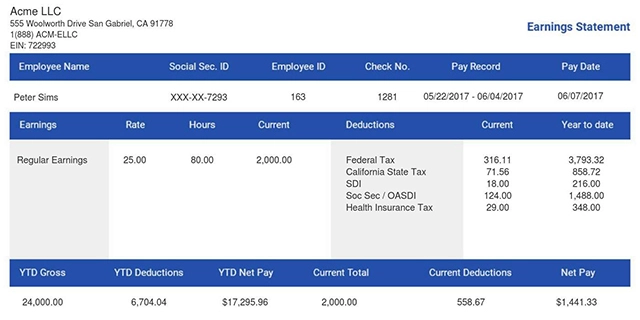
Create professional pay stubs for yourself or your team in minutes. Use our pay stub generator. No subscription required.
- 1. Enter Your Information

- 2. Select Your Favorite Theme

- 3. Download Your Stub!


 By
By