SIT Withheld Meaning: State Tax on Your Paycheck (2026)
 By
You open your pay stub and spot a line called "SIT" with money next to it. So what's the SIT withheld meaning? It's the state income tax your employer took out of this paycheck. That cash goes to your state for you, so you don't face one big bill in April.
Workers notice it when they hand a stub to a landlord or lender. Owners deal with it every time they run payroll or use a pay stub generator for their team. Below, you'll learn how to read that line, how the amount is set, and how to fix it.
Key Takeaways
- SIT means state income tax, and "withheld" means it came out before you were paid.
- The amount depends on your state, your pay, and your state withholding form.
- Nine states, including Texas and Florida, take no SIT from wages.
- Your SIT YTD total on the last stub of the year should match Box 17 on your W-2.
- You can change the amount by giving payroll a new state form.
- SIT Withheld Meaning: What Is SIT Tax?
- What Is SIT on My Paycheck? Codes to Know
- How State Withholding Tax Works
- How to Calculate State Tax Withholding
- State Tax Withholding Forms and Elections
- Does Texas Have State Income Tax Withholding?
- State Tax Withholding for Remote Employees
- SIT Withheld Meaning for Employers and Small Businesses
- How to Change Your SIT Withheld Amount
- SIT Withheld Meaning on Your W-2
- Conclusion: SIT Withheld Meaning in Plain Terms
SIT Withheld Meaning: What Is SIT Tax?
SIT stands for state income tax. "SIT withheld" is the amount of state income tax your employer took out of your pay before you got it. Your employer sends that money to your state's tax agency for you. At tax time, the total counts toward what you owe on your state return.
So what is SIT withheld in practice? It's a prepayment. The U.S. collects federal and state income taxes on a pay-as-you-go basis, so each paycheck chips away at the year's bill. Paid too much by tax time? You get a refund. Paid too little? You owe the gap. That's the SIT tax meaning in plain terms: money you've already paid toward state income taxes.
What Is SIT on My Paycheck? Codes to Know

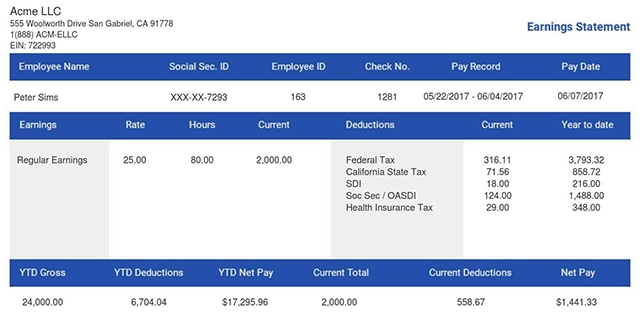
SIT on your paycheck is the line that shows state income tax taken out for this pay period. Most stubs show two numbers: the current amount and the year-to-date (YTD) total. You may also see it written as SITW, SWT, ST, or simply "State Tax," plus the two-letter code for your state.
Here's how SIT compares with the other payroll codes on a typical stub:
| Code on Stub | What It Means |
|---|---|
| SIT, SITW, SWT, ST | State income tax withheld |
| Res SIT | State tax for the state you live in |
| NR SIT | State tax for a state you work in but don't live in |
| FIT, FITW, FWT | Federal income tax withheld |
| SS or OASDI, MED | Social Security and Medicare (FICA) |
| SDI, SUI | State disability or unemployment insurance |
| Local, City | City, county, or school district tax |
A Quick SIT Check for Every Pay Stub
Once you know the SIT withheld meaning, checking that line takes about a minute.
- Right state: The state code should match where you work, or where you live if a reciprocity rule applies.
- Fair amount: In a flat-rate state, SIT should be close to that rate times your taxable pay.
- Steady YTD: The YTD total should climb by about the same amount each payday.
- No SIT where there's no tax: A stub from a Texas or Florida job that shows SIT is a red flag.
A clean tax section also makes your stub easier to trust as proof of income.
How State Withholding Tax Works
That SIT line doesn't come from nowhere. Wondering what is state withholding tax? It's the system behind that SIT line, and it runs the same way at almost every company:
- You fill out a form. New hires complete a state withholding certificate, much like the federal W-4.
- Payroll does the math. The employer applies the state's rate or tables to your taxable pay.
- The tax comes out. It's subtracted from your gross pay before your net pay is sent.
- The employer pays the state. Deposits are made on a schedule the state sets, often monthly or quarterly.
- Everything gets reported. The employer files state returns and lists your yearly total on your W-2.
That's state income tax withholding from start to finish. Each state sets its own rules, but the flow rarely changes.
How to Calculate State Tax Withholding

Start with your gross pay for the period. Subtract pre-tax deductions like a 401(k) to get taxable wages. Then apply your state's rate. Flat-rate states use one percent, such as 3.07% in Pennsylvania. Other states use tables based on your pay, filing status, and the allowances on your state form.
Here's a simple example for a Pennsylvania worker paid every two weeks:
- Gross pay: $2,000
- Pre-tax deductions: $0
- Taxable wages: $2,000
- SIT withheld: $2,000 x 3.07% = $61.40
Bracket states like California and New York take more steps. Payroll uses your yearly taxable income and filing status to find the right tax rate in the state's tables. Most state tax agencies publish their withholding tables or an online calculator, so you can check the number yourself. Pair that with the SIT withheld meaning above, and you'll spot errors fast.
State Tax Withholding Forms and Elections
Every new job comes with tax paperwork. Most states have their own state tax withholding forms, and a few common ones are:
- California: DE 4
- New York: IT-2104
- Illinois: IL-W-4
- Georgia: G-4
- Virginia: VA-4
- North Carolina: NC-4
Some states base withholding on your federal W-4 instead. In many HR portals, this step shows up as "state and local withholding elections" during onboarding. Skip it, and payroll may use a default that takes out more than you need.
Does Texas Have State Income Tax Withholding?
No. Texas has no personal income tax, so employers there do not take SIT from wages. Eight other states also skip it on wages in 2026: Alaska, Florida, Nevada, New Hampshire, South Dakota, Tennessee, Washington, and Wyoming. If you live in one of these states, a SIT line on your stub should read $0.
In these states, the SIT withheld meaning is simple: nothing comes out. Two more notes help here. New Hampshire ended its tax on interest and dividends for tax years starting in 2025. Washington taxes some large capital gains, but it doesn't touch your wages.
State Tax Withholding for Remote Employees
Remote work makes SIT a bit trickier. State tax withholding for remote employees usually follows where the work is done. If you live in one state and work in another, your employer may need to withhold for the work state. Your home state may then give you a credit for that tax, so you aren't taxed twice on the same pay.
Reciprocity deals change this. Illinois, for example, has deals with Iowa, Kentucky, Michigan, and Wisconsin. A Wisconsin resident who works in Illinois can file a form so only Wisconsin tax is withheld.
For owners, a remote hire in a new state can mean you need to withhold for that state and register there first.
What Res SIT Means on a Pay Stub
Res SIT is the resident state income tax line, which is tax for the state you live in. You'll see it next to an NR SIT line when you live in one state and work in another. The res SIT tax amount is often small, because your home state credits the tax you already paid to the work state.
SIT Withheld Meaning for Employers and Small Businesses
Owners see that line from the other side. For an owner, the SIT withheld meaning is a legal duty. Employers must take the right amount from each check, deposit it on time, and report it. Late or missing deposits can bring penalties and interest.
Make sure you avoid these common mistakes with withholding taxes:
- Paying a worker in a new state before you register there
- Missing an address change after an employee moves
- Using the federal W-4 when the state needs its own form
- Not keeping up with yearly changes in state tax laws
Accurate records matter to your team, since they use stubs to rent homes and get approved for loans. If you create stubs for your staff, make sure every tax line, including SIT, is filled in correctly.
How to Change Your SIT Withheld Amount
To change the amount, fill out a new state withholding form and give it to your employer or payroll team. Many companies let you do this online in the same portal you use for direct deposit. The change usually shows up within one or two pay periods.
Have side income or a second job? Ask for additional state withholding as a flat dollar amount per paycheck. It's an easy way to raise the amount of tax taken out without redoing your whole form.
SIT Withheld Meaning on Your W-2
At year end, your SIT totals carry over to your W-2. You'll find state withholding on W2 forms in three boxes:
- Box 15: Your state and the employer's state ID number
- Box 16: Wages taxed by that state
- Box 17: State income tax withheld for the year
Worked in two states? You'll see a separate line for each one. Box 17 should match the SIT YTD total on your last pay stub of the year. The IRS instructions for Forms W-2 and W-3 explain each box in more detail.
You Might Also Like
- How to Read a W-2 Like a Pro
- How to Read Pay Stub Deduction Codes
- How to Calculate W-2 Wages From a Pay Stub
- How Do You Get Your W-2 Online?
- What Does a Pay Stub Look Like?
Conclusion: SIT Withheld Meaning in Plain Terms
SIT withheld is your state income tax, paid a little at a time from each paycheck. Check that the state is right, the amount looks fair, and the YTD total matches your W-2. If anything's off, a new state form usually fixes it.
Running payroll for a small team or need clear records for yourself? Use our paystub generator to create accurate pay stubs that show every tax line, including SIT, in minutes.
- 1. Enter Your Information

- 2. Select Your Favorite Theme

- 3. Download Your Stub!

 By