

What Is a Blended Rate? Formula, Uses, and Payroll Guide
 By
By
Most borrowers carry at least two loans at different interest rates. When you consolidate or refinance, your lender quotes a single weighted number called the blended rate. That one figure, drawn from your multiple interest rates, decides whether the deal actually saves you money. This guide covers the definition, the formula, and when it helps. It also covers the payroll version: the blended wage rate, which shapes how employees' pay stubs reflect multiple hourly rates.
Key Takeaways
- A blended rate is the weighted average interest rate of two or more loans combined into a single monthly payment.
- To find it, multiply each loan's balance by its interest rate, sum the products, then divide by the total loan amount.
- A blended wage rate applies to payroll: the weighted average hourly rate when an employee works multiple roles in one week. Federal law requires it when figuring overtime pay.
- Not every consolidation benefits from one. Compare carefully before rolling existing debts into a single debt consolidation loan.
What Is a Blended Rate?
A loan's effective interest rate is often called its "blended rate." This blended interest rate is the combined rate of multiple loans merged into one loan. Banks and other financial institutions calculate it by weighing each loan's rate against its outstanding balance. They use it most in refinancing and debt consolidation. The result always falls between your lowest and highest rate.
You'll see it in mortgage refinancing, debt consolidation, and corporate debt. Some lenders call it a composite rate, a pooled cost of funds, or a weighted average interest rate. The terms all mean the same thing.
How Do You Calculate a Blended Rate?

To find the rate for your loans, weigh each loan's APR (annual percentage rate) against its balance, then combine them. Take two loans, each with an outstanding balance and an APR. Multiply balance by rate for each, add the products, then divide by the total loan amount. Example: $30,000 at 5% plus $20,000 at 8% = (1,500 + 1,600) ÷ 50,000 = 6.2%.
Follow these four steps:
- List each loan's outstanding balance and APR.
- Multiply balance by rate: $30,000 × 0.05 = $1,500; $20,000 × 0.08 = $1,600.
- Add the two products together: $1,500 + $1,600 = $3,100.
- Divide by the total loan amount: $3,100 ÷ $50,000 = 6.2%.
Compare this consolidated rate against any new loan you are considering. If the new loan's rate is lower than this figure, refinancing makes financial sense.
When Does a Blended Rate Help?
Four situations where it is most useful:
- Debt consolidation: Combine a personal loan, student loan, and credit card balance into one predictable monthly payment.
- Mortgage refinancing: This rate shows the true cost when you fold a low-rate or assumable mortgage into new financing.
- Variable rate protection: Lock in a blended fixed rate before your current variable rate climbs further.
- Multiple loans simplified: Roll all your debts into one loan. You cut paperwork and simplify repayment.
Most offers include hidden fees that can drive up the quoted rate. Always verify the actual APR in the contract before you sign.
What Is a Blended Wage Rate in Payroll?

In payroll, a blended wage rate is the weighted average hourly rate for an employee who works at two pay rates in the same workweek. Example: 20 hours at $14/hr + 10 hours at $17/hr = $450 ÷ 30 hours = $15/hr. The U.S. Department of Labor requires this weighted-average method for overtime pay.
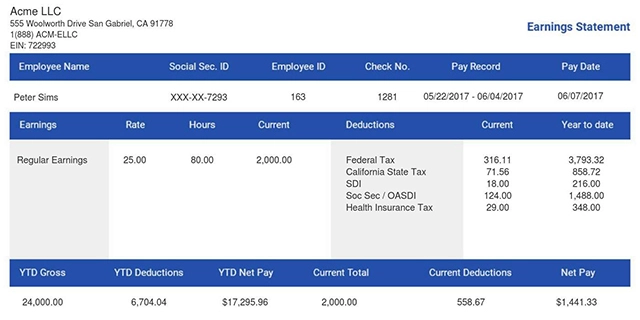
Under the Fair Labor Standards Act (FLSA), the blended wage rate is the regular rate for overtime in 2026, not either individual rate. Federal law does not require pay stubs, but many states do, so itemizing the blended overtime rate keeps multi-rate payroll clear.
Need accurate pay stubs for multi-rate employees? Use our paystub creator to document blended wage calculations correctly.
When a Blended Rate May Not Be the Right Choice
Three situations where it works against you:
- Rate outlier: If one loan carries a far higher rate, like an 18% credit card next to a 6% car loan, blending it with lower-rate debts dilutes your focus. Target that high-rate debt separately first.
- Debt avalanche method: This strategy targets the highest-rate debt first. Blending rates hides which debt to attack.
- Negotiating leverage: A strong credit profile can earn you better individual rates. You may beat any blended offer from a lender.
You Might Also Like
- How to Calculate Your Hourly, Weekly, and Monthly Income
- 6 Instances You'll Need a Pay Stub as Proof of Income
- What's the Difference Between Payroll and Compensation?
- Employment Verification and Proof of Income Documents
- How to Calculate W-2 Wages from a Pay Stub
Conclusion
The term means something different in finance and payroll, but the math is the same in both: a weighted average. Knowing both blended rate calculations helps you compare loan deals and stay compliant with payroll rules. For pay stubs that accurately reflect blended wage calculations, use a reliable paystub generator.
- 1. Enter Your Information

- 2. Select Your Favorite Theme

- 3. Download Your Stub!


 By
By