

What Is a Pay Period? Complete Guide for 2026
 By
By
Your pay period determines when your work is tracked, when payroll runs, and when your direct deposit arrives. Yet many employees can’t clearly identify when their current pay period starts or ends, or understand why it matters beyond simply knowing their payday.
That matters most when you apply for a rental or a loan. Lenders and landlords often ask for two to three recent pay stubs, and those stubs list your pay period dates to confirm steady income. A pay stub generator can help you create those records fast.
Employers also pay close attention to pay periods. The pay schedule a company chooses directly impacts payroll costs, cash flow planning, and compliance with state labor laws.
This guide covers the pay period definition, all common schedule types, and how many pay periods fall in a year. You'll also learn how to find your period dates on a pay stub.
Key Takeaways
- A pay period is the recurring time window (7, 14, 15, or 30 days) during which wages are earned and tracked.
- The biweekly pay period is the most common in the U.S., giving workers 26 paychecks per year. 43% of employers use it, per the Bureau of Labor Statistics.
- Pay period and payday are not the same. Payroll typically processes 2-4 days after the period closes.
- Your pay stub always shows your pay period start and end dates, which are useful for proving income.
- In 2026, biweekly employees receive three paychecks in both May and October.
What Is a Pay Period?
A pay period is a recurring time window, typically 7 to 30 days, during which an employee's work hours are tracked and wages are calculated. It has a fixed start and end date. When the period closes, the employer runs payroll and issues payment on the next scheduled pay date.
The pay period definition covers more than just timing. Each period captures your gross pay, tax withholding, and payroll deductions. Pay period meaning, pay cycle meaning, and payroll cycle all mean the same thing. They are the repeating schedule your employer uses to track earnings and pay you. Paycycle is another term you'll see on HR platforms. All three describe the frequency of your paycheck.
The per-pay-period meaning is straightforward. It means any figure tied to a single cycle. If your 401(k) contribution is listed as "$100 per pay period" on a biweekly schedule, that amount comes out of every individual paycheck.
What is pay period in practice? It sets your gross income for each check and your overtime status. Those same dates appear on every pay stub you'll use as income proof. So, what's a pay period at its simplest? It's the recurring earning window between one paycheck and the next.
Pay Period vs. Payday: What's the Difference?
A pay period is the recurring time window during which you earn wages. For example, January 20 through February 2.
Payday is the actual date your paycheck or direct deposit arrives, typically 2-4 business days after the period ends. An example is a pay period ending January 31, with a paycheck arriving on February 7.
When is pay day for most workers? Friday is the most common pay day in the United States. Your pay date falls after the period closes because payroll processing takes time. Employers need 2-4 business days to finalize hours, apply deductions, and send direct deposit transfers.
Pay period cutoffs also matter for overtime. Hours worked must fall within the current pay period to count toward that cycle's overtime calculation. Your pay stub shows the exact paydate and period end date, confirming which overtime hours landed in which check.
Types of Pay Periods

How do pay periods work? There are four standard pay schedules to know, plus one newer option that's changing how workers access their earnings.
Weekly Pay Period
A weekly pay period runs exactly 7 days and gives employees 52 paychecks per year. The weekly pay period typically runs Monday through Sunday, with paychecks issued 3-5 days after the period closes. Construction, manufacturing, and trade industries favor weekly schedules because they simplify overtime pay tracking for hourly workers.
Biweekly Pay Period
The biweekly pay period covers 14 days and produces 26 paychecks per year. According to the Bureau of Labor Statistics, 43% of U.S. private employers use biweekly pay schedules, making it the most common pay cycle. Both hourly workers and salaried employees work well on biweekly schedules. How long is a pay period on biweekly? Two full weeks, with pay days landing every other Friday for most employees.
Semimonthly Pay Period
Semimonthly pay period runs twice per month on fixed calendar dates, typically the 1st and 15th, for 24 paychecks per year. The per-check difference from biweekly is worth knowing. For example, a $60,000 annual salary breaks down to $2,307.69 per check biweekly (26 checks) versus $2,500.00 per check semimonthly (24 checks). Bigger checks, but fewer of them each year.
Monthly Pay Period
A monthly pay period covers a full calendar month, giving employees 12 paychecks per year. It's the least common option in the private sector and creates the most cash flow pressure for employees with fixed monthly bills. Government agencies and some educational institutions use monthly schedules.
On-Demand Pay
On-demand pay (also called earned wage access) lets employees access wages they've already earned before their scheduled pay date. Large employers like Amazon, Walmart, and DoorDash offer this through apps like DailyPay and PayActiv. On-demand pay doesn't change your official pay period. HR records still run on the standard schedule.
How Many Pay Periods Are in a Year?
The number of pay periods per year depends on your pay schedule. Weekly gives you 52 pay periods in a year; biweekly gives 26; semimonthly gives 24; and monthly gives 12. Most U.S. employers use biweekly. Occasionally, a biweekly schedule produces 27 pay periods in a year, depending on the calendar year's start date.
| Pay Schedule | Pay Days Per Year |
|---|---|
| Weekly | 52 |
| Biweekly | 26 (sometimes 27) |
| Semimonthly | 24 |
| Monthly | 12 |
Biweekly workers sometimes see 27 pay periods in a year when January starts early. Knowing "How many pay periods are there in a year?" can help with budget planning and tax withholding. In 2026, biweekly employees will receive three paychecks in both May and October. Those three-paycheck months are a great chance to build savings or make an extra debt payment.
How many pay days in a year your company runs also affects tax withholding. More pay periods mean slightly smaller per-period withholding amounts. You can use a payroll calendar to track your scheduled pay dates throughout the year.
How To Choose the Right Pay Period for Your Business
Choosing a pay schedule comes down to five factors. These include:
Employee Type
Hourly workers do better on weekly or biweekly schedules because shorter periods make overtime tracking easier. Salaried employees adapt equally well to biweekly or semimonthly. Your choice directly affects employee compensation budgeting and payroll management across your organization.
Cash Flow
Pay dates should align with revenue inflows. A retail business with strong weekend sales may prefer a Monday-to-Sunday weekly pay period so period revenue and payroll costs align.
Processing Costs
Weekly payroll runs 52 times per year versus 26 biweekly runs, doubling the admin load on your payroll software and HR team. Platforms like ADP and Paylocity typically charge per payroll run, so frequency directly impacts cost.
Legal Requirements
The Fair Labor Standards Act (FLSA) doesn't set a pay frequency, but state laws do. California requires semimonthly minimum pay for hourly workers. New York requires weekly pay for manual workers. Montana mandates biweekly or semimonthly as the minimum frequency. Check the Department of Labor's state payday requirements for rules in your state.
Employee Satisfaction
More frequent pay days boost morale and reduce financial stress. The fixed payment amount for each pay period helps employees manage their gross monthly income, budget rent, bills, and savings.
How Your Pay Period Appears on Your Pay Stub
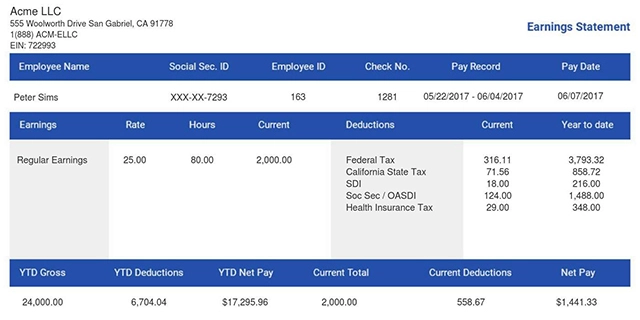
Every pay stub shows pay period dates near the top, typically labeled "Pay Period" or "Period Begin/End." Those dates confirm which work window your gross pay, tax withholding, and payroll deductions cover.
Those dates matter most for income proof. Landlords and lenders often request 2-3 consecutive pay stubs. They verify that the per-pay-period income is steady. Pay period end dates should fall within the last 30 to 60 days.
Your gross payment per pay period equals your annual salary divided by your number of pay periods. At $50,000 per year on a biweekly schedule, that's $1,923.08 per pay period before any deductions.
If you're self-employed or paid in cash, our guide on showing proof of income covers what lenders and landlords accept.
You Might Also Like
- How to Read Your W-2 Like a Pro
- Proof of Income If Paid in Cash
- Paycheck Stubs: What They Are and How to Get Them
- State Pay Stub Laws: What Employers Need to Know
- How to Tell the Difference Between a Real and a Fake Pay Stub
Conclusion
Your pay period is the foundation of your paycheck schedule. Knowing your pay cycle tells you how many paychecks you'll receive each year. It also shows when overtime hours count and what dates appear on your pay stub for income verification. In 2026, biweekly employees will see three-paycheck months in May and October. You can treat that extra check as a built-in savings opportunity or a chance to get ahead on debt.
Use a reliable paystub generator to create professional pay stubs in minutes. Easily include accurate pay period dates, gross pay, and all standard deductions.
- 1. Enter Your Information

- 2. Select Your Favorite Theme

- 3. Download Your Stub!

 By
By