

What Is a 401a? Plan Rules, Limits, and Withdrawals (2026)
 By
By
Most people know what a 401k is. Far fewer can explain the plan sitting next to it on their benefits statement, or spot it later on their pay stubs. Maybe you work for a school district, a city government, a public hospital, or a nonprofit. If so, you may have a 401a instead of a 401k, or alongside a 403b. So what's a 401a, and why does it look so much like a 401k?
The short version: a 401a retirement plan is funded largely by your employer, and your employer sets most of the rules. This guide covers how contributions work and what the 2026 limits are. It also walks through vesting, tax treatment, and withdrawal rules. Then it compares a 401a with 401k and 403b plans, and shows where the money lands on your pay stub.
Key Takeaways
- A 401a is an employer-sponsored retirement plan offered mainly by government agencies, public schools, and nonprofit organizations.
- Your employer controls eligibility, contribution rates, and the vesting schedule, and participation is often mandatory rather than optional.
- For 2026, total contributions to a 401a account cannot exceed $72,000, and only the first $360,000 of compensation counts toward the formula.
- Withdrawals before age 59 1/2 are taxed as ordinary income and often carry a 10% early withdrawal penalty.
- What Is a 401a Retirement Plan?
- How 401a Contributions Work
- 401a Contribution Limits for 2026
- Vesting: When the Money Is Actually Yours
- How 401a Tax Rules Work
- 401a Withdrawal Rules
- Is a 401a a Pension?
- 401a vs 401k
- 401a vs 403b
- What Happens to Your 401a When You Leave a Job
- Tracking 401a Contributions on Your Pay Stub
What Is a 401a Retirement Plan?
A 401a is an employer-sponsored retirement plan set up under Internal Revenue Code Section 401(a). It is offered mainly by government agencies, public schools, and nonprofits. The employer sets eligibility, contribution rates, and the vesting schedule. Participation is often mandatory. For 2026, total employer and employee contributions cannot exceed $72,000.
That last point is the one most explainers bury. In a 401k you decide whether to join and how much to defer. In most 401a plans your employer decides both, sets the eligibility requirements, and picks the investment options.
Several employer types can sponsor these plans: federal, state, local, and tribal governments, educational institutions from public schools to universities, public hospitals, and certain nonprofit organizations. Private-sector employers mostly use a 401k. In benefits paperwork the same plan may be called a money purchase plan or a profit-sharing plan.
One note on spelling. Plan documents use the formal 401(a), while most people type 401a or 401 a when they search. But what is a 401(a) exactly? It is the same plan, named for the section of the tax code behind it. Every 401(a) retirement plan follows that section, but the employer has wide latitude within it. And what is a 401a account, as opposed to a 401a plan? The account is your individual balance inside the plan.
How 401a Contributions Work

Money can reach your 401a account three ways, based on how your employer built the plan:
- Employer-only contributions. Your employer puts in a set percentage of your pay or a fixed dollar amount, whether or not you add anything.
- Employee-only contributions. You must contribute to take part, often a fixed percentage from each paycheck.
- Combination structures. Both you and your employer contribute.
Employer contributions are often non-elective. They arrive no matter what you do. Either way the amount is reported through your employer's payroll codes. They can also be matching contributions tied to elective deferrals into a companion 403b or 457b plan.
You will sometimes read that employee contributions are capped at 25% of pay. That is a common plan-design choice, not an IRS rule. The statutory ceilings are the annual dollar limit below and 100% of your compensation.
Government employers have one more option: pick-up contributions under Internal Revenue Code Section 414(h)(2). The employer formally treats your mandatory contributions as employer contributions, which changes how they are taxed.
For employers the math is attractive. Contributions are tax-deductible and exempt from Social Security and Medicare tax. A $100,000 contribution saves roughly $7,650 in payroll taxes at 7.65%.
401a Contribution Limits for 2026
The 401a limit for 2026 is $72,000. That is everything added to your account for the year, from you and your employer combined.
| Limit | 2025 | 2026 |
|---|---|---|
| Total annual contributions (IRC 415(c)) | $70,000 | $72,000 |
| Compensation that counts (IRC 401(a)(17)) | $350,000 | $360,000 |
| Grandfathered governmental compensation limit | $520,000 | $535,000 |
The compensation limit is the one almost nobody mentions, though it shares the plan's code section. Only the first $360,000 of your pay counts in your employer's contribution formula for 2026. If your plan contributes 10% of compensation and you earn $500,000, the calculation stops at $360,000.
One exception matters for long-tenured public employees. Some government plans allowed cost-of-living adjustments under the plan as in effect on July 1, 1993. Those participants use a higher compensation limit: $535,000 for 2026.
A second ceiling applies too. Total contributions can never top 100% of your pay. Someone earning $45,000 cannot get more than $45,000, no matter the dollar cap. All figures come from IRS Notice 2025-67.
Vesting: When the Money Is Actually Yours

Anything you contribute yourself is 100% vested right away. Employer contributions are different. Your plan's vesting schedule governs them.
Plans generally use one of two structures. Cliff vesting gives you nothing until a set date, then everything at once: 0% for two years, 100% in year three. Graded vesting phases ownership in: 20% after two years of service, rising in steps to 100%.
This matters most when you leave. Walk away before you are fully vested and you lose the unvested employer share. Your plan document names the exact schedule.
How 401a Tax Rules Work
The 401a tax treatment depends on who put the money in.
Employer contributions go in with pre-tax dollars, so they never hit your taxable income, much the way 401k contributions affect your MAGI. Your own mandatory contributions are made on an after-tax basis. The exception is a government employer that picks them up under Section 414(h)(2). Those count as pre-tax.
Once inside, everything grows tax-deferred: no annual tax on interest, dividends, or capital gains. Qualified withdrawals are taxed as ordinary income in the year you take them.
Unlike a 401k or 403b, a standalone 401a offers no Roth option. You cannot pay tax now for tax-free growth later.
Pick-up contributions have a quirk worth flagging. They are left out of your federal taxable wages. They still count for Social Security and Medicare tax. That is why the wage figures in different boxes of your W-2 will not match. Here is how to calculate W-2 wages from a pay stub.
401a Withdrawal Rules
You can normally withdraw from a 401a at age 59 1/2, or earlier after separation from service, disability, or death. Withdrawals before 59 1/2 are taxed as ordinary income and usually carry a 10% early withdrawal penalty, on top of the normal tax withholding rules. Required minimum distributions begin at age 73.
Your plan document also controls which events unlock the money: normal retirement age, leaving your employer, disability, death, and sometimes hardship.
The 401a withdrawal rules also work in the other direction: you cannot leave the money there forever. Once required minimum distributions start at 73, missing one is expensive. The excise tax on the amount you missed is 25%. Fix the shortfall within the IRS correction window and it drops to 10%.
One exception helps people who keep working. Say you are still employed past your RMD start age. If your plan allows it, you do not have to take money from that plan until you retire.
Is a 401a a Pension?
No. A 401a is a defined contribution plan, while a pension is a defined benefit plan. Your 401a balance depends on contributions and investment performance, with no guaranteed lifetime payment. Many public employees hold both, and some retirement systems make you choose once, for good, at hire.
The practical difference is who carries the risk. A pension promises a set monthly benefit for life, and the employer carries the investment risk. 401a retirement plans promise only what accumulates in your account, so the risk sits with you.
401a vs 401k
A 401k is technically a type of arrangement under Section 401(a), which is why the names look alike.
| 401a | 401k | |
|---|---|---|
| Typical sponsor | Government, public education, nonprofits | Private-sector employers |
| Who decides participation | Employer, often mandatory | Employee, voluntary |
| Who sets the contribution rate | Employer | Employee, up to the IRS limit |
| Employer contributions | Generally required | Permitted, not required |
| Employee contribution tax treatment | After-tax, unless picked up by a government employer | Pre-tax, with a Roth option in many plans |
| Investment menu | Usually narrower and more conservative | Usually broader |
The headline: a 401k is something you opt into and steer. A 401a is often something you are enrolled in, at a rate someone else chose. That trade defines most public sector benefit packages.
401a vs 403b
Employers in education and the nonprofit world often run both. The 401a holds employer money and the 403b holds employee deferrals.
| 401a | 403b | |
|---|---|---|
| Typical sponsor | Government, public schools, nonprofits | Public schools, 501(c)(3) organizations, religious institutions |
| Enrollment | Often mandatory | Voluntary |
| Employer contributions | Required | Optional |
| Investment vehicles | Mainly mutual funds | Custodial mutual fund accounts, annuity contracts, or church retirement income accounts |
| Catch-up contributions | Only if the plan allows employee contributions | Age 50, ages 60 to 63, and a 15-year service rule |
Both share the same $72,000 total ceiling for 2026.
What Happens to Your 401a When You Leave a Job
When you leave, you have three choices. You can leave the balance in the plan, roll it into a new employer's plan or an IRA, or cash it out. Cashing out before age 59 1/2 triggers income tax plus a 10% penalty. Any unvested employer contributions are forfeited.
Rollovers are the default choice because they keep the tax deferral intact. You can move the balance into a new employer's qualified plan, a 401k, or a traditional individual retirement account. If the plan pays you directly, you have 60 days to deposit it before it becomes a taxable distribution. It is also the moment to request a W-2 from a previous employer.
Tracking 401a Contributions on Your Pay Stub
This is the part almost no guide covers.
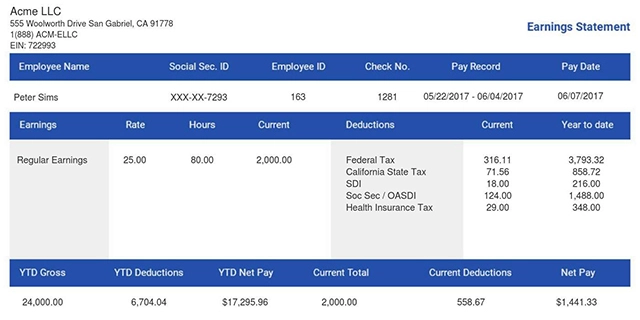
If your plan requires employee contributions, they come out of each paycheck. They appear as their own deduction line on your pay stub, often shortened so it does not clearly say "401a." Learning to read pay stub deduction codes makes it easy to spot. Employer non-elective money often does not show in your deduction column at all. That money never passed through your paycheck. Seeing nothing there does not mean nothing went in.
The effect shows up again on your W-2. Pick-up contributions reduce the federal taxable wages in Box 1. They do not reduce the Social Security and Medicare wages in Boxes 3 and 5. That is why those numbers differ.
Once a year, check your final pay stub against your plan statement. Mismatches usually mean a mid-year rate change or a missed pay period.
Those documents do double duty when a landlord or lender asks you to verify income. Pay stubs showing consistent earnings and retirement deductions are among the proof of income documents lenders ask for most often. Maybe your payroll system cannot produce a stub on demand. You can generate professional pay stubs at ThePayStubs.com.
You Might Also Like
- Employment Verification and Proof of Income Documents
- How to Read a W-2 Like a Pro
- What Is Adjusted Gross Income and How Do You Calculate AGI From a W-2
- W-2 vs Pay Stub: What Each Document Shows
- State Pay Stub Laws
Conclusion
A 401a retirement plan trades control for certainty. You give up most choices about joining, contribution rate, and investment menu. In exchange, your employer funds your retirement savings directly. For 2026 that account can receive up to $72,000, counting no more than $360,000 of your pay.
Two things are worth doing this week. Find the vesting schedule in your plan document, because it decides what you keep if you leave. Then check your next pay stub for the deduction line.
Need clean, accurate pay documentation for a loan, a lease, or your own records? Create a professional pay stub in minutes at ThePayStubs.com.
- 1. Enter Your Information

- 2. Select Your Favorite Theme

- 3. Download Your Stub!

 By
By