

What Is a Post Tax Deduction? Examples and 2026 Limits
 By
By
You're looking at your pay stub and there's a line you don't recognize. Your gross pay looks right, the taxes look about right, but your take-home pay is lower than you expected. So what is a post tax deduction, and why didn't it lower your tax bill?
Post tax deductions are one of the most misread lines on a pay stub, for employees and for the small business owners who run payroll. This guide covers the definition, the payroll sequence, the common examples, and how these differ from pre-tax deductions. It also shows you how to spot one on your own stub, what federal law says about garnishments, and how they appear on your W-2.
Key Takeaways
- A post-tax deduction comes out after taxes are calculated, so it never lowers taxable income.
- Roth 401(k) contributions, union dues, garnishments, and some insurance premiums are the most common examples.
- For insurance and spending accounts, pre-tax status depends on whether the plan qualifies under Section 125, not on the benefit's name.
- Federal law caps ordinary wage garnishments at 25% of disposable earnings.
- Post-tax amounts stay inside the wages reported in Box 1 of your W-2.
- What Is a Post Tax Deduction?
- How Post Tax Deductions Work in Your Paycheck
- Common Post Tax Deduction Examples
- Pre-Tax vs Post Tax Deductions: What's the Difference?
- What Is a Post Tax Deduction on Your Pay Stub?
- Wage Garnishments and the Legal Limits on Withholding
- How Post Tax Deductions Appear on Your W-2
What Is a Post Tax Deduction?
A post tax deduction is money withheld from your paycheck after all applicable taxes have already been calculated and withheld. Also called an after-tax deduction, it lowers your take-home pay but not your taxable income. Common examples include Roth 401(k) contributions, union dues, and court-ordered wage garnishments.
That last distinction is the whole point. A pre-tax deduction shrinks the pile of wages your taxes get calculated on. A post-tax deduction doesn't touch that pile. It comes out of what's left, so you already paid income tax and payroll taxes on that money. Payroll systems and accountants tend to call these "after-tax"; pay stubs say "post-tax." They mean the same thing.
These deductions split into two groups. Voluntary deductions are elections you made, like a Roth contribution, and you can start or stop them. Involuntary deductions come from a court or agency, and neither you nor your employer gets a say.
If you run payroll for a small team, this classification matters as much as the math. Calling a deduction pre-tax when it should be post-tax under-withholds taxes, and the business owes the difference.
How Post Tax Deductions Work in Your Paycheck

Every paycheck runs through the same five stages, in the same order:
- Gross pay. Everything you earned this period.
- Pre-tax deductions. Qualifying benefit premiums and traditional retirement contributions come out here, lowering the wages that get taxed.
- Taxes. Federal income tax and the FICA taxes for Social Security and Medicare come out first, then state and local income tax plus any state payroll taxes.
- Post-tax deductions. Everything in this article comes out at this stage.
- Net pay. What lands in your bank account.
Here's that with real numbers. Say you earn $2,000 biweekly and pay $150 toward a qualifying health plan. That $150 comes out first, so your taxable wages drop to $1,850. Taxes are calculated on $1,850 and total about $400 here, leaving $1,450. Your $100 Roth 401(k) contribution then comes out, making net pay $1,350.
Notice what the Roth contribution didn't do. Your taxable wages stayed at $1,850. The health premium moved that number; the Roth contribution didn't. That's the entire difference between the two categories.
Common Post Tax Deduction Examples
Some deductions are almost always post-tax. Others depend on the plan.
- Roth 401(k) and other after-tax retirement contributions. You pay income tax now, and qualified withdrawals in retirement come out tax-free.
- Union dues. Withheld after taxes and reported on your stub, not on your W-2.
- Group-term life insurance above $50,000 of coverage. Premiums under that threshold can be pre-tax; anything above it is taxable.
- Disability insurance premiums. Often taken post-tax deliberately, for a reason worth understanding below.
- Charitable giving through payroll and 529 contributions. Personal payments the employer processes as a convenience.
- Wage garnishments. Covered in their own section below.
The disability insurance case is the one most people get backwards. Pay those premiums with post-tax dollars and any benefit you collect later arrives tax-free. Pay them pre-tax and the benefit becomes taxable income at the exact moment you can't work. A little tax now beats a lot of it later.
Mandatory vs Voluntary Post Tax Deductions
Voluntary ones are what you signed up for: a Roth contribution, union membership, a workplace giving pledge. You can change or cancel those through HR.
Mandatory ones arrive as legal orders. Child support withholding, creditor garnishments, and tax levies fall here, and your employer faces liability for getting them wrong. The simple rule: you can decline every post-tax deduction on your check except a garnishment.
Pre-Tax vs Post Tax Deductions: What's the Difference?

The difference is timing. Pre-tax deductions come out of gross pay before taxes are calculated, so they lower your taxable income. Post tax deductions come out after taxes are withheld, so they reduce your take-home pay only. Insurance and spending-account benefits qualify as pre-tax only if they meet IRS Section 125 rules.
| Pre-Tax Deductions | Post Tax Deductions | |
|---|---|---|
| When taxes apply | After the deduction | Before the deduction |
| Effect on taxable income | Reduces it | No effect |
| Common examples | Health premiums, traditional 401(k), HSA, FSA | Roth 401(k), union dues, garnishments |
| Taxed when you use the benefit | Usually yes | Usually no |
| Effect on employer payroll taxes | Reduces them | No effect |
Here's the part most guides skip: the benefit's name doesn't decide which column it lands in. The plan structure does. Health insurance is pre-tax when it runs through a Section 125 cafeteria plan and post-tax when it doesn't. Same coverage, same premium, different tax treatment.
So don't memorize a list. For insurance and spending accounts, ask one question: does this benefit qualify under Section 125? If it does, it's pre-tax. If not, it's post-tax. Retirement plans run on a separate rule, which is why a traditional 401(k) lowers your income tax but still gets hit by Social Security and Medicare tax. Neither category wins outright. Pre-tax saves you money today; post-tax often saves you more later.
What Is a Post Tax Deduction on Your Pay Stub?
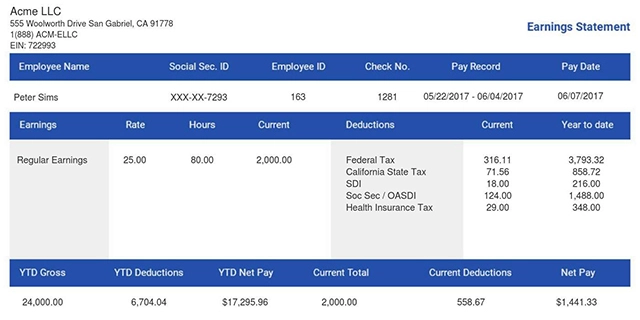
On a pay stub, post tax deductions are listed after taxes, usually in their own block below federal and state withholding. Look for codes like ROTH, GARN, CHSUP, UNION, or LIFE. The test: if subtracting the line from gross pay does not match your taxable wages, it is post-tax.
Most stubs use two blocks, though pay stub deduction codes vary by provider. These show up most often:
| Code on your stub | What it usually means | Post-tax? |
|---|---|---|
| ROTH, ROTH 401K | Roth retirement contribution | Yes |
| GARN | Creditor garnishment | Yes |
| CHSUP, CS | Child support withholding | Yes |
| UNION, DUES | Union dues | Yes |
| GTL, LIFE | Group-term life above $50,000 | Yes |
| CHAR, UW | Charitable giving through payroll | Yes |
| SEC125, PRETAX MED | Section 125 health premium | No, pre-tax |
| 401K | Traditional 401(k) | No, pre-tax |
If a code isn't on this list, run a 60-second check:
- Match the code to your elections. Compare the deduction name against your benefits and retirement paperwork.
- Ask payroll for the code description. Every system stores a plain-English description and, for voluntary deductions, a signed authorization.
- Check the date it started. A deduction still running after you changed coverage is the most common payroll error you can catch yourself, and it's far harder to unwind six months later.
Need pay documentation for a rental application or loan? Our pay stub templates make it easy.
Wage Garnishments and the Legal Limits on Withholding
Garnishments are the one post-tax deduction nobody can decline, but they aren't unlimited. Federal law caps how much can be taken, and knowing what a garnishment looks like on a pay stub helps you confirm the amount.
For ordinary debts like credit cards or medical bills, the ceiling is the lesser of 25% of your disposable earnings or the amount by which weekly disposable earnings exceed 30 times the federal minimum wage. At the current $7.25 minimum wage, that second figure is $217.50 a week. Earn less and nothing can be garnished.
Child support and alimony run higher: up to 50% if you're supporting another spouse or child, 60% if you aren't, plus 5% when payments are more than 12 weeks behind. Defaulted federal student loans are capped at 15%.
"Disposable earnings" is the term that trips people up. It's what's left after legally required deductions only, meaning taxes and mandatory retirement withholding. Your voluntary post tax deductions don't shrink that base, so you can't reduce a garnishment by electing more benefits.
One protection worth knowing: your employer can't fire you because your wages are garnished for a single debt. The full rules are in the Department of Labor's Fact Sheet #30.
How Post Tax Deductions Appear on Your W-2
Because post tax deductions come out after taxes, the money stays inside your reported wages. It sits in Box 1 and in the Social Security and Medicare wage boxes, exactly as if you'd taken it home, which is why you can calculate W-2 wages from a pay stub and still land on the right number.
Roth 401(k) contributions get their own entry in Box 12 under code AA, which lets the IRS track them against the annual limit. For 2026 you can defer up to $24,500, plus an $8,000 catch-up at age 50 or older, or an enhanced $11,250 catch-up at ages 60 through 63 under SECURE 2.0.
Union dues and life insurance premiums are different: they appear on your stub only and never reach the W-2. That mismatch drives most of the January confusion.
If you're the employer, keep the signed authorization for every voluntary post-tax deduction on file. That's what you'll need if an employee disputes a withholding.
You Might Also Like
- Payroll Codes Explained
- What Does a Pay Stub Look Like?
- Payroll Tax vs Income Tax
- How to Read a W-2 Like a Pro
- Balance of Net Pay Meaning
Conclusion
A post tax deduction comes out after taxes rather than before, which is why it reduces your take-home pay without reducing what you owe. Roth contributions, union dues, and garnishments are the ones you'll see most, and garnishments are the only category you can't decline. If a stub line still doesn't make sense, match the code, then ask payroll for the description and the authorization on file.
Need pay documentation your employer's system doesn't provide? Use a reliable paystub generator to create accurate pay stubs in minutes.
- 1. Enter Your Information

- 2. Select Your Favorite Theme

- 3. Download Your Stub!

 By
By