

Federal Mileage Rate 2026: New 76-Cent Rate Explained
 By
By
The federal mileage rate changed in the middle of 2026, and a lot of published guidance still hasn't caught up. On July 1, the IRS raised the business rate from 72.5 cents per mile to 76 cents. That means a single tax year now has two different numbers, and using the wrong one will misstate every reimbursement and deduction you calculate.
This guide covers both 2026 rates and which one applies to your trips. It also walks through the math, employer reimbursement rules, and how mileage should show up on your pay stubs.
Key Takeaways
- The business rate is 76 cents per mile from July 1 through December 31, 2026, up from 72.5 cents
- Apply the rate in effect on the date of the trip, not the date you file or get paid
- No federal law forces employers to reimburse mileage, though some states, including California, Massachusetts, and Illinois, require it
- Reimbursements paid under an accountable plan stay out of your taxable wages
- Employees can no longer deduct unreimbursed mileage, so getting reimbursed correctly matters more than ever
- What Is the Federal Mileage Rate?
- Federal Mileage Rate 2026: Current Rates
- How to Calculate Mileage Reimbursement
- What the Federal Mileage Rate Covers
- Historical Federal Mileage Rates
- Other IRS Mileage Rates: Charity, Medical, and Moving
- Do Employers Have to Reimburse Mileage?
- Taxes, Accountable Plans, and Your Pay Stub
- What the IRS Wants in a Mileage Log
What Is the Federal Mileage Rate?
The federal mileage rate is the per-mile amount the Internal Revenue Service sets each year, and the standard mileage rate is its official name. It values the cost of driving a personal vehicle for work. For business use it is 76 cents per mile from July 1 through December 31, 2026. It covers gas, maintenance, insurance, and depreciation in one figure.
The rate exists to keep things simple. Instead of tracking every fill-up, oil change, and insurance bill, you multiply your business miles by one number. The IRS studies what it costs to own and run a car each year, which is why the fed mileage rate drifts up over time.
It's a safe harbor, not a rule. Stay at or under it and the taxes stay simple.
What Is the Government Mileage Rate?
Type "what is federal mileage rate" into a search bar and you'll land on the same number as the government mileage rate. The labels multiply, but the figure doesn't: federal, standard, and IRS mileage rate all point to one IRS table.
Someone who quotes you a government rate for mileage means 76 cents for business driving in the second half of 2026. The same goes for anyone asking about government mileage reimbursement.
One genuine exception exists. The GSA sets its own travel rate for federal employees on official government business, and it doesn't automatically follow IRS mid-year changes. As of GSA's latest update, the rate for driving a privately owned car on federal travel is 72.5 cents per mile, not 76. Unless you work for a federal agency, government mileage in the everyday sense means the IRS number. Government reimbursement for mileage at the state or city level follows the same rules as any private employer.
Federal Mileage Rate 2026: Current Rates

Two sets of numbers apply to 2026 because the IRS issued a mid-year increase.
| Period | Business | Charity | Medical or military moving |
|---|---|---|---|
| Jan 1 to Jun 30, 2026 | 72.5 cents | 14 cents | 20.5 cents |
| Jul 1 to Dec 31, 2026 | 76 cents | 14 cents | 23.5 cents |
The rule for picking between them is simple: use the date of the trip. A client visit on June 28 uses 72.5 cents even if you submit the expense report in August. A delivery run on July 2 uses 76 cents even if it's part of a June-to-July pay period. Payment date and filing date don't matter.
That 3.5-cent jump is the first mid-year move since 2022, and it's the current federal mileage reimbursement rate for the rest of the year. At 76 cents, the US mileage rate works out to $38 on a 50-mile round trip. If you're asking how much per mile you can claim for business driving right now, that's your answer. The same business mileage reimbursement rate applies to employees and to self-employed people claiming a mileage deduction.
You can confirm the figures on the IRS standard mileage rates page. It lists every federal rate for mileage going back more than a decade.
How to Calculate Mileage Reimbursement
The formula is business miles multiplied by the federal mileage rate in effect for that trip.
Say you drove 400 business miles in September 2026. At 76 cents, that's 400 x 0.76 = $304. That's the standard mileage reimbursement your employer would pay tax-free. It's also the deduction you'd claim if you work for yourself.
A split year takes one extra step. Suppose you logged 1,200 business miles between January and June and 900 miles from July onward:
- First half: 1,200 x 0.725 = $870
- Second half: 900 x 0.76 = $684
- Total: $1,554
Running all 2,100 miles at 76 cents would have given you $1,596, overstating the claim by $42. Across a sales team that error compounds fast, so 2026 logs need to separate trips by period.
If you're an employer wondering how much to reimburse for mileage, the IRS rate is the usual default. It's what most employees expect, and it keeps the payment tax-free. The alternative is the actual expense method, where the driver tracks real costs like gas, repairs, insurance, and depreciation instead of applying a per-mile figure. It takes far more recordkeeping, and for a self-employed filer, choosing it in a car's first business year generally locks you out of the standard rate for that vehicle later.
What the Federal Mileage Rate Covers

Most people assume this is just a gas reimbursement. It isn't. The federal gas mileage rate label is misleading, because fuel is only one component.
The rate bundles:
- Fuel
- Maintenance and repairs
- Tires
- Insurance
- Registration and license fees
- Depreciation, usually the largest single piece
What it doesn't cover is commuting. Driving from home to your regular workplace is personal, no matter how far it is. Business travel starts when you drive between work sites, to a client, or to a temporary work location.
Historical Federal Mileage Rates
Business rates for the last several years:
| Year | Business rate (cents per mile) |
|---|---|
| 2026 (Jul 1 to Dec 31) | 76 |
| 2026 (Jan 1 to Jun 30) | 72.5 |
| 2025 | 70 |
| 2024 | 67 |
| 2023 | 65.5 |
| 2022 (Jul 1 to Dec 31) | 62.5 |
| 2022 (Jan 1 to Jun 30) | 58.5 |
| 2021 | 56 |
| 2020 | 57.5 |
| 2019 | 58 |
The federal mileage rate 2023 taxpayers used was 65.5 cents. The 2024 IRS mileage reimbursement rate rose to 67 cents. Mid-year changes are rare. Before 2026, the last one was 2022, when fuel prices spiked.
What Is the Mileage Rate for 2023?
The mileage rate for 2023 was 65.5 cents per mile for business use, 14 cents for charity, and 22 cents for medical or military moving. You'd only need it now for an amended return. The deadline to amend generally runs three years from the original filing date.
Other IRS Mileage Rates: Charity, Medical, and Moving
The federal mileage rate for business driving gets the most attention, but it isn't the only category.
Charitable driving is 14 cents per mile. The charity mileage rate is fixed in statute rather than adjusted for costs, so it hasn't moved in decades. Only miles for a qualified charity count.
Medical driving is 23.5 cents per mile in the second half of 2026. The medical and moving rates move together and cover trips to appointments, pharmacies, and treatment.
Moving is restricted to active-duty members of the Armed Forces relocating under orders. Everyone else lost the deduction for moving purposes, and it hasn't returned.
Do Employers Have to Reimburse Mileage?
No federal law requires employers to reimburse mileage, and there is no required minimum rate. A handful of states do. California, Massachusetts, and Illinois all mandate reimbursement for necessary work expenses. California Labor Code 2802(a) requires employers to cover all necessary expenditures employees incur doing their jobs, which includes business driving in a personal vehicle.
The text of California Labor Code 2802 is blunt. An employer must "indemnify his or her employee for all necessary expenditures or losses" incurred in the course of doing the job.
Outside those states, federal reimbursement for mileage is a matter of reimbursement policy. Plenty of employers reimburse employees below the IRS figure. That's generally legal, but two limits are worth knowing. First, if driving costs push a low-wage worker's effective earnings below minimum wage, that creates a separate wage-and-hour problem. Second, the federal reimbursement rate for mileage sets the tax-free ceiling. Anything above 76 cents per mile counts as taxable wages and runs through payroll under its own payroll code.
There's no official national average mileage reimbursement, but the IRS rate functions as the benchmark in practice. When workers compare notes on average mileage reimbursement, they're almost always comparing against that number. Government reimbursement for mileage at the state and local level typically tracks it too.
Taxes, Accountable Plans, and Your Pay Stub
How a mileage payment is taxed comes down to one question: does your employer run an accountable plan? Under IRS rules that means three things: a business connection, proof of the expense, and return of any extra advance.
Timing matters here. The rules give you 60 days to prove an expense and 120 days to hand back any extra advance. Miss those windows and a clean reimbursement turns into taxable income.
How Mileage Reimbursement Appears on a Pay Stub
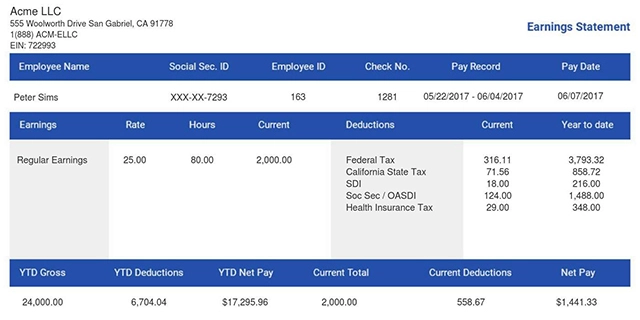
Under an accountable plan, the payment shows as a separate non-taxable reimbursement line. It stays out of gross wages, no income tax or FICA comes out of it, and it never reaches Box 1 of your W-2. Your gross pay and your net pay both reflect it correctly, but only the net side grows.
Under a non-accountable plan, the payment is wages. It goes into gross pay, gets taxed like salary, and lands in Box 1. If you see mileage folded into your regular earnings with tax withheld against it, that's what happened.
This matters if you use a pay stub as proof of income, since lenders read reimbursements and earnings differently. Keeping the reimbursement on its own line is what makes the wage figure readable.
Can Employees Still Deduct Unreimbursed Mileage?
For nearly all W-2 employees, no. The Tax Cuts and Jobs Act suspended miscellaneous itemized deductions, including unreimbursed employee expenses, for 2018 through 2025. That tax deduction was scheduled to return in 2026. The One Big Beautiful Bill Act, signed July 4, 2025, repealed the category permanently instead.
A few narrow exceptions remain: Armed Forces reservists, qualified performing artists, fee-basis state or local government officials, and workers with impairment-related expenses. Everyone else has one route left, which is employer reimbursement.
Self-employed people and independent contractors are unaffected. They still deduct business mileage on Schedule C, so a clean log directly lowers taxable income.
What the IRS Wants in a Mileage Log
Your record needs four things per trip: the date, the destination, the business purpose, and the miles driven.
Write it at or near the time of the trip. A log pieced together from memory in April is weak evidence. It's also the record that backs up whichever federal mileage rate you applied.
Odometer readings are where people over-complicate things. You don't need a start and end reading for every single trip. You just need to back up your total business miles, and odometer readings are one way to do it. A dated log with destinations and mileage does the job. An app, spreadsheet, or notebook all work.
You Might Also Like
- How to Read a W-2 Like a Pro
- How to Read Pay Stub Deduction Codes
- How to Calculate Tax on 1099-MISC Income
- Create a Self-Employed Pay Stub
- What Is Adjusted Gross Income and How Do You Calculate AGI From a W-2?
Conclusion
Two numbers govern the federal mileage rate in 2026: 72.5 cents through June 30 and 76 cents from July 1. Match the rate to the trip date and keep a log with the four required details, written as you go. Run reimbursements through an accountable plan so they stay out of your taxable wages.
For employees, reimbursement is now the only realistic way to recover driving costs, which makes accurate pay documentation more valuable than it used to be. If you need pay records that show reimbursements and wages as separate line items, our paystub generator builds them in a couple of minutes.
- 1. Enter Your Information

- 2. Select Your Favorite Theme

- 3. Download Your Stub!

 By
By