

Fully Insured Health Plans Explained: Costs, Alternatives, and Your Pay Stub
 By
By
If your company offers health coverage, someone had to decide who pays when an employee gets sick. In a fully insured plan, that someone is an insurance carrier. Your business pays a set premium, and the carrier covers the claims.
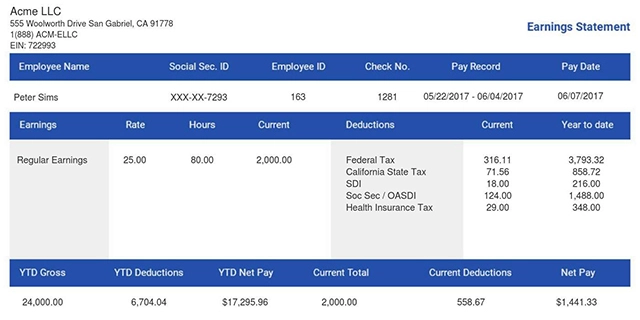
That single decision shapes your budget, your compliance workload, and the deduction line your employees see on every pay stub. Our pay stub templates show exactly where those deductions sit. Here's how this coverage works, what it costs heading into 2026, and when a different funding model makes more sense.
Key Takeaways
- A fixed premium buys risk transfer: the carrier pays the claims, and keeps the surplus if claims run low.
- In 2025, employer coverage averaged $9,325 for single and $26,993 for family coverage, with workers contributing $6,850 toward family premiums.
- Level-funded plans now reach 37% of covered workers at firms with 10 to 199 employees, making them mainstream rather than niche.
- Self-funding generally pays off above 200 employees, where claims volume is predictable enough to forecast.
- The funding model does not change how premiums appear on a pay stub. The employee share is still a pre-tax deduction.
What Does Fully Insured Mean?
Fully insured means an employer pays a fixed premium to an insurance carrier, and the carrier takes on the financial risk of paying employee medical claims. If claims run higher than expected, the carrier absorbs the loss. If they run low, the carrier keeps the difference.
This is the traditional group health arrangement most small employers buy. You agree to a rate for the plan year, and the carrier handles the network and the claims.
Some brokers use the term fully funded insurance to describe the same setup. It means the same thing: the premium is paid up front and the risk sits with the insurer, not with you.
The trade-off is control. You get a predictable number to budget against, but you don't see detailed claims data and can't customize much.
How the Premium Is Built

Your premium isn't one number. It's four things bundled together: the carrier's estimate of your employees' claims, its administrative fees, state premium taxes, and its own profit margin.
State premium tax and insurer margin shrink when an employer self-funds, because both still apply to the stop-loss premium.
Rates lock for the plan year, though your total moves with enrollment. At renewal, the carrier reprices on your group's claims history, so a bad year follows you.
There's no refund for a good year: the surplus stays with the carrier.
Comparing the Three Funding Models
This is usually framed as a two-way choice. There are really three, and the middle one is now the most common for small employers.
| Factor | Fully Insured | Level-Funded | Self-Funded |
|---|---|---|---|
| Who pays claims | Carrier | Employer, up to a cap | Employer |
| Monthly cost | Fixed premium | Fixed payment | Varies with claims |
| Refund if claims run low | None | Possible | Employer keeps it |
| Claims data access | Limited | Shared | Full |
| Main regulator | State insurance law | ERISA plus stop-loss terms | ERISA |
Self-Funded vs Fully Insured
A self-funded employer pays claims from its own money and hires a third-party administrator (TPA) to process them. Some carriers do that job themselves under an administrative services only (ASO) contract.
Most buy stop-loss insurance so one catastrophic claim can't sink the budget. Watch for lasering, where the stop-loss carrier assigns one high-cost employee a higher deductible, or drops them entirely, leaving that risk with you.
Level Funded vs Fully Insured
Level funding splits the difference. You pay a steady monthly amount that funds a claims account, administration, and stop-loss separately. Come in under projection and you may get money back. Run over and stop-loss absorbs it.
Some employers skip group coverage and reimburse individual premiums through an HRA, either an ICHRA (open to any employer) or a QSEHRA (only for employers averaging fewer than 50 full-time and full-time-equivalent employees, with no group plan).
Employers report wages the same way under all three models, so what a pay stub looks like doesn't change.
What Employer Health Coverage Costs in 2025

According to the KFF 2025 Employer Health Benefits Survey, annual premiums averaged $9,325 for single coverage and $26,993 for family coverage. Workers contributed an average of $6,850 toward the family premium.
Funding also splits by firm size. Sixty-seven percent of covered workers are in self-funded plans overall, but that breaks down to 27% at firms with 10 to 199 employees and 80% at firms with 200 or more.
Level funding fills the gap underneath, reaching 37% of covered workers at firms with 10 to 199 employees.
Because employees fund part of the premium themselves, that share also surfaces on the proof of income documents lenders and landlords ask for.
How Health Premiums Show Up on Your Pay Stub
Here's the part most benefits guides skip. The funding model doesn't change this: the employee share of the premium comes out through payroll.
On a pay stub, that share appears as a pre-tax deduction labeled "Medical," "Health," or a plan-specific code. Because it's pre-tax, it lowers taxable wages, so your gross pay won't match what gets taxed.
Many employers also display the portion they pay, often coded as ER Health, so employees can see the full value of the benefit. That line isn't money coming out of your check.
One practical check: a medical deduction that stays flat all year points to a fixed-premium or level-funded plan. But self-funded employers often hold contributions steady too, so ask HR.
Which Funding Model Fits Your Business?
Employer size drives this, though the bands are a broker rule of thumb. Fully insured plans suit employers under 100 employees who want predictable costs and minimal compliance work. Level-funded reaches well below that. Self-funding generally pays off above 200 employees, where claims volume is steady enough to forecast.
Compliance is the other half. Self-funded plans fall under ERISA, the federal law that keeps states from regulating them as insurers, so multi-state employers follow one plan design instead of 50 sets of state mandates. Payroll records stay separate, governed by state pay stub laws.
It comes with work. Self-funded plans with 100 or more participants file a Form 5500, all distribute summary plan descriptions, and nondiscrimination rules tax highly compensated individuals if a plan favors them. A carrier handles all of that, which often beats the savings for a small business.
Other Meanings of Fully Insured
Outside health benefits, the fully insured meaning changes entirely, and the search results reflect that.
In Social Security, the same phrase describes someone who has earned enough work credits to qualify for retirement benefits, generally 40 credits over a working life. It has nothing to do with employer health plans.
In construction and home services, a contractor advertising this way is claiming to carry liability coverage and workers' compensation. Ask for a certificate of insurance rather than taking the phrase at face value.
You Might Also Like
- Payroll Codes Explained
- How to Read a W-2 Like a Pro
- How to Calculate W-2 Wages From a Pay Stub
- Payroll vs Compensation: What's the Difference?
- What FTE Means for Employers
Conclusion
This model buys predictability. You pay a known premium, the carrier absorbs the claims risk, and compliance work stays light. That trade works for most employers under 100 employees, and the 2025 survey data backs it up. Above that size, level funding and self-funding start returning real money to employers willing to take on claims variability.
The premium still lands on a pay stub either way. If you need accurate pay records for your team or proof of income for yourself, our paystub generator builds professional stubs with deductions calculated for you.
- 1. Enter Your Information

- 2. Select Your Favorite Theme

- 3. Download Your Stub!

 By
By