

What Is a Statutory Employee? Rules and Examples (2026)
 By
By
Picture a W-2 with an empty federal income tax box and a checkmark in Box 13. That's a statutory employee arrangement. You're an independent contractor by most measures, but the Internal Revenue Service treats you as an employee for certain payroll taxes. Here's who qualifies and how the tax split works. We'll also cover what Box 13 changes, and how to document the income when your pay stubs and W-2 don't look like a standard employee's.
Key Takeaways
- A statutory employee is an independent contractor whom federal law treats as an employee for Social Security and Medicare taxes only.
- Four IRS categories qualify: certain drivers, full-time life insurance sales agents, home workers, and full-time traveling or city salespeople.
- Your employer withholds and matches FICA but withholds no federal income tax from your pay.
- Box 13 of Form W-2 is checked, and the Box 1 amount transfers to line 1 of Schedule C.
- Deducting business expenses on Schedule C is the main financial advantage of the classification.
- What Is a Statutory Employee?
- Who Qualifies as a Statutory Employee?
- Statutory Employee vs. Independent Contractor
- How Statutory Employees Are Taxed
- What Does Statutory Employee Mean on W2 Forms?
- Deducting Business Expenses on Schedule C
- Retirement and Benefits for Statutory Employees
- Proving Your Income as a Statutory Employee
What Is a Statutory Employee?
A statutory employee is a worker who counts as an independent contractor under common law. Federal law still treats them as an employee for Social Security and Medicare tax purposes. The employer withholds and matches FICA but takes out no federal income tax. Workers in this group receive a Form W-2 with Box 13 checked.
The statutory employee definition exists to close a gap. Congress decided a handful of occupations look a lot like employment. Those workers should get Social Security and Medicare coverage. The common law control test would still call them contractors. The statutory employee meaning is genuinely split: employee for FICA, contractor for nearly everything else. That split is why it confuses people, and why the W-2 looks unlike any other worker's.
Who Qualifies as a Statutory Employee?

Only four occupations qualify. The list covers certain commission or agent drivers and full-time life insurance sales agents. It also includes home workers using employer-supplied materials and full-time traveling or city salespeople. On top of fitting a category, the worker must meet all three IRS conditions below.
Statutory Employee Examples: The Four Categories
- Drivers. A commission driver or agent driver distributing beverages other than milk, or meat, vegetable, fruit, or bakery products. It also covers laundry and dry cleaning pickup and delivery. Picture a route driver restocking soft drinks.
- Life insurance sales agents. A full-time agent whose principal business is selling life insurance or annuity contracts, primarily for one company.
- Home workers. Someone working at home on materials the employer supplies and requires back, built to the employer's specifications.
- Traveling salespeople. A full-time traveling or city salesperson turning in orders from wholesalers, retailers, contractors, or hotel and restaurant operators.
The Three Conditions
Fitting a category isn't enough. All three of these must also be true:
- Your contract states or implies that you personally perform substantially all the services.
- You don't have a substantial investment in the equipment and property used for the work, other than transportation.
- You perform the services on a continuing basis for the same payer.
Miss one, and the IRS rules don't apply to you.
Statutory Employee vs. Independent Contractor
The common law test asks who really controls the work. It weighs behavioral control, financial control, and the parties' relationship, the same test that separates 1099 work from W-2 employment. This group fails it but gets employee treatment anyway, by statute.
| Statutory employee | Independent contractor | |
|---|---|---|
| Tax form received | Form W-2 | Form 1099-NEC |
| Social Security and Medicare | Employer withholds and matches half | Worker pays the full amount |
| Federal income tax withheld | No | No |
| Deducts expenses on | Schedule C | Schedule C |
A third group sits nearby. Statutory nonemployees count as self-employed for all federal tax purposes, and that group covers direct sellers, licensed real estate agents, and certain companion sitters. They get no W-2 and no employer FICA match, so their records look different too, usually a 1099 pay stub rather than a wage statement. If you and your employer disagree about which bucket you belong in, either party can file Form SS-8 and ask the IRS to decide.
How Statutory Employees Are Taxed

Here's where the classification earns its name. Your employer withholds Social Security at 6.2% and Medicare at 1.45%, then matches both out of its own pocket. That match is the real benefit. You cover half of FICA instead of the full 15.3% a self-employed person pays.
What your employer does not do is withhold federal income tax. The IRS instruction is blunt: do not withhold federal income tax from these wages. Nothing is set aside for your income tax bill. Most people in this position make quarterly estimated payments to avoid a shortfall in April.
Unemployment tax splits by category, which trips up employers:
| Category | Subject to FUTA? |
|---|---|
| 1. Drivers | Yes |
| 2. Life insurance sales agents | No |
| 3. Home workers | No |
| 4. Traveling salespeople | Yes |
What Does Statutory Employee Mean on W2 Forms?
It means your employer checked Box 13 to flag that FICA was withheld but federal income tax was not. IRS Publication 15-A directs employers to report these payments as other compensation in Box 1. You then carry that Box 1 figure to line 1 of Schedule C and check the box there.
A statutory employee W2 differs from a standard one in exactly three places: Box 1, Box 2, and Box 13. Publication 15-A spells out the employer's side of that reporting. It helps to know how to read a W-2 first.
What Is a Statutory Employee on W-2 Forms: Box by Box
- Box 1 holds your pay, reported as other compensation.
- Box 2 is normally blank, since no federal income tax was withheld.
- Boxes 3 and 5 show your Social Security and Medicare wages.
- Boxes 4 and 6 show the FICA amounts actually withheld.
- Box 13 carries the marked checkbox that drives all of it.
A Real Example
Say you drive a beverage route on commission and earn $52,000. Your form shows $52,000 in Box 1, nothing in Box 2, $3,224 in Box 4 for Social Security, and $754 in Box 6 for Medicare. The Box 13 statutory employee checkbox is marked. You carry that $52,000 to line 1 of Schedule C, check the box there, and subtract your route expenses. The same math lets you calculate W-2 wages from a pay stub.
Deducting Business Expenses on Schedule C
That checkbox unlocks the best part. You report the Box 1 amount on line 1 of Schedule C (Form 1040) and check the box on that line. Then deduct your ordinary and necessary business expenses: mileage, supplies, a qualifying home office, and the rest.
That matters because you're deducting against business income, not itemizing as an ordinary employee. And since your employer already withheld FICA, this income escapes self-employment tax.
One rule catches people out. If you have both self-employment income and statutory employee income, the IRS requires two separate Schedules C. That's common for anyone already making pay stubs for self-employment. You can't combine them on one form.
Retirement and Benefits for Statutory Employees
You can contribute to a simplified employee pension, or SEP, if your employer offers one. Eligibility runs on three tests. You're at least 21. You worked for the employer in at least 3 of the last 5 years. And you earned at least the SEP minimum compensation. That figure is $800 for 2026, up from $750 in 2025. Watch out for older articles still quoting $600, which hasn't applied since 2020.
Health insurance, paid time off, and retirement contributions aren't automatic either. Whether you get them comes down to what your employer's plan documents say, not to the classification itself.
Proving Your Income as a Statutory Employee
Here's the problem nobody warns you about. A landlord or mortgage underwriter sees an empty Box 2 on your W-2. It doesn't match the pattern they expect. That often triggers extra questions or paperwork requests.
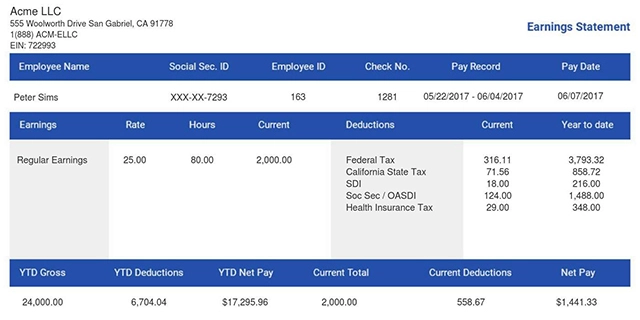
Keep three things on hand. Save period-by-period pay records showing gross pay and FICA withheld, the W-2 itself, and the Schedule C you filed. Those are the standard proof of income documents reviewers expect.
If your employer's records are thin, those same three documents are what you fall back on for employment verification requests from a lender or a new landlord.
You Might Also Like
- W-2 vs 1099: How Do You File Taxes When You Have Both
- How to Fill Out a 1099-MISC Form
- What Does a W-2 Income Statement Look Like
- Do 1099 Employees Get Pay Stubs: Full Guide
- Payroll Codes Explained
Conclusion
The classification is narrow by design: four occupations, three conditions, and one specific tax split. FICA is withheld and matched, while income tax is left entirely to you. What is statutory employee status actually worth? Mostly the Schedule C deduction, a real advantage when your job carries expenses.
Keep clean records. When you need professional pay documentation fast, our paystub generator creates itemized stubs in minutes.
- 1. Enter Your Information

- 2. Select Your Favorite Theme

- 3. Download Your Stub!


 By
By