

Payroll for Restaurants: The Complete 2026 Guide
 By
By
Running payroll for restaurants is unlike payroll in almost any other industry. Between tipped wages, servers working doubles across multiple locations, cash-versus-credit tip totals that never quite match, and line cooks who hit overtime in week three, a busy owner has a lot to track, and most small shops do it without a dedicated payroll department. If you'd rather skip the spreadsheet headaches when you need a quick document, you can build a clean pay stub in minutes with our pay stub templates. This guide walks through setting up your payroll system, claiming tip credits, staying compliant with federal and state labor laws, benchmarking your labor cost, and what your employees should see on their pay stub.
At its core, payroll for restaurants is the system you use to track and pay your staff: their wages, the various pay rates you've set up for different roles, and the federal and state labor laws you have to follow to calculate everyone's pay correctly. Once that system is set up properly, whether you build it in-house or hand it to one of the restaurant payroll companies that specialize in this work, even the messiest scheduling and tip scenarios become manageable.
This is the 2026 Guide to managing the complex process of payroll for restaurants including setting up the payroll system, claiming tip credits and employers’ liability, labor cost benchmarks and what employees should expect to see on their pay stub.
Key Takeaways
- Payroll for restaurants covers both tipped employees and those paid a fixed wage, often across many different pay rates. Many states also require employers to withhold FICA on tip income.
- The federal minimum wage for tipped employees (tipped minimum wage) is $2.13 per hour; employers must pay the difference between the employee’s tips and the minimum required wage of $7.25 per hour for every hour worked by a tipped employee.
- The labor cost of a restaurant typically averages between 25% and 35% of sales, depending on the restaurant type (casual sit-down, fine dining, or quick-service).
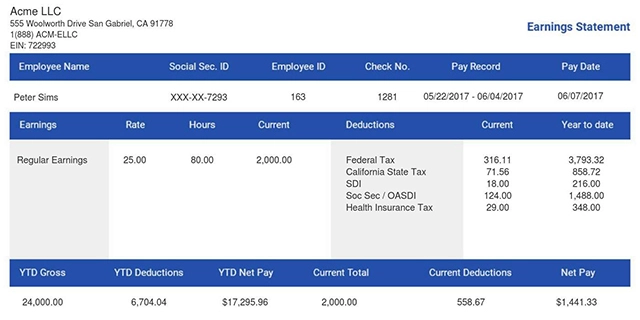
- Every employee is entitled to a pay stub, which should show gross wages (for all employees), declared tips (for tipped employees), and all deductions (such as federal and state income taxes).
- Restaurants must keep tip records for at least six years. Any employee who receives more than $30 per month in tips must report them, and the employer reports that tip income to the IRS.
What Is Payroll for Restaurants?
We service a lot of restaurants and every single one of them is vastly different. Typically restaurants are setup to track and distribute the wage of all hourly employees such as servers, tipped-line cooks, dishwashers and bussers. In addition they also pay out distributions to all of the salaried employees such as the Kitchen and General Managers for the restaurant. The key point is that there are many different types of wage that are tracked and distributed by restaurants and how you pay out distributions to hourly employees is very different than most other industries. As a starting point it would be good to have a general understanding of how most restaurants compensate their employees and then you can see just how unique the specific compensation for your restaurant is.
The first thing to recognize is that for most hourly employees in a restaurant their wage is comprised of a base wage and tips that they receive from their patrons. Because of this servers for example are required to report all of the tips that they receive to the employee’s state’s Employee Withholding Division, also known as the EW (the EW is typically part of the state’s Department of Revenue). That being said, the way that a server reports their tips can vary from state to state.
Typically servers are required to report all of the cash that they receive in tips, as well as all of the credit card tips that are charged to patrons’ cards, as well as any tips that are given to the server in the form of checks or other forms of payment. Once a server reports all of their tips for a given pay period, their employer is required to factor those tips into the employee's pay and tax withholding for that period.
In many states, most hourly employees in restaurants are considered “tipped employees.” As such, the restaurant must determine whether or not an employee is a tipped employee and calculate minimum wage for that employee based on the federal minimum wage for tipped employees of $2.13 per hour (or the applicable state minimum wage for tipped employees).
The restaurant must also determine how much in income taxes to withhold from the tips reported by a tipped employee in order to meet their obligations. The process for paying tipped employees includes tracking the number of hours worked by each tipped employee in each class of tip earning employees and determining how much each employee earned in tips for each pay period. The owner of the restaurant must then review each employee’s total compensation for the pay period to ensure that the employee earned at least the amount necessary to bring their total compensation up to the minimum wage for that pay period (if applicable). If an employee did not earn enough in cash wages to bring their total compensation up to minimum wage for the pay period, the owner must make up the difference in cash wages for that pay period.
Most employees at a restaurant are paid as hourly employees and the restaurant owner is required to calculate the time worked by the hourly employees and their pay for them. However, some employees such as managers are paid as salaried employees and the pay for these employees would also need to be calculated by the restaurant owner.
Also as an employee of a restaurant, you have the right to know how much you are being paid. You should receive a check each week that itemizes the following: 1) Your total gross wages for the week; 2) Your total tips reported for the week; 3) Your total amount of overtime pay due for the week; and 4) The total amount of deductions from your wages for the week.
Key Challenges of Restaurant Payroll Management

Restaurant payroll management comes with challenges that most other service businesses never face. The good news is that almost all of them can be avoided if you know what to watch for ahead of time.
Fluctuating Hours and Shift Changes
Record changes to employees’ schedules on time. Also, ensure all hours worked are accurately recorded in the payroll software. Inaccurate recording of hours of work could mean that employees are underpaid for the hours that they actually worked. Furthermore, owners can be held liable for paying overtime when employees are not. Without documentation of hours worked by employees, wage claims could be filed against owners.
Tip Tracking and Tip Credits
In many states, employers must report the amount of tips earned by employees to the IRS annually. Many states also allow employers to pay a reduced cash wage and take a tip credit on the difference between that cash wage and the full minimum wage for hourly employees. The total amount of wages earned by the employee, including tips, must equal the minimum wage for each hour worked for employees classified as tipped employees under the FLSA. If errors are made in the application of the tip credit for a reduced cash wage for tipped employees, the employee’s total wages for hours worked may be found to be less than the minimum wage for that employee’s hours worked in an Department of Labor audit of an employer’s payroll for restaurants for example. The resulting financial penalties for such errors can be very severe.
Multi-Rate Employees
Servers that also work as Hosts are paid at two different rates in the same week. In addition to tracking two different rates of pay, the employer must also track and pay overtime for each rate of pay separately.
High Staff Turnover
Restaurant employers face special challenges processing the pay of their employees, particularly servers, who can have as much as 50-75% of their total annual compensation come in the form of cash and other tips. In addition, as much as 100% or more of the employees of a single restaurant may turnover every year. When new employees are hired, the new employee will complete a W-4, I-9 form and state income tax forms as required, and then must be set up for processing of their compensation as a employee of the restaurant. A good system for the onboarding of new hire employees is critical in avoiding some of the typical problems encountered in processing the new hire’s pay.
Multi-Location Complexity
For restaurants with more than one location, complying with pay laws can become particularly complicated. Restaurants with locations in different states or local governments with different tax rates and regulations will need to report and pay withholdings to each state or local government. The problem becomes more complicated for a restaurant that has employees who work at more than one location during the same pay period. In such a case, the restaurant will need to track hours for each employee works at each location during the pay period in order to correctly calculate employee withholdings and pay for each location. Using a manual spreadsheet to calculate employee pay can greatly increase the chances of errors such as underpaying or even violating wage and hour laws.
Tracking employees hours on a spreadsheet can lead to serious problems. With errors of underpayment of wages, wage claims, incorrect tax payments and fines for non compliance, manual hour tracking can be a real headache and cause many problems. A simple misplaced decimal or a missed shift here and there and you could be in serious trouble.
How to Set up Payroll for Restaurants in 2026
Setting up payroll for restaurants takes a handful of one-time steps, then a repeatable process you run each pay period. Below, we walk through the setup from start to finish so you can get your first run right and avoid the compliance mistakes that trip up new owners.
- Get your Federal Employer Identification Number (EIN). The EIN is applied for on the IRS government website free at IRS.gov/businesses. You will need to apply for the EIN before you are able to run your first payroll, open a business bank account, etc. You will need to list the EIN on your tip pooling and other documents as well.
- Register for state and local tax IDs in every state where you have employees. Every state has different registration requirements for employer accounts for state taxes (like state income taxes). Some cities may also require registration of local tax accounts.
- Open a separate bank account for your restaurant’s payroll. A separate account for your restaurant’s payroll can help eliminate confusion with your cash flow and make tax reconciliation easier.
- Pay Periods / Scheduling: Most Restaurants choose a biweekly pay period to coincide with the 15th and 30th of the following month and/or a weekly pay period. There are many scheduling options available to payroll teams.
- Determine your payroll method. Decide whether you'll run payroll for restaurants in-house (handling it yourself with software) or outsource it to a restaurant payroll service or third-party payroll processing company.
- Set up tip reporting before your first pay period. The two common setups are for cash-paying employees who report their own cash tips and for employees whose tips come through credit card processing in your restaurant's Point of Sale (POS) system. Credit card tip data will need to be imported into your payroll software each period.
- Collect new-hire paperwork. Before processing anyone's first paycheck, gather a completed W-4, a signed I-9, and a copy of their ID (front and back). For a fuller rundown, see our guide to employment verification documents.
- Multiple Pay Rates for Multi-Roles Employees: In many cases a single employee would work as a Bartender and as a Server. The system would need to calculate and pay the correct rate for each of those roles for that employee.
Restaurant Payroll: Step by Step

There are several things to remember when running payroll for restaurants. First, pay your employees on a regular basis (i.e. every week or every two weeks) and keep accurate records. If an employee works additional hours or performs special services for which they receive additional pay, that additional pay must be included when processing their regular pay. Also, if an employee works in more than one role, you must also calculate their regular rate of pay for each role and process additional pay accordingly. Finally, if an employee in your establishment qualifies for overtime, you must also process their overtime compensation in addition to their regular pay.
Step 1: Gather information for all employees for the upcoming pay period. Depending on how you are tracking hours for your employees, the information for processing payroll may come from a variety of places. Common sources include time clocks, online scheduling systems, point of sale systems, etc. Make sure to verify the following: correct start and stop times for all shifts worked by employees for the pay period, accurate recording of all shift changes for employees during the pay period, correct recording of all roles performed by each employee for the pay period.
Step 2: Calculate Gross Pay. Add up each employee's total hours for the workweek, then multiply by their pay rate(s). Overtime is calculated at 1.5 times an employee's regular rate for all hours worked beyond 40 in a workweek. Tips declared by employees on credit card transactions are also added to gross pay for federal tax withholding purposes.
Step 3: Apply any additional cash wage required by state law (tip credit) Some states require an additional cash wage on top of tips. Determine if any additional cash wage is required and verify that the total of tips plus cash wage equals or exceeds the minimum wage for every hour worked by employees. If not, make up any deficiency.
Step 4: Calculate any pre-tax withholdings. All pre-tax withholdings, such as health insurance, retirement, or other benefits must be calculated and subtracted from the employee’s gross pay for the period.
Step 5: Subtract required taxes and withholdings. FICA totals 7.65% of wages, split into two parts: 6.2% for Social Security (up to the annual wage base limit) and 1.45% for Medicare (on all wages). On top of FICA, withhold federal and state income taxes based on each employee's Form W-4, plus the tax owed on reported cash tips (for employees who receive more than $20 in tips per month).
Step 6: Calculate Net Pay. Net pay equals each employee's gross wages for the period minus all deductions and all taxes withheld. This is the amount you'll actually deposit by direct deposit or hand out as a paper check.
Step 7: Pay Employees & Create Paystubs (Proof of Wage Paid – Employment Verification): Distribute each employee’s gross wages, tips (as reported on a tip declaration form), all pre-tax deductions, and net wages for the pay period. Most states consider this information to be employment verification and/or proof of income and require it to be distributed.
Step 8: File and Deposit Taxes Make your federal tax deposits on time using the appropriate Federal Tax Deposit Schedule (e.g. semi-weekly or monthly based on your estimated tax liability for the year). Also, file your federal quarterly employment tax return (Form 941) on time.
Calculating Overtime for Restaurant Staff
Overtime is where payroll for restaurants gets expensive fast, so it's worth getting right. Under the federal Fair Labor Standards Act (FLSA), overtime is paid at time and one-half of an employee's regular rate for every hour worked beyond 40 in a workweek. For example, a server who earns $15 per hour would be paid $22.50 for each overtime hour worked. (You can check the math quickly with our overtime calculator.)
This example illustrates how a server would be paid for a 40 hour work week at $15 an hour plus 5 hours of overtime for a total of $712.50 for the week. This would be reported on the server’s paycheck as $712.50 for the week, broken down between regular pay of $600 and overtime pay of $112.50.
An employee can earn two different rates within a single week, for example a server and bartender. A weighted average calculation is used to calculate gross pay for employees who earn two or more rates within a single week. This calculation is performed automatically by a number of different restaurant accounting software packages for payroll (i.e. payroll software).
Tipped Employees and Tip Credits in Payroll for Restaurants
A tipped employee is someone who receives more than $30.00 per month in tips. For minimum wage purposes, the cash wage that an employer must pay to a tipped employee is $2.13 per hour. This is where many employers get stuck. The total of cash wages paid by an employer for a tipped employee, plus tips received by the tipped employee for the same amounts of time, must equal or exceed the minimum wage for the employer’s state or the federal minimum wage of $7.25 per hour for each applicable pay period. The difference between minimum wage and cash wages paid by an employer plus tips received by the employee for the same amounts of time is the responsibility of the employer to pay.
The math restaurant owners miss:
Picture a slow 3-hour lunch shift where a server earns just $6.00 in tips. The employer's cash wage for those hours is $6.39 ($2.13 × 3), so the server's total comes to $12.39 ($6.00 + $6.39). But federal minimum wage requires $21.75 for those three hours ($7.25 × 3). That leaves a $9.36 shortfall the employer has to make up for that single shift. Multiply that across dozens of slow shifts a year and the back pay adds up fast.
State rules vary significantly:
- More than 21 states set their cash wage rates higher than the $2.13 federal tip credit rate for tipped employees.
- California, Oregon, Washington, and several other states have done away with the tip credit entirely, so employers there must pay the full minimum wage regardless of tips received.
Tip Pooling: As mentioned earlier, tip pools are legal under federal law as long as they're set up and administered correctly. Not every employee can participate, and managers and supervisors are never allowed to share in a tip pool.
What a tipped employee's pay stub shows: The hourly pay stub for a tipped employee will reflect the following information: 1) the cash wage paid by the Employer as required by the minimum wage laws (for example, the federal minimum wage for “tipped employees” is $2.13 per hour), 2) the reported tips of the employee, and 3) any tip deficiency (“tip credit”) applied by the Employer to bring the total hourly compensation of such employee(s) up to the applicable minimum wage for hourly employees (for example, the federal minimum wage for all other employees is $7.25 per hour). As mentioned earlier, the total hourly cash compensation paid to a tipped employee (cash wage rate plus tips from customers) must be at least equal to the minimum hourly cash wage for all other employees in order for the Employer to be in compliance with the minimum wage for tipped employees and to pay the employee(s) a fair wage for their work for the Employer.
FICA and Tips: Any employee who receives more than $20 in tips in a month must report them, and the restaurant withholds the employee's share of FICA on those tips along with their regular wages. Those taxes are deposited with the federal government on a set schedule and reported on the employer's quarterly Form 941.
Payroll for Restaurants: Taxes and Compliance
For the most part, the tax framework for restaurants works like it does for any other business, and the same split between payroll taxes and income taxes applies. The main wrinkle is tips: all tip income is taxable and subject to withholding, just like regular wages.
FICA breakdown:
- Social Security: 6.2% of wages up to the annual wage base limit, paid by the employee and matched by the employer.
- Medicare: 1.45% of all wages (no wage cap), paid by the employee and matched by the employer.
- Together, FICA totals 15.3% of wages: 7.65% paid by the employee and 7.65% matched by the employer.
- Tips over $20 per month are subject to withholding of tax on tip income (the same as wages) and should be reported on the appropriate form.
FUTA (federal unemployment): 6% of the first $7,000 per year of wages of every employee. If the employer is current on all required payments of state unemployment tax then the employer will receive a 5.4% credit for those taxes which results in a net FUTA rate of 0.6% on the first $7,000 per year of wages of every employee.
Required federal forms:
- Form 941 (Employer's Quarterly Federal Tax Return): Reports wages paid, income tax withheld, and Social Security and Medicare taxes each quarter. Due the last day of the month following the close of each quarter (for example, April 30 for the first quarter).
- Form 940 (annual): Reports FUTA. Due January 31.
- W-2 (Annual Wage and Tax Statement): Summarizes each employee's gross wages and all withholdings for the calendar year. You must give every employee a copy and file with the IRS and Social Security Administration by January 31 of the following year.
Employee Classification: Most restaurant workers, including servers, cooks, dishwashers, hosts, and bussers, are employees and should be reported on a W-2, not treated as independent contractors on a 1099. Misclassifying them is one of the most common, and costly, restaurant payroll mistakes.
Record Retention: Most employment tax records must be kept for at least three years after the filing date. Tip income, however, can be audited for up to six years, so it's smart to hold all tip-related records for the full six years. Good payroll software stores these records for you automatically.
What Percentage of Sales Should Payroll for Restaurants Be?
Payroll for restaurants, measured as a percentage of sales, is a benchmark owners use to gauge performance. Typically payroll for restaurants runs between 25% and 35% of total sales for restaurants. Quick-service restaurants (e.g. Subway, independent McDonald’s franchisees) can aim to have payroll for restaurants at 25%. Fast-casual restaurants are typically modeled after higher-end quick-service restaurants and aim to have their payroll for restaurants at 25% to 30%. Casual dining restaurants are typically modeled after establishments like Applebee’s or Chili’s and can have their payroll for restaurants at 30% to 35%. Fine dining restaurants, that are full-service and have in-house preparation, can spend as much as 35% to 40% of their sales on payroll for restaurants. As with anything, it is good to track this weekly using your daily profit and loss statement to see where you are at.
Labor cost benchmarks by restaurant type in 2026:
| Restaurant Type | Labor Cost % |
|---|---|
| Quick service (Subway, McDonald's franchise models) | ~25% |
| Fast casual (Chipotle, Panera models) | 25–30% |
| Casual dining (Applebee's, Chili's models) | 30–35% |
| Fine dining (full-service, in-house prep) | 35–40% |
By tracking your labor costs every week and creating a daily profit and loss (P&L) statement, you can quickly identify problems with labor costs before they cause too much harm.
For restaurant employees, knowing your gross monthly income will help you determine if your hours are being cut for budget reasons or for performance reasons.
Payroll for Restaurants: Service vs. DIY
Paying your staff is just one part of running a restaurant, and it doesn't have to be time-consuming or difficult. The right approach depends mostly on two things: how many employees you have and how much time you want to spend on payroll for restaurants. Below are three common methods, from the smallest operation to the largest.
DIY Payroll (process it yourself): Best for restaurants with 1 to 5 employees where the owner wants to run the restaurant and not have to worry about another payroll system. For this type of restaurant owner, they will use spreadsheets or a basic accounting program to calculate payroll, understand all rules and compliance for FICA and tip credit, and make sure all federal deposits are made on time. Time cost for this type of owner would be around 2 to 5 hours per pay period. There's also a real risk of compliance errors that can add up over time.
Use Payroll Software: If a restaurant has 5 to 50 employees then processing their payroll using payroll software is generally the most efficient way to handle payroll for restaurants. This type of software will charge a monthly fee per employee (ranging from $5 to $25 per employee per month). This type of software automates many functions of the payroll process including the filing of all tax returns as well as the generation of all required W-2 reports. Also, most restaurant payroll software are able to track and report tips for employees. There are many systems out there that also integrate with many POS systems such as Toast, Square and Clover. This type of processing would take around 30 to 60 minutes per month to process.
Outsource payroll to a managed restaurant payroll service. It is common for large, complex restaurants with 50 or more employees or for restaurant groups with locations spread all over the country to have their payroll calculated and filed for them by a professional employer organization (PEO) or by a full-service payroll bureau. In such a model, all of the calculations for taxes and for required contributions for employee benefits (e.g. health, retirement) are handled for the restaurant by the PEO or payroll bureau. Employees of the restaurant are treated as employees of the PEO, and the restaurant is treated as the client of the PEO. This model removes responsibility for payroll from the restaurant entirely. The restaurant pays a fee to have the PEO or payroll bureau handle payroll for them.
The decision to handle payroll for restaurants in-house or outsource to a payroll service depends on the POS system a restaurant uses and the number of employees in the restaurant. For restaurants on Toast, Square and Clover restaurant using native payroll service in their POS will save a lot of time. For the restaurants with less employees (5-50) it will be cost effective to use a payroll service (such as Gusto, OnPay, etc.) for a monthly fee of $5-$25 per employee.
Pay Stubs in Payroll for Restaurants: What Employees Should Know
Pay stubs matter for a few reasons. First, they document exactly how much a staff member earned at your restaurant, and that record is surprisingly useful whenever an employee needs to verify their income elsewhere. How stubs get delivered varies by state: some require a printed stub every pay period, while others let employers provide secure online access employees can pull up whenever they need it.
What your restaurant pay stub must show:
- Gross wages (base hourly rate × hours worked)
- Declared tips and any tip credit your employer applied.
- Overtime pay if applicable
- All deductions: the employee's share of FICA (7.65%), federal and state income tax, and any health or retirement premiums. (Not sure what a code means? Learn how to read pay stub deduction codes.)
- Net pay: your actual take-home amount
The majority of states require that paystubs be distributed to employees on a regular basis, and in most cases this is at the time of each payment. Employees in these states have the right to obtain a current paystub at any time they request. A few states are more strict, classifying paystubs as “access on request” items as opposed to regularly distributed items. In any case, employees are entitled to the same information.
Need pay stubs for a former employee or for proof of income from a prior job at a prior restaurant? You can create your own online pay stubs and download as a PDF to use as documentation for loan applications, for landlords, or for government agencies that require documentation of income. You can also use online pay stub generators as restaurant owners to create pay stubs for your employees for documentation of wages outside of regular pay dates.
For restaurant owners, these same payroll stubs and services can be used to confirm income for your restaurant employees for matters outside of normal pay distributions.
You Might Also Like
- 1099 Pay Stub: Should Independent Contractors Receive a Pay Stub?
- DoorDash Pay Stubs: What Delivery Drivers Need to Know
- Self-Employed? Here's How to Show Proof of Income
- Pay Stubs for Loan Applications: What Lenders Want to See
- Proof of Income Documents: 6 Instances You'll Need a Pay Stub
Conclusion
Payroll for restaurants is genuinely one of the more complex corners of running a business, between tip credits, multiple pay rates, cash-versus-credit tracking, and worker classification. Set your system up correctly from the start, track tip credits carefully, withhold the right FICA on tip income, and review your labor cost percentage regularly, and you'll sidestep the mistakes that cost owners the most.
Restaurant owners and their accountants: if you're reading this then you need to go through our checklist for setting up a restaurant payroll and determine what's the best way to pay your employees based on the size of your restaurant. Then, schedule a compliance review every quarter to make sure that you're meeting the complex laws and procedures around payroll for restaurants.
Restaurant employees have the right to receive proof of their total income after tips, pay stubs at every payroll period, and accurate withholdings for tax purposes for all tip income.
Need a pay stub fast? Whether you're a contractor, a freelancer, or a restaurant owner documenting wages outside your normal pay run, you can create a professional pay stub in minutes and download it instantly as a PDF for loan applications, landlords, or proof of income.
- 1. Enter Your Information

- 2. Select Your Favorite Theme

- 3. Download Your Stub!

 By
By