Payroll Services for Construction: 2026 Buyer's Guide
 By
A framer can work a federal job on Monday and a private remodel on Thursday. That's two pay rates, two cost codes, and maybe a weekly report to a government agency. Most payroll tools aren't built for that week. Payroll services for construction are.
This guide explains what these services do, what certified payroll means, and what you'll pay. You'll also learn how to pick a provider, how to run payroll yourself, and how a paystub maker helps your crew get clear pay records.
Key Takeaways
- Payroll for contractors has to handle prevailing wage, union fringes, job costing, and multi-state taxes.
- Public jobs over $2,000 with federal money need a certified payroll report every week.
- Pick a provider by testing it on one of your real jobs, not on a sales slide.
- Every worker should get a pay stub that shows hours, rates, overtime, and deductions.
- What Are Payroll Services for Construction?
- Why Construction Payroll Is Harder Than Regular Payroll
- Key Features of Payroll Services for Construction
- What Is Certified Payroll in Construction?
- Types of Construction Payroll Services
- How Much Do Payroll Services for Construction Cost?
- How to Choose a Construction Payroll Provider
- How to Do Payroll for a Construction Company
- Construction HR Services and HR Software
- 2026 Payroll Changes That Affect Construction Crews
- Pay Stubs and Payroll Records for Construction Workers
- Conclusion: Getting Payroll Services for Construction Right
What Are Payroll Services for Construction?
Payroll services for construction are payroll tools or providers built for contractors. They pay crews, withhold and file taxes, and handle the extra work most payroll systems skip. That includes prevailing wage rates, union fringe benefits, job costing by cost code, and the weekly certified payroll reports that public jobs require.
A general payroll app can cut a check. It usually can't tell that one employee earned a different rate on each job. A construction payroll service tracks those details for you.
For construction businesses, the payoff is time and fewer mistakes. Your office stops retyping timecards. Your bids get better because you know your true labor cost per job. And your records hold up if an agency or union audits you.
Why Construction Payroll Is Harder Than Regular Payroll

Most payroll is built on one rate, one place, and one schedule. The construction industry breaks that model with four problems at once.
Prevailing Wage and Union Rates
Public jobs set a minimum rate for each trade, plus fringe benefits. Union contracts add their own wage scales, dues, and fringe payments. A worker's rate can change with the job, the trade, or their years in the union.
Multiple Pay Rates in One Week
Say an electrician works 24 hours on a prevailing wage job at $52 an hour. Then they work 20 hours on a private job at $38. They worked 44 hours, so 4 of those hours are overtime. Your system must pay each job at the right rate and then figure out overtime pay correctly under federal and state rules.
Job Sites in More Than One State
Crews that cross state lines may owe income tax in the state where they work. Some cities add a local tax too. Each pay run has to match tax to the job site.
A Mix of Employees and Subcontractors
Your crew gets W-2 wages, while your subs get 1099 payments. Each group needs different forms, and getting one wrong is costly.
Key Features of Payroll Services for Construction
Not every vendor offers the same tools. Use these key features as your baseline.
| Feature | What It Does | Why It Matters on a Job Site |
|---|---|---|
| Certified payroll reporting | Builds the weekly report for public jobs | Saves hours of manual forms |
| Prevailing wage rates | Applies the right rate by trade and job | Prevents underpayment and back pay |
| Union fringe and dues | Tracks fringe payments and dues by contract | Keeps union reports accurate |
| Job costing | Posts labor cost to each job and cost code | Shows if a job is making money |
| Mobile time tracking | Lets crews clock in from the field | Ends lost paper timecards |
| Multi-state tax filing | Withholds and files by work location | Avoids state tax penalties |
| Accounting sync | Sends payroll data to your books | Cuts double entry |
| Payroll reporting | Gives labor, tax, and overtime reports | Helps with bids and audits |
| Employee self-service | Lets workers view pay stubs and W-2s | Cuts calls to the office |
Payroll processing itself, meaning gross pay, taxes, and direct deposit, is the easy part. The value is in the rows above it.
What Is Certified Payroll in Construction?

Certified payroll is a weekly report that proves you paid each worker the required prevailing wage on a public job. The Davis-Bacon Act covers federally funded or assisted construction contracts over $2,000. Each week, you list hours, rates, fringe credits, and deductions for every worker, then sign a Statement of Compliance.
The Department of Labor offers Form WH-347 for this report. Using that exact form is optional, but the data isn't. Each weekly payroll shows:
- The wage determination number for the project
- Each worker's labor classification, and whether they're a journeyworker or registered apprentice
- Straight time and overtime hours for each day
- The hourly rate paid and any fringe benefit credit
- Gross pay, deductions, and net pay
Subcontractors file their own certified payroll, and the prime contractor collects them. You must keep these records for at least three years after the work on the prime contract is done. Many states run their own prevailing wage rules for state and city jobs, so check your state's labor agency too.
Types of Construction Payroll Services
There are four main models. The right one depends on how much work you want to keep in-house.
| Model | Who Does the Work | Best Fit |
|---|---|---|
| In-house with general software | Your office does almost everything | Small crews on private jobs only |
| Construction payroll software | You run payroll; software handles rates, costing, and reports | Contractors with an office manager |
| Full-service payroll provider | The provider runs payroll and files for you | Firms with lots of public or union work |
| PEO (professional employer organization) | Co-employs your crew and handles payroll, benefits, and HR | Firms that want HR and benefits bundled |
Software gives you control at a lower cost. A full-service provider costs more, but you hand off the filing risk. A PEO goes further and shares employer duties with you.
How Much Do Payroll Services for Construction Cost?
Most providers charge a monthly base fee plus a fee per employee or per pay run. Construction add-ons raise the price. Certified payroll, union reports, multi-state filing, and job costing are often sold as extra modules. Full-service providers cost more than software, so ask for a written quote that lists every fee.
Price usually climbs with:
- Number of workers and pay runs per month
- Number of states and union contracts
- Certified payroll volume
- Setup, year-end W-2 and 1099 filing, and phone support
How to Choose a Construction Payroll Provider
A demo can make any system look easy. The best payroll software for construction company needs is the one that handles your hardest week without workarounds. Use this checklist before you sign a contract:
- List your complexity. Write down every rule you face: certified payroll, union contracts, multiple rates, and states.
- Bring real jobs to the demo. Ask the vendor to run one prevailing wage job and one union job from last month.
- Check the time-to-payroll flow. Watch hours move from a phone to payroll to the job cost report.
- Confirm your books will sync. Good construction payroll accounting means payroll posts to the right job and cost code in your general ledger.
- Confirm who fixes errors. Find out who handles a missed punch or a back-dated rate change.
- Call references. Talk to two contractors your size who use the system.
- Read the contract. Look for setup fees, minimum terms, and cancellation rules.
How to Do Payroll for a Construction Company
To do payroll for a construction company, classify each worker, set a pay rate for each job and trade, and track hours by job and cost code. Then calculate gross pay and overtime, withhold taxes, pay your crew, file reports, and post labor costs to each job. Keep every record.
Here's the full process, step by step:
- Classify workers. Decide who's a W-2 employee and who's a 1099 subcontractor.
- Collect forms. Get a W-4 and I-9 from each new hire, and a W-9 from each sub.
- Set rates. Load each worker's rate by trade, job, and wage determination.
- Track time. Record hours by day, job, and cost code.
- Calculate pay. Apply the right rates, overtime, and fringe benefits.
- Withhold and pay taxes. Take out federal, state, and local taxes, plus Social Security and Medicare.
- Pay your crew. Use direct deposit, pay cards, or checks, and give each worker a pay stub that meets state pay stub laws.
- File reports. Submit certified payroll, union reports, and tax filings on time.
- Post job costs. Send labor costs to each job so your bids stay accurate.
The most common mistakes are misclassifying crew members as subs and coding hours to the wrong job. Paying a lower trade rate on a public job is another one, and it often leads to back pay. If these steps eat up your week, payroll services for construction can take most of them off your desk.
Construction HR Services and HR Software
Payroll is only half the paperwork. Construction HR services cover hiring forms, safety training records, certifications, and workers' comp class codes. Many contractors also need help tracking OSHA training cards and license renewals.
Good HR software for construction companies keeps these records next to payroll. That way, a new hire's tax forms, pay rate, and safety cards live in one place. Many payroll services for construction now include these HR tools or sell them as an add-on. Ask which HR tasks are included and which cost extra.
2026 Payroll Changes That Affect Construction Crews
Three updates matter for contractors this year:
- Higher 1099 threshold. Starting with payments made in 2026, you file Form 1099-NEC when you pay a sub $2,000 or more. The old limit was $600.
- Overtime reporting. Workers can deduct up to $12,500 of qualified overtime pay ($25,000 on a joint return) for 2025 through 2028. Starting in 2026, employers have to report qualified overtime separately on the W-2 (box 12, code TT on the updated form), per the IRS overtime deduction guide.
- Social Security wage base. The 2026 limit is $184,500. Employers and employees each pay 6.2% up to that cap, plus 1.45% for Medicare with no cap.
Pay Stubs and Payroll Records for Construction Workers
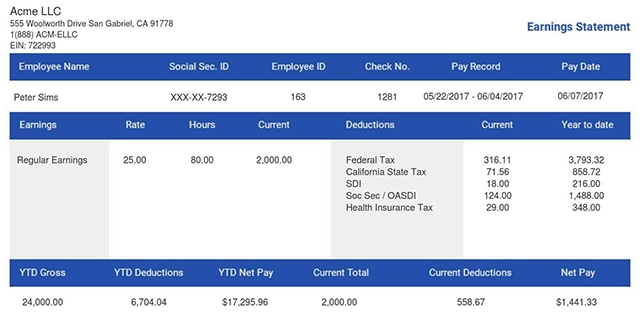
A clear pay stub protects both sides. Workers need stubs for apartment applications, car loans, and proof of income between seasonal jobs. A good stub shows hours by job, each rate, overtime, fringe, and every deduction.
For employers, stubs are part of the paper trail. They back up your certified payroll and help settle pay disputes fast. Good payroll services for construction include a portal where workers can download their own stubs. If you're a small contractor paying a few workers without a provider, you can start from a pay stub template and fill it in for each payday.
You Might Also Like
- Should Independent Contractors Receive a Pay Stub?
- How to Read Pay Stub Deduction Codes
- Payroll Tax vs. Income Tax
- Small Business Guide to Managing Payroll Yourself
- How Is Labor Cost Calculated?
Conclusion: Getting Payroll Services for Construction Right
Payroll gets easier when your system matches how your crews really work. Start with your hardest week, test providers on real jobs, and keep clean records for every worker. Need stubs for your crew or for your own proof of income? Our paystub generator creates accurate pay stubs in minutes.
- 1. Enter Your Information

- 2. Select Your Favorite Theme

- 3. Download Your Stub!

 By