

PTO Tracker Excel: Formulas, Accruals, and Setup (2026)
 By
By
Most time-off spreadsheets are calendars wearing a costume. They color in days off beautifully, then fall apart the moment an employee asks how many hours they have left. If the answer means counting colored squares by hand, you don't have a tracker. You have a picture of one.
Here's how to build a PTO tracker Excel file that actually calculates, and where a pay stub generator takes over. You'll get the sheet structure that holds up, leave codes that won't double-count, and the formulas behind the balances. We'll also cover the accrual math nobody publishes, plus the point where a spreadsheet stops being the right tool.
Key Takeaways
- Split the workbook into three sheets: employee details, a leave log, and a calculated dashboard.
- Store every entry in hours and display days, so half days and full weeks reconcile in one column.
- SUMIFS totals used PTO; NETWORKDAYS.INTL measures request length around weekends and public holidays.
- Biweekly accrual on an 80-hour policy works out to 3.08 hours per pay period.
- Unused paid time off (PTO) payout is taxable wages, withheld at the flat 22% supplemental rate.
- What a PTO Tracker Excel File Actually Needs
- Leave Codes for Your Vacation Tracker Excel Sheet
- PTO Tracking Spreadsheet Formulas That Calculate Balances
- How Do You Calculate PTO Accrual in Excel?
- Can Your PTO Tracker Excel Sheet Handle Full Days and Partial Hours?
- Where a Simple PTO Tracker Excel Sheet Stops Working
- PTO Balances, Pay Stubs, and Payout
- Conclusion: Make Your PTO Tracker Excel Sheet the Source of Truth
What a PTO Tracker Excel File Actually Needs
Most PTO tracking template downloads fail for the same reason: one flat grid, where reference data, transactions, and calculations all fight for the same cells. The fix is three sheets, each with one job.
Employee Master
Static reference data only. Employee ID, hire date, annual policy hours, pay frequency, and hourly rate. Employee names live here once and nowhere else, which is the same field list any employee time off tracker Excel file needs.
Leave Log
Every absence gets one row, appended and never overwritten. Capture employee ID, leave code, start date, end date, hours, and status. This becomes the audit trail when someone disputes a balance, and the only source your employee PTO tracker counts from.
Balance Dashboard
Fully calculated. Nobody types a number here. Protect the formula columns and use Data Validation dropdowns for leave codes so a typo can't enter the log. The same spreadsheet template works in Google Sheets if your employees need shared access.
Leave Codes for Your Vacation Tracker Excel Sheet

Give every leave type one letter, and never reuse a letter. A vacation tracker Excel sheet that uses V for both vacation and voting duty will silently double-count.
Deductible leave types (reduce the balance): V vacation, P personal, S sick leave.
Non-deductible (leaves it alone): H company holiday, B bereavement, J jury duty, W work from home.
Non-deductible absence types, including a longer leave of absence, belong in your vacation tracking records without draining anyone's PTO.
PTO Tracking Spreadsheet Formulas That Calculate Balances
This is where the workbook earns its keep. Five formulas do almost all the work.
| Goal | Formula |
|---|---|
| Used PTO for each employee, approved only | `=SUMIFS(LeaveLog[Hours], LeaveLog[EmpID], [@EmpID], LeaveLog[Status], "Approved")` |
| Count a day code across a row | `=COUNTIF(C2:AG2, "V")` |
| Working days in a request | `=NETWORKDAYS.INTL(Start, End, 1, Holidays)` |
| Period end for accrual cutoffs | `=EOMONTH(TODAY(), 0)` |
| Remaining balance | `=[@Earned] - [@Used]` |
NETWORKDAYS.INTL is the function most guides name and never explain. Its holidays argument takes a range of public holidays. A request spanning a company closure won't bill anyone for a day they were never going to work. Microsoft's documentation covers the weekend codes if your team doesn't work Monday to Friday.
Point each formula at your leave log, and your PTO tracking spreadsheet updates itself as rows get added.
How Do You Calculate PTO Accrual in Excel?

Divide the annual PTO policy by the number of pay periods, then multiply by periods earned. On an 80-hour policy paid biweekly, that is 80 divided by 26, or 3.08 hours per period. For hourly staff, use 80 divided by 2,080 to earn 0.03846 hours per hour worked.
Multiply the per-period rate by periods elapsed, or the per-hour rate by hours worked, and store the result in the earned column of your dashboard.
The per-hour method matters more than it sounds. Salaried staff earn a flat amount every period, but part-time employees on uneven schedules should earn PTO in proportion to hours actually worked. Using one flat rate for both is how balances quietly drift from what people are owed.
Can Your PTO Tracker Excel Sheet Handle Full Days and Partial Hours?
Yes. Store every entry in hours rather than days, then display days with a divide-by-8 formula. A half day logs as 4 hours, a full week as 40. Running two parallel columns, one for days and one for hours, is what makes balances drift out of sync.
Set your standard day length once in the Employee Master and let the dashboard divide. A vacation time tracker built this way handles a two-hour appointment and a two-week holiday in the same column.
Where a Simple PTO Tracker Excel Sheet Stops Working
Before it does, a few habits keep it honest:
- Update balances on a fixed weekly cadence, not when someone asks.
- Protect the formula columns so nobody overwrites a calculation.
- Use Ctrl+H to roll dates forward at year end.
- Archive a dated copy before carryover is applied.
This structure handles a small team well. It stops working when accrual rules differ by group or by state, much like pay stub laws do, or when multiple locations each need their own holiday calendar. At that point the workbook hides your policy instead of enforcing it.
PTO Balances, Pay Stubs, and Payout
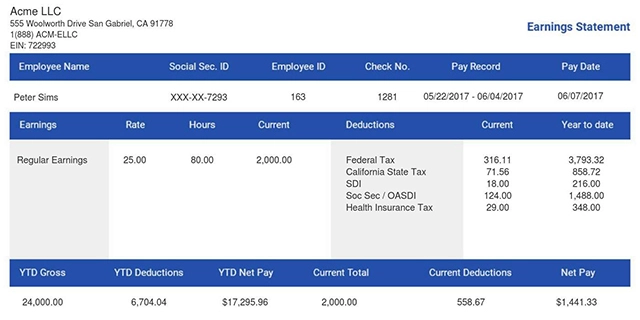
Your spreadsheet is a working view. The pay stub is the record an employee or a lender relies on, so the two should agree.
Federal law sets a low floor. The Department of Labor is explicit that the FLSA doesn't require payment for time not worked, so PTO is a matter of agreement. States override that. California treats earned vacation as wages, bans use-it-or-lose-it policies, and requires payout at separation.
Payouts are taxable supplemental wages, withheld at a flat 22% under IRS Publication 15 for 2026. BLS data from March 2025 puts private-industry access to paid vacation at 80%, averaging 11 days after a year of service.
Need pay documentation that shows those balances clearly? Our pay stub templates make it easy.
You Might Also Like
- Payroll Codes Explained
- How to Calculate Overtime Pay
- Employment Verification and Proof of Income Documents
- Why Some Jobs Hold Your First Paycheck
- Payroll vs Compensation: What's the Difference?
Conclusion: Make Your PTO Tracker Excel Sheet the Source of Truth
A PTO tracker Excel file works when it's built like a small application. Reference data in one sheet, transactions in another, and calculations nobody can overwrite. Store hours, display days, and let SUMIFS do the counting. A balance you can't recompute from the leave log isn't a balance, it's a guess.
When you need to hand someone proof of what they earned, a spreadsheet cell won't do it. Create clean, professional records with our paystub generator in minutes.
- 1. Enter Your Information

- 2. Select Your Favorite Theme

- 3. Download Your Stub!

 By
By