

How to Calculate PTO: Formulas and Examples (2026)
 By
By
Your PTO balance isn't just a number buried in an HR portal. It's hours you've earned, and in several states it's money your employer owes you the day you walk out. Yet most people have never checked whether that number is right. Learning how to calculate PTO takes one division problem. The math is identical for an employee auditing a balance and for a business owner setting an accrual rate. Getting that number onto the stub is the employer's one extra step, and a pay stub generator handles it.
This guide covers the core formula, accrual rates for every pay schedule, and how to convert hours into days. It also walks through prorating for mid-year hires, what happens to unused time when you leave, and how to check it all against your paystub.
Key Takeaways
- PTO accrual rate equals annual PTO hours divided by annual hours worked
- A 15-day plan is 120 hours, or 0.058 hours earned per hour worked
- Convert hours to days by dividing by your standard shift length, usually 8
- Available PTO is accrued time minus used time minus time already scheduled
- Reconcile your balance against your paystub quarterly, not on your last day
- What to Know Before You Learn How to Calculate PTO
- How to Calculate PTO in 4 Steps
- How to Calculate PTO Accrual Rates by Pay Frequency
- How to Calculate PTO in Days Instead of Hours
- How to Calculate PTO for a Mid-Year Hire
- What Changes Your PTO Accrual Rate
- Rollover, Caps, and Use-It-or-Lose-It Rules
- What Happens to Unused PTO When You Leave
- How to Check Your PTO Balance on Your Paystub
- Three Mistakes That Break Your PTO Math
What to Know Before You Learn How to Calculate PTO
PTO accrual means you earn paid time off gradually as you work, instead of receiving the full year's allotment on January 1. That upfront approach is called lump-sum or front-loaded PTO, and it needs no math at all. Accrual does.
Knowing how to calculate PTO starts with three inputs:
- Your annual allotment. How many days or hours of paid time off you get in a full year.
- Your annual hours worked. For full-time employees that's usually 2,080, or 40 hours across 52 weeks.
- Your pay frequency. Weekly, biweekly, semi-monthly, or monthly, since accrual normally posts once per pay period.
Work in hours, not days. Some employers bundle vacation time and sick leave into one PTO bank, while others keep them separate. Hours are the only unit that survives either setup.
How to Calculate PTO in 4 Steps

Convert your annual PTO allotment to hours (15 days x 8 = 120). Find your annual hours worked (40 x 52 = 2,080). Then divide: 120 / 2,080 = 0.058 hours of PTO per hour worked. Multiply that rate by hours worked to calculate accrued time off for any period.
Here's how to calculate PTO step by step on a common 15-day plan.
- Convert your allotment to hours. 15 days x 8 hours = 120 hours per year.
- Find your annual hours worked. 40 hours x 52 weeks = 2,080 hours.
- Divide for your accrual rate. 120 / 2,080 = 0.058 hours per hour worked.
- Multiply by hours worked. A 40-hour week earns 40 x 0.058 = 2.31 hours.
Running the Numbers as an Employee
Say you worked 480 hours last quarter. At 0.058 per hour you accrued 27.8 hours, roughly three and a half days. That's what your stub should show, minus anything already taken.
Running the Numbers as an Employer
The rate belongs to the plan, not the person, so a part-timer on the same plan uses the identical 0.058. Someone working 25 hours a week earns 1.45 hours weekly instead of 2.31. You don't need a separate part-time policy, just the same rate applied to actual hours worked.
Checking Your Work
Multiply the rate back out across a full year. 0.058 x 2,080 = 120.6, which rounds to your original 120-hour allotment. If that reverse check doesn't land near your annual number, one of your inputs is wrong.
How to Calculate PTO Accrual Rates by Pay Frequency
Divide the annual PTO hours by the number of pay periods in a year. On a 120-hour plan, weekly is 120 / 52 = 2.31 hours and biweekly is 120 / 26 = 4.62. Semi-monthly is 120 / 24 = 5.00, and monthly is 120 / 12 = 10.00 hours.
Most payroll systems post a fixed number of hours per pay period rather than accruing per hour worked. The rate shifts with the schedule; the annual total never does. Every row below comes from that same 120-hour plan.
| Accrual Method | Formula | Rate Per Period | Annual Total |
|---|---|---|---|
| Per hour worked | 120 / 2,080 | 0.058 hours | 120 hours |
| Weekly (52 periods) | 120 / 52 | 2.31 hours | 120 hours |
| Biweekly (26 periods) | 120 / 26 | 4.62 hours | 120 hours |
| Semi-monthly (24 periods) | 120 / 24 | 5.00 hours | 120 hours |
| Monthly (12 periods) | 120 / 12 | 10.00 hours | 120 hours |
That's how to calculate PTO for any schedule: pick the divisor that matches your payroll, and the annual total holds steady. For a 10-day plan, swap 120 for 80 and rerun: 80 / 52 = 1.54 hours weekly, 80 / 26 = 3.08 biweekly.
Hourly Accrual vs Per-Period Accrual
Per-hour accrual is fairer when hours swing. A retail worker scheduled 12 hours one week and 38 the next earns proportionally, while flat per-period accrual pays both weeks the same. Per-period accrual is simpler to run, and salaried staff can predict it without running any numbers. Match whichever you choose to your payroll run, because accrual posted biweekly against a semi-monthly pay cycle drifts out of sync over time.
How to Calculate PTO in Days Instead of Hours

Divide your PTO hours by the length of your standard workday, which is an 8-hour workday for most full-time employees. So 72 hours of PTO equals 9 workdays, 120 hours equals 15 workdays, and 80 hours equals 10 workdays. Always count workdays, not calendar days.
| PTO Hours | Workdays (8-Hour) | Work Weeks |
|---|---|---|
| 40 hours | 5 days | 1 week |
| 72 hours | 9 days | 1.8 weeks |
| 80 hours | 10 days | 2 weeks |
| 120 hours | 15 days | 3 weeks |
| 160 hours | 20 days | 4 weeks |
Three weeks of PTO trips people up most often. It's 15 workdays, not 21, because employers count workdays rather than calendar days.
A paid time off calculator handles these conversions instantly, which helps when you're spot-checking a balance mid-year. Confirm what it assumed for shift length and annual hours first. A tool set to an 8-hour day misreports PTO for anyone on 10-hour or 12-hour shifts.
How to Calculate PTO for a Mid-Year Hire
Multiply the annual allotment by the fraction of the year remaining. Someone on a 15-day plan starting July 1 has 6 of 12 months left. They earn 7.5 days, or 60 hours, for that first partial year. Check your first paystub against the prorated figure.
Proration is where PTO math most often goes wrong, because the annual allotment is no longer the right starting number. The formula is annual allotment x (months remaining / 12). Start October 1 on that same plan and it's 15 x (3/12) = 3.75 days, or 30 hours.
Some employers prorate by pay period instead, which is more precise for mid-month starts. A September 18 hire on a semi-monthly schedule has 7 of 24 periods left: 120 x (7/24) = 35 hours.
If You're the Employee
Seeing 60 hours when you expected 120 usually means proration, not a payroll error. If it still looks off, ask HR which method they used, months remaining or pay periods remaining, because the two rarely land on the same number.
If You're the Employer
Write the proration rule into your PTO accrual policy. Without it, every mid-year hire becomes a separate negotiation, and two people hired the same month can end up with different balances.
What Changes Your PTO Accrual Rate
These factors change the inputs rather than how to calculate PTO itself, so the arithmetic never changes.
Full-Time vs Part-Time Status
Part-time employees usually accrue PTO at the same rate against fewer hours, which lands them proportionally less time. The IRS treats 30 hours a week as the full-time threshold for benefits purposes, though your employer's own definition drives the PTO policy.
Length of Service
Tiered accrual is standard: often 10 days of PTO for the first couple of years, then 15, then 20 or more past ten years. Each tier is simply a new annual allotment, so you rerun the same division. Moving from 10 to 15 days lifts biweekly accrual from 3.08 hours to 4.62.
Unlimited and Front-Loaded Plans
Neither accrues. Unlimited PTO has no balance to calculate and nothing to pay out. Lump-sum PTO hands you the full allotment upfront. Both swap the math for different tradeoffs. Front-loaded plans carry heavier liability early in the year, and unlimited plans often see lower usage rather than higher.
Is Your PTO Normal?
Benchmarks help you judge an offer. The Bureau of Labor Statistics reports that 91% of workers at private employers with 500 or more employees had paid vacation access in March 2025. At employers with 1 to 49 workers, it was 71%. Access runs from 46% in leisure and hospitality to 96% in manufacturing. About 51% are on consolidated leave plans, the single-bank PTO model. After one year of service, 31% received 10 to 14 vacation days; after ten years, 31% received 15 to 19 days.
Rollover, Caps, and Use-It-or-Lose-It Rules
Three different limits get called caps, and they do different things.
- Accrual cap. You stop earning once your balance hits a ceiling, often 1.5 to 2 times the annual allotment. You earn PTO again only once you use some of the balance.
- Rollover cap. You can carry only so many hours into next year, and the rest expires.
- Use-it-or-lose-it. Nothing carries over.
The accrual cap catches people out because it stops your balance silently. If your stub shows the same accrued figure three periods running and you haven't taken time off, you've hit the cap. Several states restrict use-it-or-lose-it policies, treating earned time as wages that can't be forfeited. Check with your state labor department before assuming unused PTO expires. Going the other way, some employers let you borrow against future accrual, which leaves you with a negative PTO balance to work off.
What Happens to Unused PTO When You Leave
No federal law requires employers to pay out unused PTO. Some states, including California, Colorado, Illinois, and Massachusetts, require payout of earned time. Everywhere else, your employer's written policy or contract controls, and it is enforceable. Multiply available hours by your hourly rate to estimate the payout.
Nothing federal requires an employer to offer PTO in the first place, so the obligation comes from two other places.
State Law
A handful of states treat earned PTO as wages that must be paid at separation. State-by-state lists circulate online and contradict each other often enough that they aren't worth trusting. Your state labor department is the authority.
Your Employer's Written Policy
A handbook that promises payout is a commitment your employer has to honor. One that says nothing usually means no payout, so read the separation section before you give notice, not after.
Running the PTO payout: 48 available hours at $28 an hour is $1,344 in your final check. Salaried employees divide annual salary by 2,080 for the equivalent hourly figure. That payout is taxed like regular wages, so the net will land lower than the gross figure.
How to Check Your PTO Balance on Your Paystub
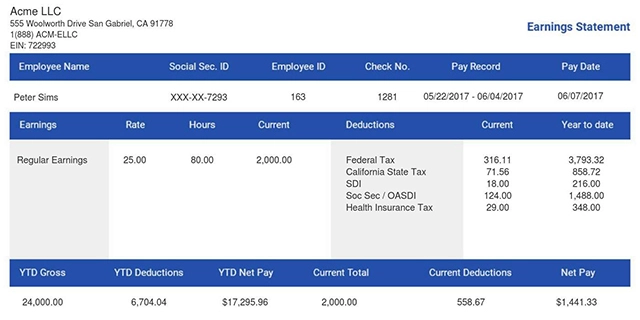
Find the accrual or PTO line on your paystub, usually near the earnings section. It typically shows three figures: accrued, used, and available. Available should equal accrued minus used minus any time already scheduled. If it does not match your own math, ask payroll for your accrual rate in writing.
Mixing up those columns is the most common reason a balance looks wrong:
- Accrued. Total earned since your accrual year started.
- Used. Time already taken and paid.
- Available. What's actually left to book.
Once you know how to calculate PTO, verifying the stub takes about two minutes. Recompute your rate, multiply by the pay periods worked so far this year, and compare. When the numbers disagree, ask payroll for your accrual rate and your accrual start date in writing. Most discrepancies trace back to a start date that doesn't match your hire date, or a tier change that never got applied. If other lines on the stub look unfamiliar too, our guide to pay stub deduction codes decodes the abbreviations.
Keep a short log of the accrued figure from each stub and reconcile quarterly. Waiting until your last day is how a small tracking error becomes a real loss in a payout state. If your employer's records are thin, or you need clean pay documentation of your own, our pay stub templates make it straightforward.
Three Mistakes That Break Your PTO Math
- Dividing by 2,080 when nobody worked 2,080 hours. That figure assumes 40 hours a week, every week, all year. Unpaid leave, furloughs, and part-time schedules all cut actual paid hours, so using 2,080 inflates the rate.
- Assuming PTO accrues during unpaid leave. It usually doesn't, since accrual tracks hours worked. The Family and Medical Leave Act regulations are explicit that employers don't have to let benefits or seniority accrue during unpaid FMLA leave. What you banked before the leave is protected, though: that balance has to be available to you when you return.
- Counting scheduled time as available. Approved vacation that hasn't happened yet is already spent. Treat it as gone when approved, or you'll book a second trip against hours you no longer have.
The reverse check catches all three: multiply your rate by the periods you've actually worked, then compare it to the stub.
You Might Also Like
- Does PTO Count Towards Overtime?
- What Unpaid PTO Means for Your Paycheck
- Free PTO Policy Template
- Overtime Pay Calculator
- State Pay Stub Laws
Conclusion
Learning how to calculate PTO comes down to a single division: annual PTO hours divided by annual hours worked. Whatever goes wrong almost always goes wrong in the inputs, not the arithmetic. Get your allotment, real hours worked, and pay frequency right and the rest follows.
As an employee, check once a quarter against your stub rather than finding a three-year-old error on your way out the door. As an employer, write the accrual rate, the proration rule, and the cap into your policy. Then make sure the balance appears on every stub you issue. Clear pay records are the cheapest way to avoid an expensive argument later. Need to produce them yourself? Our paystub generator creates professional pay stubs in minutes.
- 1. Enter Your Information

- 2. Select Your Favorite Theme

- 3. Download Your Stub!

 By
By