

Bi Weekly Pay Period Start and End Date: How to Find Yours (2026 Calendar)
 By
By
Three different dates show up on most pay stubs, and they're easy to mix up. Your bi weekly pay period start and end date marks the two weeks you actually worked, and any decent paystub generator prints it near the top. The pay date is when the money lands, and it's always later. Confusing the two is why people think they were shorted a week's wages when nothing went wrong. Below you'll find a simple way to calculate your own dates from a single payday, a full 2026 calendar you can copy, and a walkthrough of the labels printed on your stub.
Key Takeaways
- A biweekly pay period covers 14 days, or two full workweeks, which is 80 hours for standard full-time schedules.
- Most years contain 26 biweekly pay periods, though roughly every 11 years a 27th one appears.
- Your pay date is never the same as your period end date. Payroll needs several days to process, commonly three to seven.
- Two months each year deliver three paychecks instead of two, which affects deductions and cash flow.
- Vacation and sick leave accrual usually follows the same 14-day cycle as the pay period.
- Bi Weekly Pay Period Start and End Date vs Pay Date
- What Is a Bi Weekly Pay Period?
- How to Calculate Your Bi Weekly Pay Period Start and End Date
- 2026 Bi Weekly Pay Period Start and End Date Calendar
- How to Find Your Bi Weekly Pay Period Start and End Date on a Pay Stub
- How Many Bi Weekly Pay Periods Are in a Year?
- Biweekly vs Semimonthly vs Weekly Pay Periods
- Three-Paycheck Months and What They Mean for You
- Pay Frequency Rules and State Law
Bi Weekly Pay Period Start and End Date vs Pay Date
Payroll runs on three dates, and each answers a different question.
- Pay period start date is the first day of the two-week window you're being paid for.
- Pay period end date is the last day of that window, and it's the cutoff for hours worked.
- Pay date is when your employer actually issues the check or deposit.
Here's an example from the 2026 schedule below. If your bi weekly pay period start and end date are January 4 and January 17, you're paid on January 23. The six-day gap isn't a delay. It's the time payroll needs to collect timesheets, run withholding, and move the money.
That gap matters both ways. Employees reconciling a deposit against hours need the period dates, not the pay date. Employers should print both clearly. If the wording trips you up, the difference between a payday, a pay cycle, and a pay period is worth a read.
What Is a Bi Weekly Pay Period?

A bi weekly pay period is a 14-day stretch covering two full workweeks. It starts the day after the previous period ends and always runs the same length, so a standard full-time schedule adds up to 80 hours. Most employers using this cycle run 26 pay periods per year.
The key difference from a semimonthly schedule is what drives it. Biweekly pay is interval-driven, repeating every 14 days regardless of the calendar. Semimonthly pay is date-driven, landing on fixed days like the 15th and the last day of the month. That distinction explains most questions about shifting dates, and this pay period breakdown covers the other cycles.
How to Calculate Your Bi Weekly Pay Period Start and End Date
Start from a payday you can confirm. Count back your employer's processing lag, usually three to seven days, to reach the pay period end date, then count back 13 more days to reach the start date. Every period after that begins exactly 14 days later, so once you have one pair of dates the rest of the year follows.
Working Backward From a Known Payday
- Pick any payday you can verify from a deposit or a stub.
- Subtract your employer's processing lag, usually three to seven days, to land on the period end date. The 2026 calendar below uses six.
- Subtract 13 more days from that end date to reach the period start date.
- Add 14 days to both dates to get the next period, and repeat.
Check any stub showing both the period ending date and the pay date. That gap stays constant.
Setting the Anchor as an Employer
Business owners build the schedule forward. Pick the first period start date, add 13 days for the end date, then add your processing lag. Repeat every 14 days and publish the full year.
If a pay date lands on a bank holiday, employers usually move it earlier.
Need pay documentation for a rental application or a loan? Our pay stub templates make it straightforward.
2026 Bi Weekly Pay Period Start and End Date Calendar

All 26 periods for the year are mapped out below. The table assumes periods run Sunday through Saturday with payday the following Friday. If your employer anchors on a different date, shift every row equally.
| Period | Start Date | End Date | Pay Date |
|---|---|---|---|
| 1 | Dec 21, 2025 | Jan 3, 2026 | Jan 9, 2026 |
| 2 | Jan 4, 2026 | Jan 17, 2026 | Jan 23, 2026 |
| 3 | Jan 18, 2026 | Jan 31, 2026 | Feb 6, 2026 |
| 4 | Feb 1, 2026 | Feb 14, 2026 | Feb 20, 2026 |
| 5 | Feb 15, 2026 | Feb 28, 2026 | Mar 6, 2026 |
| 6 | Mar 1, 2026 | Mar 14, 2026 | Mar 20, 2026 |
| 7 | Mar 15, 2026 | Mar 28, 2026 | Apr 3, 2026 |
| 8 | Mar 29, 2026 | Apr 11, 2026 | Apr 17, 2026 |
| 9 | Apr 12, 2026 | Apr 25, 2026 | May 1, 2026 |
| 10 | Apr 26, 2026 | May 9, 2026 | May 15, 2026 |
| 11 | May 10, 2026 | May 23, 2026 | May 29, 2026 |
| 12 | May 24, 2026 | Jun 6, 2026 | Jun 12, 2026 |
| 13 | Jun 7, 2026 | Jun 20, 2026 | Jun 26, 2026 |
| 14 | Jun 21, 2026 | Jul 4, 2026 | Jul 10, 2026 |
| 15 | Jul 5, 2026 | Jul 18, 2026 | Jul 24, 2026 |
| 16 | Jul 19, 2026 | Aug 1, 2026 | Aug 7, 2026 |
| 17 | Aug 2, 2026 | Aug 15, 2026 | Aug 21, 2026 |
| 18 | Aug 16, 2026 | Aug 29, 2026 | Sep 4, 2026 |
| 19 | Aug 30, 2026 | Sep 12, 2026 | Sep 18, 2026 |
| 20 | Sep 13, 2026 | Sep 26, 2026 | Oct 2, 2026 |
| 21 | Sep 27, 2026 | Oct 10, 2026 | Oct 16, 2026 |
| 22 | Oct 11, 2026 | Oct 24, 2026 | Oct 30, 2026 |
| 23 | Oct 25, 2026 | Nov 7, 2026 | Nov 13, 2026 |
| 24 | Nov 8, 2026 | Nov 21, 2026 | Nov 27, 2026 |
| 25 | Nov 22, 2026 | Dec 5, 2026 | Dec 11, 2026 |
| 26 | Dec 6, 2026 | Dec 19, 2026 | Dec 25, 2026 |
Two details stand out. May and October each carry three pay dates, and the year's final pay date lands on Christmas Day, so most employers would shift it to December 24.
How to Find Your Bi Weekly Pay Period Start and End Date on a Pay Stub
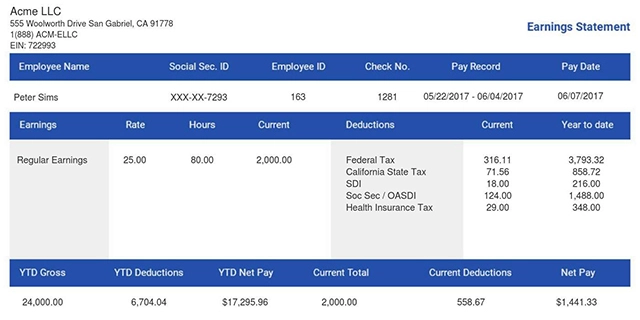
Look for a line labeled "Pay Period Beginning" and "Period Ending," usually printed near the top of the stub. Those two dates are the work window you're being paid for. The "Pay Date" or "Check Date" is separate and always later, because payroll processing takes a few days.
Label wording varies. You might see "Period Start" and "Period End," or a range like "01/04/26 to 01/17/26." Whatever the phrasing, the earlier pair is your bi weekly pay period start and end date and the standalone later date is when you got paid.
Landlords and lenders often ask for stubs covering a specific stretch, and the wrong ones stall an application. Employers face the mirror image: stubs without clear period dates generate payroll questions. A sample biweekly pay stub shows where these dates sit.
How Many Bi Weekly Pay Periods Are in a Year?
Most years have 26. Because 26 periods of 14 days cover 364 days, one day drifts forward each year, and roughly every 11 years that drift adds up to a 27th pay period. Whether your year has 26 or 27 depends on where your first payday lands.
Salaried employees feel this most. Annual pay is normally divided by 26, so a 27-pay-date year means either slightly smaller checks or one extra, depending on the employer. Mapping out each bi weekly pay period start and end date before January is the simplest way to catch one early.
Biweekly vs Semimonthly vs Weekly Pay Periods
| Feature | Weekly | Biweekly | Semimonthly |
|---|---|---|---|
| Paychecks per year | 52 | 26 | 24 |
| Period length | 7 days | 14 days | About 15 days, varies |
| Dates each month | Shift | Shift | Fixed |
| Overtime tracking | Simple | Simple | Harder |
Biweekly and semimonthly get confused constantly because both average roughly two paychecks a month. Take a $62,400 salary: split across 26 biweekly checks that's $2,400 each, while 24 semimonthly checks come to $2,600 each. Same annual pay, different rhythm.
Overtime is where biweekly earns its popularity. The Fair Labor Standards Act (FLSA) counts overtime by the workweek, anything past 40 hours in a fixed seven-day stretch, so a 14-day period holds two clean workweeks. Semimonthly periods often split a workweek across two checks, making overtime messier. The rules for overtime calculated weekly or biweekly trip up new payroll admins. According to the Bureau of Labor Statistics, biweekly is the most common pay frequency among US private employers.
Three-Paycheck Months and What They Mean for You
Twenty-six paychecks don't divide evenly into 12 months, so two months a year deliver three instead of two. On the 2026 schedule above, those are May and October. Shift your anchor date and different months take the honor, which is why no calendar can name yours without your start date.
For employees, the extra check isn't a bonus. It's the same annual salary in a different pattern.
For business owners, these months need planning. Cash flow takes a bigger hit, and flat-rate deductions like health insurance premiums are usually spread across 24 checks, leaving two checks a year without them. Percentage-based items such as 401(k) contributions and garnishments come out of all 26. Learning to read pay stub deduction codes makes these swings easier to spot.
Pay Frequency Rules and State Law
Federal law doesn't mandate a specific pay frequency, but it does expect consistency once you pick one. States are where the real requirements live. Many set a minimum frequency, and several require weekly pay for certain non-exempt workers, ruling out a biweekly schedule for those roles. Check the Department of Labor's state payday requirements before setting or changing a schedule.
Record-keeping matters too. Payroll records must show the start and end of each workweek clearly enough to prove overtime compliance, and state pay stub laws vary on what has to appear on the document itself.
You Might Also Like
- Payroll Codes Explained
- How to Get a Pay Stub From Direct Deposit
- What Does a Pay Stub Look Like?
- Jobs That Hold Your First Paycheck
- How to File Taxes With Your Last Pay Stub
Conclusion
Once you know one payday and your employer's processing lag, every bi weekly pay period start and end date for the rest of the year is simple arithmetic. Count back to the end date, count back 13 more for the start, then add 14 days as many times as you need. Keep the 2026 calendar handy for the three-paycheck months.
Need clean pay records for a lease, a loan, or your own team? Create professional documentation in minutes with our paystub generator.
- 1. Enter Your Information

- 2. Select Your Favorite Theme

- 3. Download Your Stub!

 By
By