

Retro Hours on Your Pay Stub: What They Mean (2026)
 By
By
You open your pay stub and there's a line that wasn't there last time: RETRO. Maybe it lists a few retro hours, maybe just a dollar figure. Either way, you're wondering whether it's a bonus, an error, or money you were owed.
It's almost always a correction. Retro hours are hours you already worked that got paid at the wrong rate, and retro pay is your employer squaring up. Need pay records of your own? Our pay stub generator builds them in minutes.
Below, we'll cover why that line appeared, how to check the math yourself, how the taxes work, and what to do if the number looks wrong.
Key Takeaways
- Retro hours are past hours that got shorted: paid at the wrong rate, or missed entirely, in an earlier pay period.
- Retro pay is the money that corrects them, usually added to your next paycheck as a separate line.
- Most payroll systems post retro as an earnings amount rather than adding hours back to your old timecard.
- The IRS treats retro pay as supplemental wages, so the withholding on that check can look unusually high.
- You can check the math yourself: the rate difference multiplied by the affected hours.
- What Are Retro Hours?
- What Does Retro Mean on a Pay Stub?
- Why Retro Hours Show Up on Your Paycheck
- How to Calculate Retro Hours and Retro Pay
- Retro Pay vs. Back Pay: What's the Difference?
- How Retro Pay Is Taxed
- Retro Check vs. Next Paycheck: Getting Paid for Retro Hours
- What to Do If You're Owed Retro Hours
- How Employers Can Prevent Retro Pay Errors
What Are Retro Hours?
Retro hours are hours you already worked that were paid at the wrong rate, or not paid at all, during an earlier pay period. Retro pay is the money that corrects them. Employers usually add it to your next paycheck as a separate line, calculated as the rate difference multiplied by the affected hours.
The two terms describe one event from two angles: retro hours are the time you were shortchanged on, and retro pay, short for retroactive pay, is the fix.
Payroll software doesn't spell it consistently, which is why the same correction shows up under different names. You'll see it printed as retro payment, as retro active pay, or squeezed into one word. What is retropay? Identical concept, just a compressed spelling. Whatever label your employer's system prints, the retro payment meaning is the same: money that closes the gap between what you were paid and what you'd actually earned.
It cuts both ways. Employees spot retro hours on a stub and want to verify them. Small business owners owe retro pay after catching a mistake, and how fast they fix it matters.
What Does Retro Mean on a Pay Stub?

RETRO on a pay stub marks a correction to earlier earnings, listed in the earnings block separately from your regular and overtime lines. It may show hours, a dollar amount, or both. Most payroll systems post it as a separate earnings amount rather than reopening your closed timecard.
That explains the inconsistency people find confusing. Some stubs show retro hours with a rate beside them; others show a flat dollar figure and nothing in the hours column. Both are correct, and RETRO is just one of many payroll codes employers abbreviate differently. If your stub prints the label as one word, the retropay meaning doesn't change.
The reason comes down to how payroll handles closed periods. Once a period is processed and taxed, systems generally don't reopen it. They post the correction as a new earnings line in the current period instead, often as miscellaneous income. Your old timecard stays as it was; the money arrives now.
When you check the line, compare it against three things: your correct rate, the number of hours or pay periods affected, and the date the change should have taken effect.
Why Retro Hours Show Up on Your Paycheck
These corrections almost always trace back to a timing or data-entry problem:
- A raise or promotion processed late. Approved on the 1st, entered after the payroll cutoff.
- Overtime paid at straight time. Hours past 40 in a week should be paid at time and a half.
- A missed shift differential. Nights, weekends, and hazardous shifts often carry a premium the system didn't apply.
- An unpaid commission or bonus. Earned in one period, recorded in the next.
- The wrong pay rate entered. Common when someone holds two roles at different rates.
- Employee misclassification. A non-exempt worker treated as exempt misses overtime they were legally owed.
Three quick examples: a warehouse worker's $2 per hour night differential never lands on the check; a nurse works six hours past 40 and gets straight time; a small business owner approves a raise effective the 1st but keys it in on the 5th, after payroll ran. All three end with someone getting retro paid the next period.
How to Calculate Retro Hours and Retro Pay

The formula is the same in every case: subtract the rate you were paid from the rate you should have been paid, then multiply by the hours or pay periods affected. Always run this on gross pay, before deductions, because that's how payroll calculates it. Working backward from net pay won't reconcile.
Hourly Employees
Start from your correct hourly rate, subtract the rate you were actually paid, and multiply the difference by every affected hour.
Say your raise moved you from $19.50 to $21.00 an hour, but the new rate didn't take effect for 72 hours of work. The difference is $1.50, and $1.50 multiplied by 72 hours comes to $108.00 in retro pay.
Overtime works the same way with one extra step: compare against the overtime rate, not the base rate. If your base is $32.00 an hour, your overtime rate is $48.00. Six overtime hours paid at straight time leaves a $16.00 gap per hour, or $96.00 owed.
Salaried Employees
Divide both the old and new annual salaries by the number of pay periods in your year, then multiply the per-period difference by the number of periods that were wrong.
So what is retro pay example math on a salary? Same formula, just per pay period instead of per hour. A raise from $58,000 to $62,000 on a biweekly schedule means 26 pay periods. The old rate per period was $2,230.77 and the new one is $2,384.62, a difference of $153.85. If three pay periods went out at the old figure, the retro pay owed is $461.55.
One caveat: exempt employees generally don't qualify for overtime, so their retro pay comes from rate and salary changes.
Retro Pay vs. Back Pay: What's the Difference?
Retro pay corrects work that was paid at the wrong rate, so you receive the difference between what you got and what you were owed. Back pay covers wages you never received at all, and it often follows a legal claim, settlement, or court order. Back pay is typically the larger amount.
| Retro pay | Back pay | |
|---|---|---|
| What went wrong | You were paid, at the wrong rate | You weren't paid at all |
| Typical trigger | Payroll error, late raise, missed differential | Wage dispute, wrongful termination, court order |
| Amount | The difference between the two rates | The full unpaid wages |
| How it's resolved | Correction on an upcoming paycheck | Often a settlement or judgment |
The distinction affects how each one is taxed and documented.
How Retro Pay Is Taxed
Retro pay is taxable, and the IRS treats it as supplemental wages under Publication 15. That's why withholding can look strange on a check that includes it.
Employers have two options for federal income tax here: the percentage method, a flat 22% as of 2026, or the aggregate method, which combines the retro amount with your regular wages and withholds based on your W-4. Social Security and Medicare come out either way, plus any state and local tax.
Here's the part that catches people: adding retro pay to a normal paycheck can push that period into a higher withholding bracket even though your annual tax bill hasn't changed. You'll typically get the difference back at filing.
Two more details. Retro wages normally count as 401(k)-eligible pay, so your usual deferral comes out and any employer match applies, though your plan document has the final word on that. And the amount lands on your Form W-2 for the year it's paid, not the year you earned it.
Retro Check vs. Next Paycheck: Getting Paid for Retro Hours
Most of the time, retro pay rides along on your next regular paycheck as its own earnings line. That's the simplest route and it's what the majority of employers do.
The alternative is a standalone retro check, issued through an off-cycle payroll run. Employers use it when the amount is big enough, or the delay long enough, that making you wait another two weeks isn't reasonable. So what is a retro check? Just the same correction delivered on its own rather than bundled in. The tax treatment doesn't change either way.
What to Do If You're Owed Retro Hours
If you think a correction is missing or the amount looks wrong, work through it in order:
- Confirm your correct rate and its effective date from your offer letter, raise notice, or employment agreement.
- Count the affected hours or pay periods between that date and the paycheck where the correct rate appeared.
- Multiply the rate difference by that number to get the gross amount you're owed.
- Compare it against the RETRO line on your stub. If there's no such line, nothing was corrected.
- Raise it in writing with your manager or payroll contact, and include your numbers.
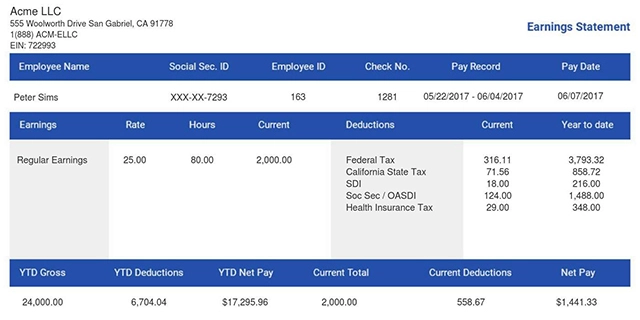
One check catches what a single stub won't: compare the year-to-date gross on your latest pay stub against your rate and hours for the year. A rate that's been wrong for months hides in one period but not in the YTD figure.
Hold onto your stubs; they're the documentation that supports your case. Need clean pay records for a loan or rental application in the meantime? You can get pay stubs online in a couple of minutes.
How Employers Can Prevent Retro Pay Errors
The Fair Labor Standards Act (FLSA) requires employers to correct wage errors promptly. The Department of Labor generally expects payment by the next regular payday after the error surfaces, and the overtime rules behind most retro corrections are worth reviewing. Several states impose tighter deadlines, so multi-state employers should check each jurisdiction.
Retro pay can also be court-ordered. Claims involving discrimination under the Equal Pay Act, retaliation, breach of contract, and overtime or minimum wage violations can all lead a judge to require retroactive compensation.
Prevention is mostly process: use effective-dated rate changes so an increase applies from the right date no matter when it's keyed in, run periodic payroll audits to catch discrepancies before they compound, and document every correction. Occasional retro adjustments are normal; frequent ones point at something broken upstream.
You Might Also Like
- How to Read a W-2 Like a Pro
- How to Get a Pay Stub From Direct Deposit
- Paycheck Stubs Explained
- How to File Taxes With Your Last Pay Stub
- W-2 vs. Pay Stub: What's the Difference?
Conclusion
Retro hours aren't a bonus, and they usually aren't a mistake in your favor. They're a correction for work you already did, and the math is simple enough to verify in a few minutes: rate difference times affected hours. The tax treatment surprises most people, since supplemental wage withholding can make a corrected check look lighter than expected.
Employees should keep every stub that shows a retro line. Employers should document the error and pay it on the next run. If you need accurate, professional pay records of your own, our paystub generator creates them in minutes.
- 1. Enter Your Information

- 2. Select Your Favorite Theme

- 3. Download Your Stub!


 By
By