

ERC Tax Credit: What It Is, Who Qualifies & 2026 Status
 By
By
The ERC tax credit gave eligible businesses one of the biggest payroll tax breaks in recent U.S. history. At its peak, employers could claim up to $26,000 per employee. That money helped small businesses survive COVID-19 shutdowns, keep workers on payroll, and avoid layoffs. The pay stubs from those quarters now serve as key proof for IRS audit defense. But in 2026, things look very different.
The filing deadline passed on April 15, 2025. No new claims can go in. But businesses that got the employee retention tax credit are now facing IRS audits, pending payments, and the need to defend their claims. People still have a lot of questions: What is ERC? How does it work? What is ERC in 2026?
This guide covers everything you need to know about the erc tax credit: who qualified, how to calculate it, and what it means for your business in 2026.
Key Takeaways
- The erc tax credit was worth up to $7,000 per employee per quarter, or up to $26,000 per employee total.
- Three ways to qualify: government shutdown, big drop in gross receipts (50% in 2020 or 20% in 2021), or recovery startup business status.
- The April 15, 2025 deadline to file new ERC claims for 2020 or 2021 has passed.
- The IRS can audit ERC claims for up to 5 years. Keep your records. This matters more now than ever.
- Use solid payroll records as your main defense against ERC audits.
What Is the ERC Tax Credit?
The erc tax credit, formally the employee retention credit, is a refundable tax credit from the Internal Revenue Service under the CARES Act (March 2020). The erc meaning is simple: it was designed to credit the employee retention efforts of businesses during the COVID-19 pandemic. Across the eligible quarters 2021, the credit covered 70% of qualified wages per employee per quarter. That meant up to $7,000 per employee per quarter, or $26,000 per employee total.
What is erc credit, or what is the erc credit, in the simplest terms? The erc tax credit is a direct cut to the employer's payroll tax bill. When the credit was more than the taxes owed, the IRS sent a cash refund. What is ertc? It's the same program by another name: Employee Retention Tax Credit. The ertc meaning is simple: it's the same program. The erc meaning is no different. Both terms point to this refundable COVID-era payroll tax credit.
The History Behind the Program
The cares act employee retention credit was set up on March 27, 2020. It was part of the same law that created the Paycheck Protection Program. What is the employee retention credit and why did it matter? It was built to push employers to keep workers on payroll during shutdowns and drops in revenue. In 2020, the credit covered 50% of qualified wages per employee. The annual cap was $10,000, so the most any employer could get was $5,000 per employee for the year.
Three major legislative changes expanded the program:
- Consolidated Appropriations Act (December 2020): Extended the ERC through Q2 2021 and raised the credit rate to 70% of qualified wages.
- American Rescue Plan Act (March 2021): Extended ERC through Q3 2021 and added recovery startup businesses as eligible.
- Infrastructure Investment and Jobs Act (November 2021): Ended the ERC for most businesses after September 30, 2021.
So what does erc stand for? Employee Retention Credit. The goal was simple: keep workers on the job and get dollars to employers during the worst economic crisis in modern U.S. history.
Who Qualifies for the Employee Retention Tax Credit?
Who qualifies for the employee retention tax credit? The program ran from March 2020 through September 2021. To qualify, a business had to meet one of three tests: a full or partial government-ordered shutdown, a big drop in gross receipts (50% in 2020 or 20% in 2021), or status as a recovery startup business.
Here's the full decision framework for erc tax credit eligibility:
Pathway 1: Government-Ordered Shutdown
If your business was forced to fully or partly close due to a government order tied to COVID-19, you may qualify under this pathway.
- The order must come from a federal, state, or local government body.
- A supply chain issue alone is not enough. There must also be a direct limit on your business activity.
- The impact cannot be small. Per IRS Notice 2021-20, the order must affect more than 10% of total business operations.
For example, a restaurant forced to close its dining room clearly qualifies. But a factory that lost one supplier yet kept running would likely not meet the bar.
Pathway 2: Significant Decline in Gross Receipts
This test compares each quarter's gross receipts to the same quarter in 2019.
| Quarter | Decline Threshold (vs. Same 2019 Quarter) |
|---|---|
| Any Quarter in 2020 | Greater Than 50% Decline |
| Q1–Q3 2021 | ≥20% decline |
A key note: if you qualify for Q2 2021 based on Q1 2021 gross receipts, you're in. But if you used Q4 2020 to qualify for Q1 2021, that does not carry over to Q2 2021. Each quarter is checked on its own.
Pathway 3: Recovery Startup Business
New businesses that started after February 15, 2020 and averaged less than $1 million in yearly gross receipts had a third option. They did not need to show a drop in revenue or a government shutdown. The eligible window was Q3 and Q4 2021, with a max credit of $50,000 per quarter.
Employee Size Rules for the Employee Retention Credit
The rules for which employees count changed depending on full-time equivalent (FTE) size and year:
The FTE threshold shifted between 2020 and 2021, which changed which wages could be counted toward the credit.
| Period | Employer Size | Which Wages Qualify |
|---|---|---|
| 2020 | ≤100 FTE | All wages paid to all employees |
| 2020 | >100 FTE | Only wages paid to employees NOT working |
| 2021 | ≤500 FTE | All wages paid to all employees |
| 2021 | >500 FTE | Only wages paid to employees NOT working |
Health plan expenses also count as qualified wages, even for periods when employees were not providing services.
Who Does NOT Qualify for the ERC?

Not every business hurt by COVID-19 could claim the ERC. Here's who was left out.
You don't qualify for the ERC if:
- You have no employees. Self-employed individuals cannot count their own wages. Wages paid to family members (spouse, sibling, parent, child) also do not count.
- You are a household employer. Domestic workers do not qualify for the ERC.
- You are a government employer. Federal, state, and local government bodies are usually not eligible. Some tribal governments, credit unions, and tax-exempt groups can still claim.
- Your only issue is supply chain. A supply chain problem alone, without a qualifying government order, does not meet the test.
- You paid no wages during the qualifying period. The ERC is a payroll tax credit. No wages paid means no credit to claim.
- You are an employee or retiree. The ERC is for employers only. It cannot be claimed on personal tax returns.
Some ERC promoters got their clients in trouble by filing claims for scenarios the IRS had ruled out, like supply chain issues. The IRS is actively going after these bad claims.
How to Calculate Your ERC Tax Credit
The erc tax credit equals 70% of qualified wages per employee per quarter. The wage cap is $10,000 per employee per quarter. That means the max credit is $7,000 per employee per quarter, or $21,000 for the three eligible quarters in 2021.
The ERC Formula
2021 erc tax credit Formula:
× 70%
= erc credit per Employee per Quarter (max $7,000)
2020 erc tax credit Formula:
× 50%
= erc credit per Employee for 2020 (max $5,000)
The credit applies against the employer's share of Social Security taxes. If the credit is more than what's owed, the IRS refunds the difference as cash.
Worked Example: ERC Calculation for a Small Business
A small bakery in Chicago with 15 employees saw a 30% drop in Q1 2021 gross receipts vs. Q1 2019. Here's how the math works:
| Element | Amount |
|---|---|
| Employees | 15 |
| Qualified wages per employee (Q1 2021) | $12,000 (capped at $10,000) |
| Effective wages per employee | $10,000 |
| ERC rate | 70% |
| Credit per employee | $7,000 |
| Total Q1 2021 credit | $7,000 x 15 = $105,000 |
Across all three eligible quarters in 2021 (Q1, Q2, Q3), the total employee tax retention credit for the bakery could reach $315,000. That's major relief for a small food service business that kept its team on payroll during the pandemic. Health plan costs also count as qualified wages, even for times when employees were not working.
How to Claim the Employee Retention Tax Credit

The filing process changed over time, and many businesses were confused about the steps. There were two paths: original filing and retroactive filing. Each had its own forms and deadlines.
Original filing: Businesses wanted to know how to claim employee retention credit during the active program. Employers reported qualified wages and health insurance costs on Form 941 (the quarterly employment tax return). The covid employee retention credit was included on that same form. Employers could also cut their payroll tax deposits while waiting for IRS processing.
Retroactive filing: Employers who missed the employee retention credit 2021 or 2020 window could file Form 941-X (Amended Quarterly Federal Tax Return). This let them claim the credit after the fact. The filing window ran three years from the original Form 941 due date.
The 2026 reality: The deadline for 2021 ERC claims was April 15, 2025. That window is now closed. No new claims for the employment retention credit can be filed for 2020 or 2021. The same applies to ertc tax credits, which is just another name for the same program.
For pending claims: Some businesses filed Form 941-X before the deadline and are still waiting for the IRS to process them. The IRS built up a large backlog during the processing pause (see Section 7 below). If you filed a valid claim and have not been paid, call the IRS Business and Specialty Tax Line or ask a tax professional to check on it.
What are erc funds once you receive them? They come as a direct check from the U.S. Treasury, not a credit on future tax bills. This is what made the program stand out: it put real cash in the hands of qualifying businesses.
ERC and PPP: Can You Claim Both?
Yes. Businesses that got a PPP loan can also claim the erc tax credit, as long as the same wages are not used for both. Any wages applied toward PPP forgiveness cannot also be counted for the erc credit calculation.
PPP and ERC Wage Allocation Example
Say a small business had $100,000 in payroll for Q1 2021.
| Wages | Allocation | |
|---|---|---|
| $60,000 | Applied to PPP forgiveness | |
| $40,000 | Available for ERC calculation | |
| ERC | 70% of $40,000 (10 first employees) | $28,000 (reduced by $10,000/employee) |
Here's a key rule change: in 2020, PPP loan recipients could NOT claim the ERC at all. The Taxpayer Certainty and Disaster Tax Relief Act of 2020 changed that. After the update, businesses with a PPP loan could also claim the ERC. The catch was careful tracking of which taxable wages went to PPP and which went to ERC.
Bottom line: If a business took a PPP loan and also qualified for the ERC, it likely left money on the table if it did not review its wage allocation before the April 2025 deadline.
IRS Moratorium and ERC Audit Activity
ERC fraud grew so fast that the IRS had to step in and hit pause on the entire program.
On September 14, 2023, the irs announced a hold on processing new ERC claims. The agency cited a flood of likely bad applications. Many of these claims were being pushed by “ERC promoters” who charged fees based on the refund amount.
The scale of the problem:
- The IRS opened 301 criminal probes into erc tax credit claims, with losses topping $3.4 billion as of October 2023.
- Thousands of civil audits of erc tax credit claims launched at the same time across the country.
- The IRS also went after promoters who pushed businesses into filing bad claims.
IRS actions since the moratorium:
- June 2024: The irs announced it would deny tens of thousands of high-risk ERC claims but keep paying lower-risk valid ones.
- August 2024: The IRS began working through claims filed during the pause.
- Second Voluntary Disclosure Program (August to November 22, 2024): Let businesses repay 80% of incorrect ERC to avoid full penalties. The first VDP closed in March 2024. The second closed in November 2024.
- Withdrawal program: Businesses with unprocessed claims could pull them back to avoid penalties entirely.
Businesses that received erc funds and are not sure their claim was valid should fix the error before the IRS reaches out. Acting first leads to better outcomes than waiting.
How to Avoid ERC Scams
The erc tax credit fraud problem made the IRS annual "Dirty Dozen" list of top tax scams. If you fell for a promoter scam, you don’t just repay the funds. You also owe interest and penalties. In some cases, businesses face criminal charges.
IRS warning signs of an ERC scam:
- "You have nothing to lose." In reality, repaying bad claims plus interest and penalties costs far more than doing it right the first time.
- Fees based on a percentage of your refund. Real tax pros charge flat fees or hourly rates, not a cut of the credit.
- Cold calls or ads that promise an "easy" process. If they make it sound too simple, that's a red flag.
- Guaranteed approval in minutes. A real review takes time and requires actual documentation.
- Advice that goes against your own CPA or tax attorney. If a promoter tells you something your accountant disagrees with, trust your accountant.
- Large upfront fees with no clear breakdown of what you’re paying for.
The IRS is clear: the business is on the hook for the accuracy of its ERC claim. Even if a promoter filed it on your behalf, you are still liable for any tax, interest, and penalties if the claim is denied. "My promoter told me I qualified" is not a valid defense.
The best way to stay safe is to work with a licensed CPA, enrolled agent, or tax attorney who can review your records and confirm real eligibility.
The ERC Tax Credit in 2026: What Businesses Should Know Now
The April 15, 2025 filing deadline has passed, but the story is far from over. The ERC still affects businesses in several ways.
Here's the 2026 reality:
1. IRS audit activity for the erc tax credit continues. The IRS has 5 years to audit ERC claims. Since most claims were for the 2021 tax year, audits can run through 2026 and beyond. The “One Big Beautiful Bill” (2025) may extend that window even further.
2. Some pending payments are still processing. Valid ERC claims filed before the pause are still in the queue. The IRS is clearing the backlog as fast as it can. If you need an employee retention credit update on your claim, call the IRS Business and Specialty Tax Line or ask your tax professional.
3. Overpayment demands are going out. The IRS is now sending notices to businesses that received erc funds the agency considers improper. These notices demand repayment and have strict deadlines. If you get one, respond on time or you may lose your right to appeal.
4. The VDP is closed. The second Voluntary Disclosure Program shut down on November 22, 2024. Businesses that missed both rounds now have fewer ways to fix errors without paying full penalties.
What should you do right now?
- Keep all records for at least 5 years from the date you filed. Hold on to them until the statute of limitations runs out.
- Do not throw away payroll records, government orders, gross receipts, or Form 941-X filings.
- If you claimed the ERC and are not sure you qualified, talk to a tax professional before the IRS contacts you.
- Respond to IRS notices on time and in person or in writing.
Payroll Records and ERC Audit Readiness
For businesses that claimed the ERC, the best audit defense is strong payroll records. The IRS expects every claim to be backed by clear proof.
Here's what you need on file:
- Payroll records broken down by employee, showing wages per quarter and health plan costs.
- Gross receipts proof such as bank statements, sales reports, and quarterly financials.
- Government order records with full text, dates, and details of any shutdown (full or partial).
- FTE calculations based on your 2019 baseline, showing which employee wages were counted.
- Wage allocation records for any PPP loan, showing which wages went to PPP forgiveness and which went to ERC.
- Form 941 and contribution records for each quarter, including any Form 941-X amendments.
For small business owners, good payroll records start with tracking what each employee was paid, each pay period, each quarter. The goal is simple: clean wage records, the same proof of income documentation lenders and auditors both expect, that match what was reported to the IRS.
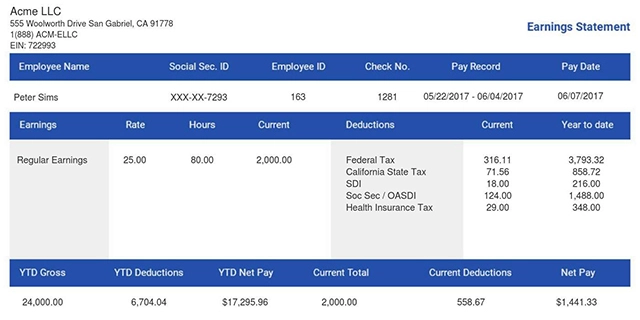
If your business needs payroll documentation for ERC audit readiness, loan applications, or HR compliance, a pay stub generator can help. ThePayStubs.com lets business owners create complete pay stubs showing gross wages, deductions, and net pay. That's the kind of clean payroll record the IRS looks for when reviewing an ERC claim.
You Might Also Like
- What Happens If You Don't File a W-2 Statement
- How to File Taxes with Your Last Pay Stub
- EITC Refund Date: What to Expect
- How to Calculate Tax on 1099-MISC Income
- W-2 vs 1099: How to File Taxes When You Have Both
Conclusion
The erc tax credit was one of the most valuable, and most misused, COVID-era relief programs. Businesses could receive up to $26,000 per employee in direct federal credits. But improper filings created real audit risk, and many of those audits are still playing out in 2026.
For small business owners who want solid payroll records for ERC audit readiness, proof of income, or general business use, visit ThePayStubs.com to create accurate pay stubs in minutes. Good payroll records are not just good practice. In 2026, they may be the most important business document you have.
- 1. Enter Your Information

- 2. Select Your Favorite Theme

- 3. Download Your Stub!


 By
By