

W-4 Form: What It Is and How To Fill It Out (2026)
 By
James Wilson
By
James Wilson The W-4 form is one of the first things you sign at a new job. Most people fill it out by guessing. That guess can cost you.
If you withhold too little from your paycheck, you may owe the IRS in April. If you withhold too much, you reduce your take-home pay all year and essentially give the government an interest-free loan. Both errors show up on your pay stub every pay period.
This 2026 guide covers what a W-4 is, why it matters, and how to fill out a W4 form step by step. If you're wondering "What is the W4?", you'll find the answer here. You'll also learn what a W4 tax form does to your take-home pay, when to update it, and the common mistakes that cost employees and small business owners at tax time.
Key Takeaways
-
The W-4 form, officially the Employee's Withholding Certificate, tells your employer how much federal income tax to deduct from each paycheck
-
Accurate withholding prevents a tax bill at filing time and keeps more money in your paycheck throughout the year
-
You can update your W-4 any time; no need to wait for open enrollment
-
Exemption status must be renewed each year by February 15, or withholding reverts to default
-
After your W-4 is processed, federal withholding appears on your pay stub as "FWT" or "Federal Income Tax"
- What Is a W-4 Form?
- What Is the Purpose of a W-4 Form?
- 2026 W-4 Form: What Changed
- How To Fill Out a W-4 Form Step by Step
- When Do You Need to Submit a New W-4?
- How To Claim Exemption on a W-4
- Common W-4 Mistakes To Avoid
- How Your W-4 Affects Your Pay Stub
- You Might Also Like
- Conclusion: Your W-4 Is Worth the 10 Minutes
What Is a W-4 Form?
A W-4 form is an IRS form that every employee fills out when starting a new job. Its official name is the Employee's Withholding Certificate. It controls federal income tax withholding from each paycheck. This keeps you paying taxes bit by bit rather than in one large sum at filing time.
For anyone asking, "What's a W4 form at their first job?" This is the document that sets your paycheck withholding for every pay period that follows. HR teams tracking "What is a W4 employee form?" should keep completed copies for at least four years.
The W-4 applies only to federal income taxes. Social Security tax and Medicare tax (together called FICA taxes) are fixed by law. Your W-4 has no effect on those deductions.
Filling out an employee W4 form follows the same five steps whether it's your first job or your tenth. Employers collecting completed W4 forms should keep them on file. They're needed for accurate W-2 reporting at year-end. You can download the current W-4 at irs.gov/pub/irs-pdf/fW4.pdf.
W-4 vs. W-2
You fill out your W-4 before your first paycheck to set your withholding. Your employer issues your W-2 form after the year ends. It shows your total wages and taxes withheld. You use the W-2, not the W-4, to file your income tax return.
What Is the Purpose of a W-4 Form?
Federal income tax is a pay-as-you-go tax. You pay it throughout the year, not all at once in April. Knowing the purpose of the W-4 form is key. If you're asking, "What's a W4 tax form?" It's the document that gives your employer what they need to withhold the right amount. If done right, it matches your actual tax bill so you don't end up owing or overpaying.
If you get it wrong, you may:
-
Under-withhold: A tax bill at filing, and potentially a $500 underpayment penalty for insufficient withholding.
-
Over-withhold: Smaller take-home pay all year. You get it back as a refund, but lose access to that money in the meantime.
If an employee doesn't submit a W-4, the employer defaults to single filer with no adjustments, typically the highest withholding rate.
2026 W-4 Form: What Changed

The 2020 redesign eliminated withholding allowances entirely. The old system of "claiming 3 allowances" no longer exists. Today's W-4 uses a 5-step process that directly reflects your financial situation.
For 2026, the updated standard deductions are:
-
Single / Married filing separately: $15,000
-
Married filing jointly: $30,000
-
Head of household: $22,500
New deductions for seniors and working Americans take effect for the 2025–2026 tax year. These may lower taxable income for eligible employees. They were enacted in July 2025 under the One Big Beautiful Bill Act.
The Tax Cuts and Jobs Act (TCJA) of 2017 got rid of personal exemptions. That's why the current form uses direct inputs like filing status, dependent credits, and extra income instead of the old allowance system.
How To Fill Out a W-4 Form Step by Step
Knowing how to complete a W4 correctly prevents the most common payroll errors. Here is how to fill out W4 in five steps. Filling out W-4 for the first time takes about 10 minutes.
To fill out a W-4 form, complete five steps. Enter your personal info and filing status. Account for income from multiple jobs or a working spouse. Claim dependents if eligible. Add other income or deductions. Then sign and date the form. Skip optional steps if they don't apply.
Step 1: Enter Personal Information
Provide your legal name, address, and Social Security number. Then select your filing status. This may be Single, Married Filing Jointly, or Head of Household. Head of Household applies if you're unmarried, have a dependent, and pay more than half of the household expenses.
Employers should note that this is where the employee confirms their legal name as it appears on their Social Security card. This matters for accurate W-2 reporting at year-end.
Step 2: Account for Multiple Jobs or a Working Spouse
This is where employees who don't know how to fill W-4 for dual-income households make costly errors. Complete Step 2 only if you hold more than one job or file jointly with a working spouse. Each employer withholds based only on what they know. Without this step, your combined withholding is almost always too low.
Use the IRS Tax Withholding Estimator (recommended). Before you start, gather your most recent pay stub, last year's tax return, and any expected bonuses. Go to irs.gov/individuals/tax-withholding-estimator. You can also use the Multiple Jobs Worksheet on page 3 of the form.
Step 3: Claim Dependents
If you have qualifying dependents:
-
Children under age 17: Multiply by $2,000 each (Child Tax Credit)
-
Other dependents: Multiply by $500 each (Credit for Other Dependents)
The Child Tax Credit can reach up to $2,200 per child in 2026. Phase-outs begin at $200,000 (single) or $400,000 (married filing jointly). This step lowers your withholding, so skip it if you'd rather keep the extra cushion against other income.
Step 4: Other Adjustments (Optional)
-
4(a): Non-job income, including freelance, dividends, and rental income
-
4(b): Use the Deductions Worksheet if you plan to itemize rather than take the standard deduction
-
4(c): Enter an additional dollar amount to withhold per paycheck. This is useful if you have self-employment or gig income (DoorDash, Uber) that doesn't have withholding elsewhere.
Step 5: Sign and Date
An unsigned form is not valid. Employers fill in the bottom section with their company name, address, Employer Identification Number (EIN), and the employee's first day of work. Employers must keep completed W-4 forms on file for at least four years.
When Do You Need to Submit a New W-4?

You don't have to renew your W-4 each year. It stays on file until you change it. But update it when:
-
You get married or divorced
-
You have or adopt a child
-
You start or leave a second job
-
Your spouse enters or exits the workforce
-
Your tax refund was unexpectedly large, or you owed more than expected at filing
To update mid-year: download the current form, complete it, and hand it to HR. No need to wait for open enrollment. Employers must implement changes within 30 days of receiving the updated form. Many employees search for "How to change my W-4 form online", but the IRS doesn't offer direct electronic filing for this form. You fill it out and give it to your employer.
If you're estimating what you'll owe before making changes, see how to file taxes with your last pay stub for a quick calculation.
How To Claim Exemption on a W-4
Withholding exemption means your employer won't take federal income tax from your paychecks. You qualify only if:
-
You had no federal tax liability last year (got a full refund of any tax withheld, or owed nothing)
-
You expect no federal tax liability this year
Example: A college student working part-time in the summer whose gross income falls well below the standard deduction threshold.
How to claim it: Complete Steps 1(a), 1(b), and Step 5 only. Write "Exempt" in the blank below Step 4(c).
Caveats: FICA taxes (Social Security and Medicare) still apply. And the exemption must be renewed by February 15 each year.
If you miss the deadline, your employer may revert to default single-filer withholding.
Common W-4 Mistakes To Avoid
Getting the W-4 form wrong rarely surfaces until tax season. Not knowing how to fill out the W4 form for your specific situation is behind most of these errors. Watch for these five:
-
Over-withholding by skipping Step 3: If you have qualifying dependents and don't claim them, you're leaving money on the table each paycheck.
-
Under-withholding by ignoring a spouse's income or second job: Each employer withholds as if that's your only income. The combined total is often short.
-
Not updating after a major life event: Marriage, a new baby, or a second job all change your withholding needs. An outdated W-4 keeps quietly working against you.
-
Claiming to be exempt when you don't qualify: You'll owe a full year of federal income tax at filing, plus potential interest and penalties.
-
Forgetting about untaxed income: Freelance, gig work, or investment gains have no built-in withholding. Use Step 4(a) or quarterly estimated payments to cover the gap.
Use the IRS Tax Withholding Estimator to check your current withholding. It takes about 10 minutes.
How Your W-4 Affects Your Pay Stub
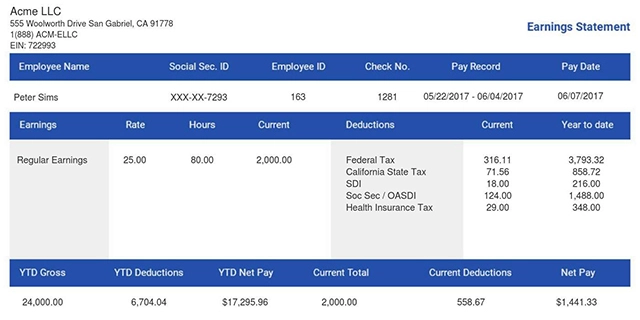
Once your employer processes your form, the result shows up on every paycheck. Look for the line labeled "FWT," "Fed Tax," or "Federal Income Tax" on your pay stub. That dollar amount is your withholding in action.
If it looks off after an update, give it one pay cycle. Still wrong? Follow up with HR to confirm the new W-4 was entered correctly in payroll.
For small business owners, clear pay stubs that show federal withholding, FICA, and net pay not only build trust but also support payroll compliance. Use our pay stub generator at ThePayStubs.com to create pay stubs for your staff or your own records.
You Might Also Like
Conclusion: Your W-4 Is Worth the 10 Minutes
Your W-4 controls how much of your money goes to the IRS versus your bank account each year. Filling it out with care and updating it when your life changes are among the easiest ways to stay ahead at tax time.
Use the IRS Tax Withholding Estimator to confirm your withholding is accurate. Then use the pay stub generator at ThePayStubs.com to create professional pay stubs that clearly show your federal withholding and net pay. It works for employees tracking their own records and small business owners managing payroll.
- 1. Enter Your Information

- 2. Select Your Favorite Theme

- 3. Download Your Stub!

 By
By