

What Can I Write Off on My Taxes? 2026 Self-Employed Guide
 By
By
What can I write off on my taxes? That is the top question every tax season. Most self-employed workers leave hundreds or even thousands of dollars on the table. The IRS lets you deduct costs that pass the "ordinary and necessary" test. The expense must be common in your field. It must tie to your work. A pay stub creator helps you track income all year long, not just at filing time.
An ordinary expense is one that a typical business in your field would pay. A necessary expense is one that fits your work. It does not have to be required. It just has to make sense. That two-part test is the base of every deduction on this list. Every worker should know "What can I write off on my taxes?" and how to claim each one.
This guide covers the full picture. It walks through self-employment tax deductions for freelancers, sole proprietors, gig workers, and small business owners. It also covers write-offs for W-2 employees. You will find dollar limits, how to do the math, and every new deduction from the One Big Beautiful Bill Act. Real savings exist on both sides of the work line. You just need to know where to look.
Key Takeaways
- Self-employed workers can deduct home office costs, mileage at $0.70 per mile, health insurance, and half of the self-employment tax
- W-2 employees can deduct retirement contributions, HSA funds, student loan interest, and charitable gifts without itemizing
- If you itemize, you can also deduct mortgage interest, SALT (capped at $40,000), and medical costs above 7.5% of your adjusted gross income
- New for 2026: the OBBBA added deductions for tips, overtime pay, car loan interest, and a bigger senior deduction
- Keep every receipt. The IRS needs proof for every deduction you claim
- What Can I Write Off on My Taxes? The Full List
- Self-Employment Tax Deductions: The Complete List
- Home Office Deduction: Two Ways To Calculate It
- Business Vehicle and Mileage Tax Deductions
- Above-the-Line Deductions for Self-Employed and Everyone Else
- What Can I Write Off on My Taxes as a W-2 Employee?
- New 2026 Tax Write-Offs You Should Not Miss
- What Cannot You Write Off on Your Taxes?
- How To Claim Self-Employment Tax Deductions on Schedule C
- Self-Employed Tax Deductions Worksheet and Gig Worker Checklist
- How Pay Stubs Connect to Tax Deductions
- You Might Also Like
- Conclusion
What Can I Write Off on My Taxes? The Full List
You can write off costs the IRS calls "ordinary and necessary" for your work. Self-employed people can deduct home office costs, mileage ($0.70 per mile in 2025), health insurance, and retirement plan payments. W-2 employees can deduct charitable gifts, mortgage interest, and retirement payments, even if they do not itemize.
A tax write-off (also called a tax deduction or tax right off) cuts your taxable income, not your tax bill. If you are in the 22% bracket, a $1,000 deduction saves you $220, not $1,000. That is why stacking many deductions matters.
What deductions can I claim? Beyond the ordinary-and-necessary test, deductions fall into two groups.
What are tax-deductible expenses? They split into two types. They include:
- Above-the-line deductions: These cut your adjusted gross income (AGI). Everyone can use them, even with the standard deduction. Self-employed retirement payments, student loan interest, HSA funds, and health insurance all go here.
- Below-the-line deductions: These are itemized deductions and only help if your total beats the standard deduction. Mortgage interest, the SALT deduction, and high medical costs go here.
| Filing Status | 2025 Standard Deduction |
|---|---|
| Single | $15,000 |
| Married Filing Jointly | $30,000 |
| Head of Household | $22,500 |
Most W-2 employees take the standard deduction. Self-employed workers get their above-the-line cuts first. Then they pick standard or itemized. That is why self-employed deductions carry so much weight.
These deductions help sole proprietors, LLCs taxed as self-employed, freelancers, contractors, and gig workers. W-2 employees have a smaller set. The things you can write off on taxes vary by group. The rest of this guide answers "What can I write off on my taxes for each group?" in detail.
Self-Employment Tax Deductions: The Complete List
What can I write off on my taxes if I file a Schedule C? You have access to a strong tax-deductible expenses list. Here is how each category works. These are the core self-employed tax deductions that cut your tax bill the most.
Self-Employment (SE) Tax Deduction
W-2 workers split Social Security and Medicare taxes with their boss. The self-employed pay both sides, that is, 15.3% of net income. That combined charge is the self-employment tax.
The good news is that you can deduct half of what you pay. That is the employer portion (7.65%). It is an above-the-line deduction, so it cuts your AGI.
Real numbers: If your net profit is $50,000:
- SE tax = $50,000 x 0.9235 x 15.3% = about $7,065
- Deduction = $7,065 x 50% = $3,533
That $3,533 comes off your AGI before income tax kicks in. Claim it on Schedule SE, filed with your Form 1040. This is one of the most missed self-employment expenses. Do not skip it. When people ask, "What can I write off on my taxes?" this deduction should be at the top.
Health Insurance Premiums
This is one of the best above-the-line deductions. It includes 100% of health, dental, and long-term care premiums for you, your spouse, and your dependents. This is a full above-the-line deduction and one of the largest for sole proprietors.
Two rules apply, including:
- You cannot be on an employer plan (a spouse's plan counts).
- Your business must show a net profit.
The deduction caps at your net self-employment income for the year.
Advertising and Marketing
Most money you spend to draw in clients is deductible. Online ads, social media, content, business listings, and branded items all count. Web design, logos, and email tools do too.
This can be confirmed if the cost pushes your business forward. A personal hobby does not count. A targeted ad campaign for your freelance work does.
Office Supplies and Equipment
Pens, paper, and printer ink are 100% deductible when you buy them. For big items (a laptop, camera, or tools), use Section 179 to deduct the full cost in year one. You can also spread the cost over many years. Most self-employed workers take the full deduction right away.
Business Insurance
General liability, professional liability (errors and omissions), property insurance, and workers' comp for your staff are all deductible. Personal life and disability insurance are not.
Professional Fees
Fees paid to CPAs, lawyers, tax pros, and business advisors for work purposes are deductible. A lawyer who reviews a client's contract? Deductible. Personal legal help, like estate planning? Not deductible.
Professional Development and Education
Courses, workshops, conferences, trade books, and classes that build skills for your current work are deductible. The keyword is "current." The training must improve your existing work, not start a new career.
A freelance writer can deduct a content strategy course. A rideshare driver cannot deduct business school tuition.
Contractors and Freelancers (Form 1099-NEC)
Payments to subs, contractors, or freelancers you hire are deductible. If you paid someone $600 or more, you must file Form 1099-NEC to report it. The deduction applies no matter what. But missing the 1099-NEC filing brings IRS fines.
Retirement Plan Contributions
Self-employed workers can put money into their own retirement plans and deduct it. This is often one of the largest sole proprietor deductions. It is also one of the top answers to "What can I write off on my taxes for high earners?"
| Plan | 2025 Limit |
|---|---|
| SEP IRA | Up to 25% of net income (max $70,000) |
| SIMPLE IRA | $16,500 (plus $3,500 catch-up if 50+) |
| Solo 401(k) | $70,000 total (employee + employer) |
| Traditional IRA | $7,000 ($8,000 if 50+) |
SEP IRA plans are the go-to for most self-employed people. You can open one and add funds up to the tax filing deadline, with extensions. That lets you max the deduction after you see your final net income.
Meals (50% Rule)
The business meals deduction covers 50% of meals with clients or staff when there is a clear work reason. Examples include a project talk, a sales pitch, or a review. Office snacks for your team also qualify at 50%.
Meals you eat alone while working are personal. They do not qualify. Check the full list of business expenses above to see what else counts.
Business Travel
The business travel deduction covers flights, trains, rental cars, hotels, and 50% of meals when the trip has a real work purpose. The trip must have a main business purpose. If you add personal days to a work trip, only the work portion counts.
For trips that mix work and personal time, the ratio of business to personal days sets the split.
Phone and Internet
You do not need a separate business line. The business-use share of your phone and internet plan counts. If you use your phone 65% for work calls, emails, and apps, deduct 65% of the monthly bill. Keep a short note on how you figured the work-use share. Auditors may ask.
Software Subscriptions
SaaS tools, accounting apps, project platforms, cloud storage, and design suites used in your business are 100% deductible. Annual costs are fully deductible in the year you pay.
Qualified Business Income (QBI) Deduction
Sole proprietors, LLC owners, and partners in pass-through entities may deduct up to 20% of qualified business income. This is one of the most powerful self-employed write-offs.
Income limits apply for 2025. The deduction phases out at $197,300 (single) or $394,600 (married filing jointly). Service fields like law, health, and finance face extra rules. A tax pro can confirm if you qualify.
Real-world example: Freelance Graphic Designer
Maya earns $60,000 in freelance income. Here are her examples of tax deductions:
| Deduction | Amount |
|---|---|
| SE tax deduction (half of $8,478) | $4,239 |
| Health insurance premiums | $7,200 |
| Home office (200 sq ft, simplified) | $1,000 |
| Vehicle mileage (5,000 mi x $0.70) | $3,500 |
| Software subscriptions | $1,800 |
| Professional development | $1,200 |
| Advertising and marketing | $2,400 |
| Total deductions | $21,339 |
Maya cuts her taxable income from $60,000 to about $38,661 before the QBI deduction. A steady tracking system helps her log tax expense categories all year long. Her case shows "What can I write off on my taxes in a real-world setting?"
Home Office Deduction: Two Ways To Calculate It

What can I write off on my taxes for a home office? The home office deduction helps self-employed people who use a set space only for work. The space can be a room, a clear area, or a separate building, such as a garage studio.
"Regularly and exclusively" are both required. A guest room you also sleep in does not qualify. A room used only for client work does.
Two ways to figure this deduction:
| Simplified Method | Regular Method | |
|---|---|---|
| How it works | $5 per sq ft of home office | Work-use % x total home costs |
| Max deduction | $1,500/year (300 sq ft cap) | No cap, based on real costs |
| Example (200 sq ft, $18,000 home costs) | 200 x $5 = $1,000 | 20% x $18,000 = $3,600 |
| Records needed | Very few | Receipts for all home costs |
| Depreciation recapture | None | Applies when you sell |
Which To Choose
The regular method gives a bigger deduction in most cases. But it means tracking all home costs, including rent or mortgage interest, property taxes, power, insurance, and repairs. If your office is small or records feel like a burden, the simplified method works well.
Costs tied only to the office (a business phone line, office-only repairs) are 100% deductible. Shared costs (electric bill, internet) are split by the home-use share.
Business Vehicle and Mileage Tax Deductions
What can I write off on my taxes for vehicle use? Your car can be one of the biggest entries on your tax write-off list if you drive often for work. The IRS offers two ways to figure this out:
Standard Mileage Rate (2025)
$0.70 per mile for business driving. Multiply your work miles by $0.70.
Example: 8,000 work miles x $0.70 = $5,600 deduction
Actual Expense Method
Track every car cost (gas, oil, insurance, tags, repairs, and depreciation). Then multiply by the share of miles driven for work. If 60% of your driving is for work, you deduct 60% of all car costs.
How to choose: The standard rate is simpler and works well for high-mileage drivers. The actual method can save more for pricey cars with lower miles. Once you pick the actual method for a car, you usually cannot switch back.
Work mileage includes:
- Client meetings and site visits
- Work errands (supply runs, bank trips)
- Travel between two job sites
- Trips to a short-term work location
Commuting is never deductible. Driving from home to your main workplace is personal, even for the self-employed.
Use a mileage app to log trips. Keep records of the date, where you went, why, and how far you went. IRS auditors look for this.
Above-the-Line Deductions for Self-Employed and Everyone Else

What can I write off on my taxes before choosing standard or itemized? Above-the-line deductions cut your adjusted gross income first. Everyone can use them. That makes them very useful for self-employed business expenses planning.
Retirement Contributions
Payments to a Traditional IRA, SEP IRA, SIMPLE IRA, or Solo 401(k) are deductible within set limits. For most self-employed workers, the SEP IRA has the highest caps and the most freedom. You can add funds up to the filing deadline, with extensions.
Student Loan Interest
Deduct up to $2,500 in interest on student loans. For 2025, this phase-out occurs at $80,000 MAGI (single) and $170,000 (married filing jointly). The loan must be in your name.
Health Savings Account (HSA) Contributions
HSA funds have a triple tax win. Deductible going in, tax-free growth, and tax-free payouts for medical costs. 2025 limits are $4,300 (self-only) and $8,550 (family). You must have a high-deductible health plan (HDHP).
Educator Expenses
K-12 teachers can deduct up to $300 in supplies bought out of pocket. These include books, tools, or gear for students. Both teachers in a joint filing can each claim $300.
Self-employed workers often claim retirement funds, SE tax, and health insurance above the line. If you also earn W-2 income, knowing how to calculate W-2 wages from a pay stub helps you match both streams. These three cuts lower AGI by a lot.
What Can I Write Off on My Taxes as a W-2 Employee?
What can I write off on my taxes with a W-2? You can deduct retirement payments (IRA, 401k), student loan interest (up to $2,500), HSA funds, and charitable gifts, even without itemizing. If you itemize, add mortgage interest, SALT (capped at $40,000), and medical costs above 7.5% of AGI.
W-2 employees have fewer deductions than the self-employed. The deductions for self-employed workers are far broader. Comparing W-2 vs 1099 tax rules shows how big the gap is. The above-the-line cuts still apply. When you itemize, more write-offs open up.
Should You Itemize?
For 2025, the standard deduction is $15,000 (single), $30,000 (married filing jointly), and $22,500 (head of household). If your itemized total beats the standard amount, itemizing saves more. For most workers, the standard wins. Homeowners in high-tax states often come out ahead by itemizing.
Charitable Donations
Cash gifts, goods given to charities (at fair market value), and miles driven for charity ($0.14/mile) count when you itemize. Get a written note for any gift over $250.
Mortgage Interest
Interest on your home loan (up to $750,000 in principal for loans after December 15, 2017) is deductible. Starting in 2026, PMI premiums are deductible again for those who qualify under the OBBBA.
SALT Deduction
The state and local tax (SALT) deduction covers state income taxes (or sales taxes) plus property taxes. The cap is $40,000 per household in 2025, up from $10,000. That jump helps people in California, New York, and New Jersey the most.
Medical Expenses
Medical and dental costs above 7.5% of your AGI are deductible when you itemize. If your AGI is $80,000, costs above $6,000 count. Save EOB statements and receipts all year.
Not sure how to read your W-2 income statement? That is a separate skill from knowing what to deduct.
Employee Business Expenses
W-2 employees cannot deduct work costs, even for home offices set up for required remote work. This rule began in 2017 and has not changed.
Run both scenarios (standard vs. itemized) in tax software like TurboTax before filing. Most tools compare and pick the bigger deduction for you.
New 2026 Tax Write-Offs You Should Not Miss
The One Big Beautiful Bill Act (OBBBA) added new deductions for 2025 and 2026. Some help workers who have never had strong write-offs before. Wondering what things are tax-deductible under the new law? What can I write off on my taxes that was not available last year? Here are the key changes.
Tips Deduction
Workers in tipped roles (restaurants, salons, hospitality) can exclude up to $25,000 in tip income from federal taxes. This runs from 2025 through 2028.
Overtime Pay Deduction
Workers can deduct up to $12,500 (single) or $25,000 (married filing jointly) in overtime pay. It phases out at $150,000 (single) and $300,000 (MFJ). It also ends after 2028.
Car Loan Interest Deduction
Interest on a new car loan for a vehicle built in the U.S. is now deductible, up to $10,000 per year. This covers cars bought between 2025 and 2028.
Enhanced Senior Deduction
People 65 and older can claim an extra $6,000 each ($12,000 for married couples where both are 65+). This is much more than the old extra standard deduction for seniors.
Charitable Giving Without Itemizing
Starting in 2026, all taxpayers can deduct up to $1,000 ($2,000 joint) in cash charity gifts, even without itemizing.
What Cannot You Write Off on Your Taxes?
Not everything counts when you ask, "What can I write off on my taxes?" Personal costs (clothes, haircuts, gym fees, vacations, and commute costs) are not deductible. W-2 employees cannot deduct work costs at all, a rule since 2017. Federal income tax, fines, and penalties are also off limits. If an expense is personal, it does not qualify.
Even when a cost feels tied to your job, some types always fail the IRS test:
- Clothing and grooming: Work clothes count only if they are a required uniform that cannot be worn off the job. Chef jackets, scrubs, and safety gear qualify. A business suit does not, even if you wear it only to work.
- Commuting: Driving from home to your main workplace is personal. This holds even for long drives or odd hours.
- Mixed personal and work costs: A vacation with a few work calls is not a business trip. A solo lunch while reading client notes does not count as a business meal.
- Gym fees: Unless you are a personal trainer who works at the gym, gym costs are personal.
Gray areas exist. Clothing worn only at work and not fit for daily wear may qualify. Home upgrades count only for the part tied to a qualifying home office. When in doubt, keep notes. The IRS looks at your intent and your records.
How To Claim Self-Employment Tax Deductions on Schedule C
What can I write off on my taxes using Schedule C? Self-employed workers list their tax deductions for self-employed on Schedule C (Profit or Loss from Business), filed with Form 1040. The Schedule C expenses list covers every allowed business cost. Your Schedule C deductions go here.
Schedule C Layout:
- Part I: Report gross business income
- Part II: Standard cost groups (ads, car costs, insurance, legal fees, office costs, rent, repairs, utilities, wages, and more)
- Part V: Other costs not in Part II (custom groups like software, training, or platform fees)
The QBI deduction does not go on Schedule C. It goes on Form 8995. The result then shows on your Form 1040.
Quarterly Estimated Taxes
Every self-employed business owner must pay quarterly taxes because no boss withholds for them. Missing or short payments trigger a penalty, even if you pay in full by Tax Day.
| Quarter | Period | 2026 Due Date |
|---|---|---|
| Q1 | January to March | April 15, 2026 |
| Q2 | April to May | June 16, 2026 |
| Q3 | June to August | September 15, 2026 |
| Q4 | September to December | January 15, 2027 |
Use Form 1040-ES to figure and send each payment. The IRS has an online portal at IRS.gov for ACH and card payments.
Recordkeeping
Keep all receipts, bank records, mileage logs, and invoices for at least 7 years from the filing date. Digital copies (scanned receipts in folders, cloud-backed bank records) are fine.
The top Schedule C audit flag is mixing personal and business funds in one account. Some people try to file taxes with their last pay stub as a starting point. Open a separate business checking account. It makes tracking easier and gives clear proof of business costs.
Self-Employed Tax Deductions Worksheet and Gig Worker Checklist
Use this self-employed tax deductions worksheet to find every deduction you may have missed. It covers the most common gaps for gig workers, 1099 contractors, and freelancers.
Many creative tax deductions for small business owners hide in plain sight. Tracking your self-employment deductions all year makes filing much smoother. A small business tax deductions worksheet like this one helps you stay on top of every cost.
Looking for tax write-offs for self-employed people? Check each item below. You may also want to review deductions for self-employment that apply to platform-based work.
Gig Worker Deduction Checklist:
- Phone bill: Track the share used for maps, app logins, and client texts
- Vehicle mileage: Log every trip with date, start, end, and work reason
- Home office: If you dispatch from home, handle bookings, or do client work from a set space
- Platform fees: Uber, DoorDash, Upwork, and Fiverr take a cut of your pay. That fee is a deductible cost
- Equipment and tools: Delivery bags, phone mounts, cameras, or gear tied to your gig
- Self-employment tax: Half is always deductible. This is often missed
- Health insurance: If you lack employer coverage, 100% is deductible
- Professional development: Any course or resource that builds skills in your current work
How Pay Stubs Connect to Tax Deductions
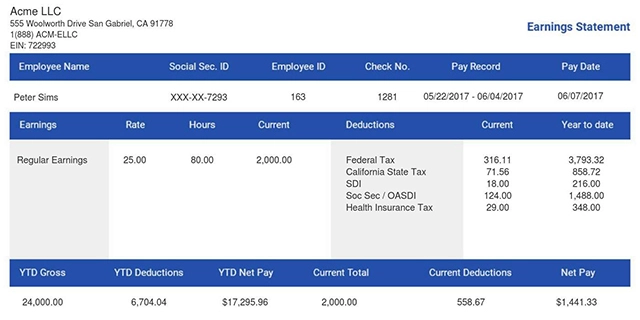
Self-employed workers who create pay stubs through ThePayStubs.com can use those stubs as income records for Schedule C. Each stub shows gross and net pay, the same figures you report. Lenders and landlords often need proof of income documents. Pay stubs serve that need.
If you have employees, pay stubs tie to your sole proprietorship tax deductions too. Each stub documents deductible payroll costs, including wages, employer FICA (Social Security and Medicare), and related expenses. The independent contractor deductions and payroll cost groups on your worksheet map to what a good pay stub system tracks each month.
Keep every pay stub as part of your 7-year tax file, along with receipts and mileage logs.
You Might Also Like
- How to Calculate Tax on 1099-MISC Income
- 5 Tips to Reduce Taxes on 1099 Income
- Freelancing for Beginners: 1099 vs W-2
- What Happens If You Don't File a W-2 Statement
- FIT Taxable Wages: What They Mean on Your Pay Stub
Conclusion
Now you know "What can I write off on my taxes for nearly every work situation.?" Real tax deductions exist on both sides of the work line. Freelance designers, gig drivers, small business owners, and W-2 employees with a mortgage all have savings within reach. The IRS "ordinary and necessary" test is your guide. If a cost is common in your field and supports your work, document it and claim it.
Start tracking now. Review all of your self-employed tax write-offs before you file. Every mile you log, every receipt you save, and every work cost you record is money you get to keep. Use a simple pay stub generator to document your income and costs. When tax time hits, you will have the records you need.
- 1. Enter Your Information

- 2. Select Your Favorite Theme

- 3. Download Your Stub!


 By
By