

What Is a Business Certificate? 2026 Guide for Owners
 By
By
So what is a business certificate? That depends on which one you mean. Search the term and you'll get three different answers on one page. One is a filing at your town hall. Another is a supplier credential for government contracts. The third is a college program you finish in six months. They share a name and little else, which is why the term trips up new owners.
Here's what a business certificate actually is in each sense, and where our pay stub generator fits once the name is official and your pay records need to match it. We'll start with the meaning most people want: the local filing that puts your business name on public record. You'll also get the entity rules that decide whether you need one, plus the filing steps and real costs. Then come renewal deadlines and a plain comparison against an EIN, an LLC, and a business license.
Key Takeaways
- A business certificate is usually a DBA filing that puts your trade name on public record
- You file it with your city, town, or county clerk, not with the IRS
- It is not a business license, an LLC, or a trademark, and it provides no liability protection
- Two other things share the name: supplier certifications such as WOSB or MBE, and academic certificate programs
- Renewal runs on a clock in most places, and late filers can be fined
- What Is a Business Certificate?
- Who Needs a Business Certificate?
- The Three Meanings of "Business Certificate"
- How to Get a Business Certificate
- Business Certificate vs. EIN, LLC, and Business License
- How Much Does a Business Certificate Cost?
- What a Business Certificate Does Not Do
- What Is a Business Certificate Worth Once You Have One?
What Is a Business Certificate?
A business certificate is a public filing that links a trade name to the person or company behind it. Most often called a DBA, or doing business as, it is filed with your city, town, or county clerk. It records your business name and owner address, and it is not a license.
You'll see the same document called a few different things depending on where you live. Trade name, fictitious name, assumed name, and certificate of assumed name all describe the same filing. The paperwork connects two names: your legal name and the one on your sign.
Your legal name is whatever you registered when you formed the company, or your own full name if you're a sole proprietor. So if Maria Delgado runs her bookkeeping practice as "Riverside Books," those two names don't match. The certificate closes that gap for anyone who needs to know who's behind the business.
That's the meaning that sends most people searching. Two others share the name, and we'll sort those out below.
Who Needs a Business Certificate?

You need a business certificate whenever you operate under a name that is not your legal name. Sole proprietors using their own full name are usually exempt. General partnerships almost always file. LLCs and corporations register an assumed name with the state instead of the town clerk.
Three rules cover nearly every situation:
- Sole proprietors: In a sole proprietorship you only file if you use a name other than your own. "Maria Delgado" needs nothing; "Riverside Books" does.
- General partnerships: You'll almost certainly file, because partnerships nearly always trade under a business name rather than a list of the partners' names. Partners who also take 1099 contractor work keep those records separate.
- LLCs and corporations: Your legal name is already on record with the state. You only file if you want to trade under a different one, and that filing typically goes to the state, not the town clerk.
One trigger catches people off guard: changing your business name means filing again. A new name is a new certificate, not an edit to the old one.
The Three Meanings of "Business Certificate"
The reason this term feels slippery is that three unrelated documents wear the same label. So what is a business certificate in your case? Here's how to tell instantly which one you're looking for.
A DBA or Assumed Name Filing
This is you if you're registering a name to operate under. It's a local filing, usually handled by a city, town, or county clerk's office. It's also the meaning behind most searches for a business certificate.
The filing itself is simple: a short form, a signature, and a small fee. It produces a stamped certificate. Show it to a bank, a landlord, or a client who wants to confirm who owns the business. It usually sits alongside the other proof of income documents those parties ask for. Most small business owners encounter this one first, often the same week they open a business bank account.
A Supplier or Diversity Business Certification
This is you if you want access to contracts reserved for certain kinds of owners. These are business certifications, not filings, and they're awarded after a review of your ownership and operations.
On the federal side, the Small Business Administration runs three of the best-known programs. The 8(a) Business Development Program serves socially and economically disadvantaged owners. HUBZone supports businesses in historically underutilized areas. There's also the Women-Owned Small Business program. The numbers are why owners bother: the government aims to steer at least 23% of all federal contracting dollars to small businesses each year, including 5% to small disadvantaged businesses, 5% to women-owned firms, and 3% to HUBZone firms. Certification is what lets you compete for the set-aside and sole-source contracts inside those targets. Private certifiers cover the corporate side: WBENC for women-owned firms, NMSDC for the Minority Business Enterprise credential, and NGLCC for LGBT-owned businesses. There are also veteran-owned programs, B Corp status for mission-driven companies, and LEED for buildings.
Expect real work. The certification process usually includes paperwork, an application fee, and often a site visit. Thresholds change too, so check current requirements with the certifying body rather than a blog.
An Academic Business Certificate
This is you if you're adding a credential rather than registering a business. Certificate programs from colleges and online providers focus on one area, such as project management, marketing, finance, or business analytics.
They take months rather than years, cost far less than a degree, and often carry credits that transfer if you later enroll in one. For working professionals, that's the appeal: a targeted skill without a multi-year commitment.
How to Get a Business Certificate

Filing a DBA is one of the shorter errands in business setup. The steps rarely change:
- Confirm where you file. Sole proprietors and general partnerships file locally, usually with the city, town, or county clerk. LLCs and corporations file an assumed name with the state.
- Search the name first. Clerk offices and state databases let you check whether your name is already taken. Doing this before you print signs saves money.
- Complete the form. You'll list the business name, the address, and every owner's legal name and home address.
- Sign it, often in front of a notary. Many offices won't accept an unnotarized signature.
- Pay the filing fee. Amounts are set locally.
- Keep the stamped copy. Banks ask for it, and it's your proof the name is registered.
Pro tip: call the clerk before you go and ask three questions. Do they take walk-ins or require an appointment? Does the signature need to be notarized? What payment methods do they accept? Plenty of offices are still cash-or-check only, and a wasted trip is the most common way a first filing goes sideways. Local rules vary here the same way state pay stub laws do, so never assume the neighboring town works the same way.
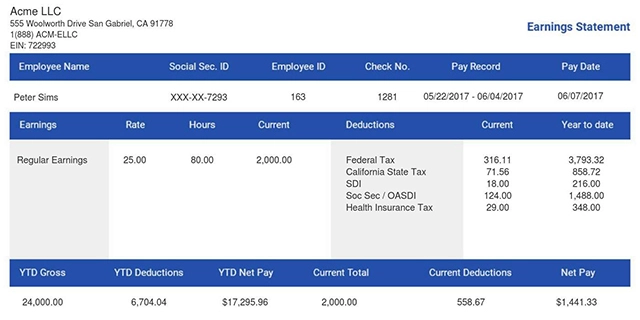
Once the name is registered, our pay stub templates give you records that match it.
Business Certificate vs. EIN, LLC, and Business License
These four get mixed up constantly, and they do genuinely different jobs.
| Document | What It Is | Who Issues It | What It Gets You |
|---|---|---|---|
| Business certificate (DBA) | Public record of a trade name | City, town, or county clerk (or the state for LLCs) | The right to operate and bank under a name that isn't your legal name |
| EIN | A federal tax ID for your business, also called a FEIN | IRS, free and issued immediately online | Payroll, business tax filings, and most business bank accounts |
| LLC | A separate legal entity | Your state's business filing office | Liability separation between business and personal assets |
| Business license | Permission to run a specific activity or location | State, county, or city agency | Legal authority to operate in a regulated field |
One warning worth repeating: an EIN is free from the IRS and arrives in minutes online. Paid filing services rank well for that search, but you never have to pay a fee for one.
How Much Does a Business Certificate Cost?
Filing fees are set by your city, town, or county, so there is no national price; the clerk's office publishes the current amount. Processing can take from same day to a few weeks. Renewal matters too: Massachusetts certificates run four years, and letting one lapse can draw a fine of up to $300 for every month the violation continues.
That Massachusetts example is worth borrowing even if you're nowhere near it, because it shows what "requirements vary" means in practice. Under M.G.L. ch. 110, section 5, a business certificate stays in force for four years from the date of issue and goes void unless you renew it. Miss that renewal and the statute allows a fine of up to $300 for each month the violation continues. Other places set their own terms. Ask the clerk for your expiration date when you file, and put it on the calendar the same day.
What a Business Certificate Does Not Do
This is where the document gets oversold, so here's the short list of what it doesn't cover.
- It's not liability protection. The Small Business Administration puts it plainly: registering a DBA name "doesn't provide legal protection by itself." If you want your personal assets separated from the business, that's an LLC or a corporation.
- It's not a trademark. Registering a name locally doesn't give you ownership of it, and trademark infringement laws still apply if someone else holds the mark.
- It's not a business license. Massachusetts spells this out on its own guidance page. Many businesses need both, from different offices.
- It's not an EIN or a tax registration. Those are separate, and you'll likely need them too.
What Is a Business Certificate Worth Once You Have One?
A filed business certificate lets you bank, invoice, and sign contracts under your trade name instead of your personal one. It won't shield your personal assets. But it makes the business name usable in the places that ask for proof: banks, landlords, vendors, and clients.
Once the stamped copy is in hand, a few things open up quickly. You can open a business bank account under the trade name. Checks made out to the business can be deposited there instead of to you personally. You can sign contracts, vendor agreements, and leases in the business name, and put that name on invoices, estimates, and receipts.
The part that catches people later is matching paperwork. Once you operate under a business name, your records need to match it. If you pay yourself from the business, document that income the way a lender or landlord expects to see it. "I own the company" isn't proof of income on its own. The same goes the moment you hire your first employee: clear, itemized pay records stop being optional.
That's where showing proof of income while self-employed gets practical. Many owners create a self-employed pay stub each pay period so the paper trail matches the registered name.
You Might Also Like
- Employment Verification and Proof of Income Documents
- How to Write a Proof of Income Letter for Apartments
- Freelancing for Beginners: 1099 vs W-2
- EIN Lookup: How to Find a Business Tax ID
- Paystub Generator for the Self-Employed
Conclusion
What is a business certificate for you? Start by naming which document you actually need. If you're registering a name to trade under, that's a DBA filed with your local clerk. It takes one short form plus a fee. If you're chasing set-aside contracts, that's a certification with a real review behind it. If you're building skills, that's a certificate program.
Whichever one applies, keep your records consistent once the business name is official. When you need professional pay documentation for yourself or your team, our pay stub generator creates accurate stubs in minutes.
- 1. Enter Your Information

- 2. Select Your Favorite Theme

- 3. Download Your Stub!

 By
By