

FLSA Exemption Test: How to Tell If a Job Is Exempt (2026)
 By
By
A salary and a manager title don't make a job exempt from overtime. The FLSA exemption test does. It's the federal check that decides if a worker gets time and a half after 40 hours a week, or if a fixed salary covers every hour. It also changes what each stub shows, whether it comes from payroll software or a paystub maker.
Getting it right matters on both sides of the paycheck. Owners need it to set pay and avoid back wage claims. Workers need it to know if they're owed overtime. This guide walks through each part of the test, gives you a quick questionnaire, and shows real examples. You'll also see how each result looks on a pay stub.
Key Takeaways
- A job is exempt only if it passes all three checks: salary level, salary basis, and duties.
- The federal salary floor for 2026 is $684 per week, or $35,568 per year.
- Job duties decide the result, not job titles.
- Blue-collar workers and front-line first responders like police and firefighters don't qualify for these exemptions.
- What Is the FLSA Exemption Test?
- The Three Parts of the FLSA Exemption Test
- The Exempt Duties Test by Job Category
- Which Jobs Can't Pass the Duties Test?
- FLSA Exemption Test Questionnaire: 7 Quick Questions
- Exempt vs Non Exempt Duties Test Examples
- How the FLSA Exemption Test Shows Up on a Pay Stub
- FLSA Overtime Exemptions and Misclassification Risks
What Is the FLSA Exemption Test?
The FLSA exemption test is the three-part check the U.S. Department of Labor uses to decide whether a job is exempt from federal minimum wage and overtime rules. An employee must earn at least $684 per week, be paid a fixed salary, and have a primary duty that fits an exempt category.
The Fair Labor Standards Act sets the federal rules for minimum wage and overtime. Most workers are covered by default. An exempt employee is the exception: they're paid a salary and don't earn overtime. A non-exempt employee gets at least minimum wage and 1.5 times their regular rate for hours over 40 in a workweek.
People also call this the FLSA exempt test. The name changes, but the rule is the same. The employee must pass every part, or the job stays non-exempt.
The Three Parts of the FLSA Exemption Test

Think of the three parts as gates. A job has to clear all of them in order.
Salary Level Test
The worker's weekly pay must be at least $684 ($35,568 a year). In 2024, the Labor Department tried to raise this floor, but a federal court struck the rule down that November. So the 2019 level still applies in 2026. Some states, such as California, New York, and Washington, set a higher bar. When state and federal rules differ, the one that pays the worker more wins.
Salary Basis Test
Pay has to arrive as a set amount each pay period, and it can't drop because the work was slower or lower in quality. In most cases, you can't dock pay for a partial day. You can deduct a full day taken off for personal reasons.
This is where plenty of "salaried" jobs quietly fail. If an employer makes a habit of improper deductions, like cutting pay by the hour for a late start, the job can lose its exempt status under the salary basis test.
Duties Test
Here the focus shifts from pay to the work. What counts is the primary duty: the main, most important part of the role, not a task done now and then.
The FLSA duties test looks at how the person really spends a normal week, so a job posting or a title on its own won't settle it.
The Exempt Duties Test by Job Category
The duties test for exempt employees changes with the type of work. Federal law lists a few main FLSA exemptions, and each one has its own rules.
| Category | What the job must involve | Salary rule |
|---|---|---|
| Executive | Manages the business or a department, directs at least two full-time workers, and can hire or fire (or has real input) | $684 per week |
| Administrative | Office work tied to running the business, using independent judgment on matters of significance | $684 per week |
| Learned professional | Work that needs advanced knowledge in science or learning, usually from years of study | $684 per week |
| Creative professional | Work that needs invention, imagination, or talent in an artistic field | $684 per week |
| Computer employee | Systems analysis, programming, or software engineering | $684 per week or $27.63 an hour |
| Outside sales | Making sales away from the employer's place of business | No salary test |
| Highly compensated | Office work, at least one exempt duty, and $107,432 or more in total pay | $684 per week as part of that total |
A few details trip people up. An assistant who handles office tasks but never uses real judgment isn't administrative. A salesperson who sells from the store floor isn't an outside sales worker. The employee's primary duty has to match the row, not just the title.
Which Jobs Can't Pass the Duties Test?

Blue-collar jobs, such as mechanics, electricians, and construction or production workers, can't pass the duties test because their work is manual and routine. Police officers, firefighters, and paramedics are also non-exempt. A job title never decides the result: what the person actually does every week does.
These workers keep full FLSA coverage no matter how much they earn. A well-paid crew lead who spends most of the day on the line is still owed overtime. The Department of Labor's Fact Sheet 17A lists each exemption in full.
FLSA Exemption Test Questionnaire: 7 Quick Questions
Answer yes or no. One "no" usually means the job is non-exempt.
- Does the worker earn at least $684 per week?
- Is that pay a set salary that doesn't change with hours or output?
- Do you pay the full salary for any week they do some work?
- Is their main duty managing, office work tied to the business, or skilled professional work?
- Do they use their own judgment on decisions that matter?
- Is the work mostly mental, not manual?
- Does the written job description match what they really do each week?
If you answered yes to all seven, the employee likely qualifies. Save your answers. They help if the choice is ever questioned.
Exempt vs Non Exempt Duties Test Examples
Here's how the test plays out for three common roles.
| Role | Pay | Result | Why |
|---|---|---|---|
| Office manager who runs a team of four | $52,000 salary | Exempt | Passes salary level, salary basis, and executive duties |
| "Assistant manager" who mostly runs the register | $32,000 salary | Non-exempt | Fails the salary level test, and the duties don't fit either |
| Warehouse lead who loads trucks all day | $60,000 salary | Non-exempt | Manual work, so no exemption applies |
The second example is the one that catches most small businesses. A salary under $684 a week ends the test right there.
How the FLSA Exemption Test Shows Up on a Pay Stub
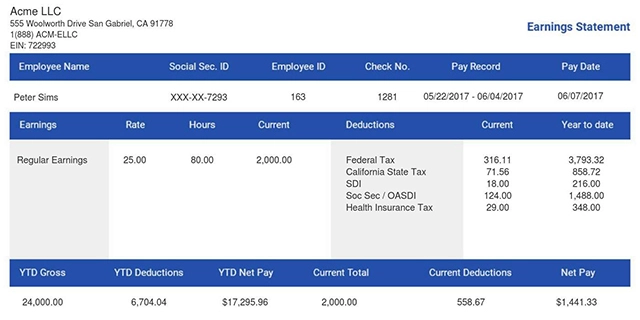
The result shapes what each pay stub shows, since salary and hourly pay stubs look different. An exempt pay stub lists a fixed salary line and no overtime. A non-exempt stub shows hours worked, the hourly rate, and any overtime at 1.5 times that rate.
Employers must also keep records of hours for every non-exempt worker. Clear stubs back up those records. Workers can use them to prove steady income for a lease or loan. If your payroll setup doesn't produce detailed stubs, start from a pay stub template that fits either status.
FLSA Overtime Exemptions and Misclassification Risks
Getting FLSA overtime exemptions wrong can cost a lot. If an exempt worker should have been non-exempt, the employer owes the unpaid overtime. That covers up to two years, or three if the error was willful. A court can also add an equal amount in liquidated damages, which doubles the bill. Run the test again any time a worker's pay or duties change. The same care applies when you decide who counts as an employee or a contractor.
You Might Also Like
- How Much Overtime Is Too Much?
- Does PTO Count Towards Overtime?
- Payday vs. Pay Cycle vs. Pay Period: What's the Difference?
- FIT Taxable Wages Explained
- Freelancing for Beginners: 1099 vs. W-2
Conclusion
The FLSA exemption test comes down to three questions: pay level, pay basis, and real job duties. Check all three, write down your answers, and review them when a role changes. Clear pay records make every one of those steps easier. Need accurate stubs for your team or your own records? Our paystub generator creates them with the right salary and overtime lines in minutes.
- 1. Enter Your Information

- 2. Select Your Favorite Theme

- 3. Download Your Stub!

 By
By