

Benefits Package: What's Included and What It's Worth
 By
By
Two jobs can pay the same $22 an hour and still be very different offers. The difference is the benefits package. For the average private-sector job, benefits make up about 30% of what an employer spends on each worker. That's health coverage, retirement savings, and paid days off you'd otherwise pay for yourself. If you run payroll in-house, a check stub maker keeps each deduction visible on every stub.
This guide explains what's included and which parts the law requires. You'll see what a package is worth in dollars and where it shows up on your pay stub. Business owners will find a simple plan for building one on a small budget. Job seekers will get a quick way to compare two offers side by side.
Key Takeaways
- Benefits are the pay you get beyond your wages, like health insurance, retirement plans, and paid time off.
- Only a few benefits are required by law, such as Social Security, Medicare, unemployment insurance, and workers' comp.
- Benefits cost private employers $14.07 per hour on average in June 2026, about 30% of total pay.
- Most benefit costs you share show up as deductions on your pay stub.
- Compare offers by adding salary, employer premium share, 401(k) match, and paid leave.
- What Is a Benefits Package?
- What's in a Typical Benefits Package?
- Legally Required Benefits vs. Optional Perks
- What Makes a Comprehensive Benefits Package?
- How Much Is a Benefits Package Worth?
- How Benefits Show Up on Your Pay Stub
- How to Build a Small Business Benefits Package
- How to Compare Benefits in a Job Offer
- Benefits Package vs. Compensation Package
What Is a Benefits Package?
A benefits package is everything your employer gives you on top of your paycheck. It usually covers health insurance, a retirement plan, and paid time off. Some jobs add life insurance, disability pay, or tuition help. Your employer pays all or part of the cost, and you often pay your share through payroll deductions.
Think of it as the part of your pay that doesn't land in your bank account. A benefits package for employees is usually laid out in the offer letter and explained during onboarding. You pick your plans when you're hired and again each year during open enrollment.
The term covers any job. A retail worker, a nurse, and a software engineer all have a job benefits package, even if one is thin and another is generous. What changes is how much the employer pays and how many extras it adds.
What's in a Typical Benefits Package?

A typical benefits package has five parts: health insurance, a retirement plan, paid time off, life and disability insurance, and extra perks. Health coverage is the most common. In March 2026, 71% of private industry workers had access to medical plans, per the Bureau of Labor Statistics. Perks vary the most from job to job.
An employee benefits package usually mixes required items with optional ones. Here's what each part usually looks like.
Health Insurance
This is usually the biggest and priciest piece of the whole offer. Health care coverage usually includes medical, plus dental insurance and vision insurance as separate options. Your employer picks the insurance plan choices, and you pick your level of coverage.
Many jobs also offer tax-free accounts for medical expenses. In 2026, you can put up to $4,400 in a health savings account (HSA) for self-only coverage, or $8,750 for a family. A health flexible spending account (FSA) allows up to $3,400.
Retirement Plans
A 401(k) is the most common way to save for later, using money taken from each check. Many employers add a match, such as 50 cents for every dollar you save, up to 6% of pay. In 2026, you can defer up to $24,500 of your own pay into a 401(k).
Paid Time Off
Vacation, sick days, and holidays are the days you get paid without working, usually called PTO. Some employers use one PTO bank, while others split vacation and sick leave. In March 2026, 80% of private industry workers had paid vacation and 81% had paid sick leave.
Life and Disability Insurance
These two protect you and your family when something goes badly wrong. If you die while employed, a life policy pays your family. Many employers give basic coverage equal to one year of salary at no cost. Disability insurance replaces part of your pay if an illness or injury keeps you from working. Short-term plans cover weeks, and long-term plans can cover years.
Other Perks
The extras are where benefits packages differ the most. Common perks include mental health support, tuition reimbursement, gym stipends, remote work, and commuter benefits. They cost less than health plans but can matter a lot to the right person.
Legally Required Benefits vs. Optional Perks
Only a short list of benefits is required by federal law. Everything else is a choice, so no two plans look the same.
Required for nearly every employer:
- Social Security and Medicare: You match each worker's FICA tax, 6.2% for Social Security and 1.45% for Medicare.
- Unemployment insurance: You pay federal FUTA tax and your state's unemployment tax.
- Workers' compensation: Most states require it, and rules vary by state.
- Family and medical leave: The FMLA gives up to 12 weeks of unpaid, job-protected leave at employers with 50 or more employees.
Health coverage is only required at larger firms. Under the Affordable Care Act, employers with 50 or more full-time-equivalent workers must offer affordable coverage or pay a penalty. A benefits package for small business teams under that line can skip health insurance entirely. Most employers offer it anyway because workers expect it. Some states and cities add their own rules, like paid sick leave, so check local law before you set your employer benefits package.
What Makes a Comprehensive Benefits Package?

A comprehensive benefits package covers health, wealth, and time off, and the employer pays a real share of each. That means medical, dental, and vision plans, a 401(k) with a match, at least two weeks of paid time off, and life and disability insurance. Extras like mental health support or tuition aid round it out.
The table below gives a benefits package example at three levels. It shows how a basic plan grows into comprehensive benefits and then into an executive tier.
| Benefit | Basic (small team) | Comprehensive | Executive |
|---|---|---|---|
| Health insurance | Medical, employee pays a large share | Medical, dental, vision, employer pays most | Richer plans, low or no premium |
| Retirement | SIMPLE IRA or no plan | 401(k) with a match | 401(k) plus deferred pay or stock |
| Paid time off | 5 to 10 days | 15 to 20 days plus holidays | Flexible or unlimited |
| Insurance | None or basic life | Life plus short- and long-term disability | Extra life and disability coverage |
| Extras | Flexible hours | Mental health, tuition, wellness | Car allowance, bonus plans, coaching |
An executive benefits package adds perks tied to senior roles, like stock options or deferred pay. A competitive benefits package sits near the comprehensive column for your industry and region.
How Much Is a Benefits Package Worth?
For the average private-sector job, benefits are worth about 30% of total pay. In June 2026, employers spent $14.07 per hour on benefits and $32.82 per hour on wages, per the Bureau of Labor Statistics. That works out to roughly 43 cents in benefits for every dollar of wages, or about $29,000 a year full time.
Here's how the Bureau of Labor Statistics breaks down private-sector costs:
| Cost per hour worked (June 2026) | Amount | Share |
|---|---|---|
| Wages and salaries | $32.82 | 70.0% |
| Benefits | $14.07 | 30.0% |
| Total compensation | $46.89 | 100% |
Health coverage is the biggest single piece. The average family premium for job-based health insurance hit $26,993 in 2025, and the employer paid most of it. To size up your own offer, start with the health plan. Then add the 401(k) match and the value of your paid days off.
A quick rule of thumb: add 30% to 40% to the base pay of a job with solid benefits. A $50,000 salary with strong benefits can be worth $65,000 or more in total.
How Benefits Show Up on Your Pay Stub
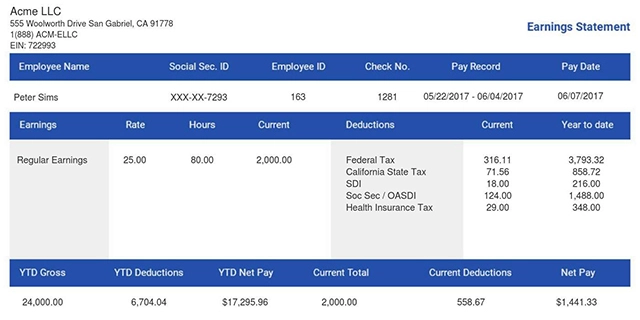
Your pay stub is where your benefits turn into real numbers. Your share of each plan comes out of your gross pay as a deduction, often under a short pay stub deduction code.
- Pre-tax deductions: Health, dental, and vision premiums, traditional 401(k) savings, HSA and FSA amounts. These lower your taxable wages.
- Post-tax deductions: Roth 401(k) savings, extra life insurance, and some disability plans.
- Employer amounts: Some stubs list the employer's 401(k) match or premium share. The yearly cost of employer health coverage also appears on your W-2 in Box 12, code DD.
Check your first stub after open enrollment. The deductions should match the plans you picked. If they don't, raise it with payroll right away.
Pay stubs also matter outside work. Landlords and lenders read them to confirm income, and clean deduction lines make that easier. Small business owners who run payroll themselves can use a pay stub template to list each deduction clearly for their team.
How to Build a Small Business Benefits Package
Your plan doesn't need to match a big company's. It needs to fit your budget and the people you want to keep. Here's a simple plan, using a 12-person landscaping crew as the example.
- Set a budget. Pick a monthly amount per worker. The crew's owner starts with $400 per person.
- Ask your team. A short survey shows what matters. The crew ranks health coverage first and paid days off second.
- Choose core coverage. Offer a group health plan, or use a health reimbursement account like a QSEHRA or ICHRA. For retirement, a SIMPLE IRA costs little to run.
- Add low-cost perks. Flexible start times, a boot allowance, and paid holidays cost little and build loyalty.
- Write it down. Put your company benefits package in a one-page summary and your handbook. Most health and retirement plans also fall under ERISA rules, so ask your broker what paperwork you need.
- Set up payroll. Load each deduction into payroll before the first check so every stub is right.
What does a typical benefits package for small business teams include? Usually one health plan, a simple retirement plan, and 5 to 10 PTO days. Many small businesses also use a PEO or broker to get group rates they couldn't get alone.
How to Compare Benefits in a Job Offer
Salary is easy to compare. Benefits take a few more steps. So what is a good benefits package? It's one that covers your real needs at a cost you can afford.
- Ask human resources for the Summary of Benefits and Coverage. This short document lists premiums, deductibles, and copays.
- Compare your share of the premium. In 2025, workers at firms with 10 to 199 employees paid 36% of the family premium. At larger firms, they paid 23%, per KFF.
- Add the 401(k) match. A 4% match on $50,000 is $2,000 a year of free money.
- Value the paid leave. Multiply your daily pay by your PTO days.
The best benefits package for you depends on your stage of life. A parent may want strong family coverage. A younger worker may care more about the match or remote work. Look past the headline and add up each part of the work benefits package.
Benefits Package vs. Compensation Package
A compensation package is your total pay. It includes your salary or hourly rate, bonuses, commissions, and your benefits. Benefits are just the non-cash part of that.
Employers often call the full offer a compensation and benefits package, or "total rewards." Your wage must meet the minimum wage, but benefits beyond the legal list are optional. When you compare offers, look at the whole compensation picture, not just the hourly rate.
You Might Also Like
- ER Health on a Pay Stub
- Proof of Income Documents: 6 Times You'll Need a Pay Stub
- What's the Difference Between Payroll and Compensation?
- Employee Benefits and Compensation Ideas
- Do Part-Time Employees Get Benefits?
Conclusion
Good benefits can add thousands of dollars to what a job is worth. Know the five core parts, which ones the law requires, and how each one shows up on your stub. For workers, that means comparing offers by total value, not just the hourly rate. For employers, a small business benefits package that fits your budget helps keep good people. Need clean records of wages and deductions for your team or a rental application? Create them in minutes with our paystub generator.
- 1. Enter Your Information

- 2. Select Your Favorite Theme

- 3. Download Your Stub!

 By
By