

Indirect Compensation: Examples, Taxes, and Pay Stubs
 By
By
The salary number in your offer letter is rarely what the job is actually worth. Indirect compensation, the health coverage, retirement matching, paid leave, and perks layered on top of base salary, accounted for 30.1% of what private industry employers spent per hour worked in March 2026, according to Bureau of Labor Statistics data. Close to a third of the value of a job never arrives as a wage at all, which is why so little of it is obvious when you look at a pay stub. That gap matters whether you are weighing two offers or running payroll for a small team, where every benefit you provide has to end up documented correctly. Below you will find a clear definition, ten common examples, which benefits are taxable under current IRS rules, exactly where it appears on your pay stub and W-2, and how to put a dollar figure on your total package.
Key Takeaways
- Indirect compensation is the non-wage value an employer provides on top of salary, commonly called employee benefits.
- The largest categories are health insurance, retirement contributions, and paid time off.
- Some benefits are tax-free up to a limit, while cash stipends and most gift cards are taxable wages.
- Much of it is visible on your pay stub and in Box 12 of your W-2.
- What Is Indirect Compensation?
- Direct vs. Indirect Compensation: What Is the Difference?
- 10 Examples of Indirect Compensation
- Mandated vs. Voluntary Indirect Compensation
- Is Indirect Compensation Taxable?
- How Indirect Compensation Appears on Your Pay Stub and W-2
- How to Calculate the Value of Your Total Compensation
- Why Indirect Compensation Matters for Workers and Employers
What Is Indirect Compensation?
Indirect compensation is the non-wage value an employer provides on top of base salary, including health insurance, retirement contributions, paid time off, and perks. It is often called employee benefits. Some forms are legally required, such as the employer share of Social Security, while most are offered voluntarily to attract and keep staff.
The defining feature is that the value does not arrive as money in your bank account. Your employer pays a premium, makes a contribution, or grants you time, and you receive something worth real money without it passing through your paycheck as wages.
You will hear this called several things: employee benefits, the benefits side of a package, perks, or fringe benefits. The IRS uses "fringe benefits" in its guidance, which is worth knowing when you go looking for tax rules.
For workers, it is the part of an offer that is easiest to undervalue because it is not a single number. For small business owners, it is the part of payroll that is easiest to underestimate, because the cost lands across insurance invoices, retirement plan filings, and tax deposits rather than in one line item.
Direct vs. Indirect Compensation: What Is the Difference?

Direct compensation is money paid straight to the employee: base salary, hourly wages, overtime pay, commissions, and bonuses. Indirect compensation is everything else of value, such as health coverage, retirement matching, and paid leave. Direct pay appears as earnings on your pay stub, while indirect compensation usually appears as a deduction, an employer contribution, or nothing at all.
The distinction between direct and indirect pay trips people up in one specific place: overtime and bonuses. Because they feel like extras, people often file them under benefits. They are not. If it is cash paid to you for work performed, it is direct compensation and it is taxable wages.
| Direct Compensation | Indirect Compensation | |
|---|---|---|
| What it is | Cash paid for work performed | Non-wage value and benefits |
| When it is paid | Each pay period, or at a set payout date | Continuously, or when you use the benefit |
| Taxable? | Almost always | Often excluded from wages, with limits |
| On your pay stub? | Yes, listed under earnings | Sometimes, usually as a deduction or employer contribution |
| Examples | Base salary, hourly wages, overtime pay, commissions, bonuses | Health insurance, 401(k) match, paid time off, tuition help |
This is also where people confuse compensation with payroll itself, and the difference between payroll and compensation is worth knowing before you compare offers. One practical read: if you want to know what you earned, look at earnings. If you want to know what you are worth to your employer, you have to add the benefits side on top.
10 Examples of Indirect Compensation
These are the most common examples in US workplaces, grouped by what they do for you.
Health and Insurance Benefits
1. Group health insurance. The single largest piece of most benefits packages. Your employer pays a share of the premium for a group health plan, and you pay the rest through a payroll deduction. Employer-paid premiums for group health insurance are generally excluded from your taxable wages.
2. Dental and vision coverage. Usually offered alongside group health as separate, lower-cost plans. Often fully or heavily employer-funded, which makes them easy to overlook when comparing offers even though replacing them privately is rarely cheap.
3. Life and disability insurance. Many employers provide basic group-term life insurance at no cost to the employee, typically at one or two times annual salary, plus short-term disability insurance and long-term coverage that replaces a portion of income if you cannot work. Disability coverage is the benefit workers most often discover they need only after they need it.
Retirement and Financial Benefits
4. Retirement plan contributions. A 401(k) match is the clearest example. If your employer matches 4% of a $60,000 salary, that is $2,400 a year you would otherwise have to fund yourself. Matches usually carry a vesting schedule, so leaving early can mean forfeiting the employer portion while keeping your own contributions.
5. Health savings account contributions. Employers pairing a high-deductible health plan with an HSA often contribute directly to the account. That money is yours to keep even if you leave, which makes it one of the few benefits that survives a job change intact.
6. Stock options and equity. Common at startups and public companies. Equity typically vests over three to five years, so its value depends on both share price and how long you stay. Treat it as the least certain line in any offer, since unvested equity is a promise rather than a payment.
Time Off and Flexibility
7. Paid time off. Vacation days, sick leave, and holidays all count because you are paid without working. Fifteen paid days off on a $60,000 salary is roughly $3,460 of value. Whether PTO counts toward overtime is a separate question, and the answer affects how those hours are paid.
8. Paid parental and family leave. Leave above what the law requires, paid at full or partial salary. Federal law guarantees job-protected leave for eligible employees but does not require that it be paid, so any paid portion is a genuine benefit rather than a legal minimum.
9. Flexible work arrangements. Remote work, hybrid schedules, and compressed weeks carry real financial value through reduced commuting, parking, and meal costs, even though no money changes hands. Flexible work is the one benefit on this list that costs an employer almost nothing to offer and that employees consistently price highly.
Career, Family, and Lifestyle Perks
10. Education, child care, and everyday perks. This bucket includes tuition reimbursement and professional certifications, dependent care benefits and on-site child care, a company car or vehicle allowance, wellness stipends, commuter benefits, and meals. Education and child care benefits carry specific tax exclusions covered in the next section, which makes them more valuable per dollar than a cash bonus of the same size. Employers use this group to differentiate a package when they cannot compete on salary alone.
Mandated vs. Voluntary Indirect Compensation

Not all of it is a choice. US employers are legally required to fund several benefits, and separating those from voluntary perks explains why two employers can look very different on paper while both being fully compliant.
Legally mandated:
- Social Security and Medicare employer share. In 2026, employers pay 6.2% for Social Security on wages up to the taxable maximum of $184,500, plus 1.45% for Medicare on all wages with no cap.
- Federal and state unemployment insurance taxes.
- Workers' compensation insurance, required in nearly every state.
- Health coverage meeting minimum standards, for applicable large employers with 50 or more full-time equivalent employees.
Voluntary: everything else. Retirement matching, paid time off beyond state minimums, dental and vision plans, tuition assistance, and perks are offered because an employer chooses to offer them.
That employer payroll tax share is real compensation most workers never count, though you can see your own side of it as Social Security wages on your W-2. On a $60,000 salary, the employer contributes about $4,590 in Social Security and Medicare taxes on your behalf.
Is Indirect Compensation Taxable?
It depends on the benefit. Employer-paid health premiums, educational assistance up to $5,250 per year, and dependent care assistance up to $7,500 are excluded from taxable wages under IRS rules. Cash stipends, most gift cards, and group-term life insurance above $50,000 of coverage are taxable and must be reported as income.
The governing guidance is IRS Publication 15-B, the employer's tax guide to fringe benefits. It sets out which benefits are excluded from wages and the limits that apply.
Generally tax-free, within limits:
- Employer-paid premiums for group health insurance, dental, and vision.
- Educational assistance up to $5,250 per employee per year under a qualifying Section 127 program.
- Dependent care assistance up to $7,500, or $3,750 for a married employee filing separately.
- Group-term life insurance covering the cost of up to $50,000 of coverage.
- De minimis benefits, meaning items so small that accounting for them is impractical, such as occasional coffee or snacks.
Generally taxable:
- Cash stipends of any kind, including health and wellness stipends. Cash is wages.
- Most gift cards and cash equivalents, regardless of amount.
- Personal use of a company car.
- The cost of group-term life insurance above $50,000 of coverage.
The dividing line matters because only taxable benefits are added to FIT taxable wages and withheld against. For business owners, this is the compliance line that matters most. A taxable benefit that never makes it onto a pay stub or a W-2 becomes a payroll correction later.
How Indirect Compensation Appears on Your Pay Stub and W-2
Most articles define the term and stop there. Here is where it actually shows up on the documents you already have.
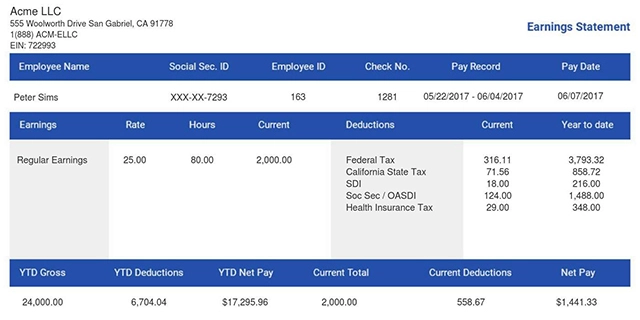
What You See on a Pay Stub
Your pay stub reflects these benefits in three ways:
- Pre-tax deductions. Your share of the group health premium, your 401(k) deferral, and HSA or FSA contributions appear as deductions that reduce your taxable wages. These lower the gross figure your income tax is calculated on.
- Employer contributions. Many pay stubs include an employer-paid or employer contribution column showing what your employer put in for health coverage or retirement. This is informational and is not subtracted from your net pay.
- Accrued balances. Paid time off balances often appear as accrued and used hours, which is the only place a time-based benefit gets quantified.
If the abbreviations are unfamiliar, our guide to pay stub deduction codes decodes the most common ones. If your stub shows no employer contribution column, you are seeing only your share. Ask your employer or HR for a total compensation statement to see the rest.
For business owners, this is where accuracy matters. Pre-tax deductions have to be applied before income tax is calculated, taxable benefits have to be added to wages rather than handled off the books, and both need to appear on the stub you hand your employee. Getting the order wrong changes the tax withheld, which becomes a correction at year end when the numbers fail to reconcile with the W-2.
What You See on Your W-2
Your W-2 is more explicit. Several boxes exist specifically to report these benefits:
- Box 1 shows wages, tips, and other compensation. It is often lower than your gross salary precisely because pre-tax benefits were subtracted.
- Box 10 reports dependent care benefits.
- Box 12, Code D reports your 401(k) elective deferrals.
- Box 12, Code DD reports the total cost of employer-sponsored health coverage. This is reporting only and is not taxable, but it is the clearest single dollar figure you will find for what your health benefit is worth.
- Box 12, Code C reports the taxable cost of group-term life insurance above $50,000.
- Box 12, Code W reports employer contributions to your HSA.
Box 12 Code DD is the most useful number on the form for valuing a package, and almost nobody looks at it. If the rest of the form is unfamiliar, here is how to read a W-2 box by box.
How to Calculate the Value of Your Total Compensation
Comparing two offers on salary alone is how people talk themselves into the weaker one. Start from a clean salary figure, which means knowing how to calculate your hourly, weekly, and monthly income before you add benefits on top. Here is the arithmetic, using a realistic example.
Offer A: $68,000 salary, 3% retirement match, employer pays 60% of a $9,000 health premium, 12 paid days off.
Offer B: $64,000 salary, 6% retirement match, employer pays 90% of a $9,000 health premium, 20 paid days off.
| Offer A | Offer B | |
|---|---|---|
| Base salary | $68,000 | $64,000 |
| Retirement match | $2,040 | $3,840 |
| Employer health premium | $5,400 | $8,100 |
| Paid time off value | $3,138 | $4,923 |
| Total | $78,578 | $80,863 |
Offer B pays $4,000 less in salary and is worth about $2,285 more per year.
Two rules make this reliable. Count employer contributions at face value, since that is cash your employer actually spends on you. Then discount perks you will not realistically use, because a gym membership you never visit is worth zero no matter what it costs the company.
Two things do not belong in this calculation. Leave out your own payroll deductions, since your contribution to a premium or a 401(k) comes out of the salary you already counted and adding it back double counts the same dollar. Leave out unvested equity until it vests. If you want the employer's true cost rather than your own benefit, add the employer payroll taxes from the previous section on top of both totals.
Why Indirect Compensation Matters for Workers and Employers
For workers, these benefits are negotiating leverage. When an employer cannot move on salary, benefits are often where there is room: an extra week of paid time off, a larger retirement match, or a certification budget. It also changes the math on switching jobs, since a $5,000 raise that comes with a weaker health plan and fewer paid days can leave you behind.
Employer size is the single biggest predictor of how rich that benefits side will be. BLS data for March 2026 shows benefits made up 25.9% of total compensation costs at private employers with 1 to 49 workers, compared with 35.2% at employers with 500 or more. Two people earning identical salaries at a 20-person shop and a national chain are not receiving comparable packages, and the difference is worth several thousand dollars a year.
For employers, it is the main lever for retention. Replacing an employee costs a meaningful share of that person's salary once you count recruiting, onboarding, and lost productivity, and benefits are consistently a top reason candidates accept or decline offers. Strong benefits help you compete for new hires against companies that can simply outbid you on wages. If you run a small business, the BLS gap above is also an argument for making your package legible: when you cannot match a large employer's spend, showing employees exactly what you contribute keeps that value from going unnoticed.
There is a documentation duty attached. If you offer benefits to your employees, you have to withhold correctly, report taxable benefits, and produce accurate pay stubs showing deductions and contributions. Employees increasingly ask for that detail when applying for a mortgage or a rental, and clean records are what let them prove their income without a phone call to your office.
You Might Also Like
- W-2 vs Pay Stub: What Is the Difference?
- What Does a Pay Stub Look Like?
- How to Calculate W-2 Wages From a Pay Stub
- Employment Verification Letter: What to Include
- Medicare Tax: How It Works and What You Pay
Conclusion
Indirect compensation is the difference between what you are paid and what your job is actually worth. Once you know which benefits are tax-free, which are taxable wages, and where each one lands on your pay stub and W-2, you can value an offer accurately instead of guessing, and you can document your own payroll correctly if you employ others.
If you need clean pay stubs that show earnings, deductions, and contributions clearly, whether for a rental application, a loan, or your own employee records, our paystub generator creates accurate stubs with automatic tax calculations in a couple of minutes.
- 1. Enter Your Information

- 2. Select Your Favorite Theme

- 3. Download Your Stub!


 By
By