

Average PTO Accrual Rate: 2026 Benchmarks by Tenure
 By
By
You know how much PTO you have. What you probably don't know is whether that number is any good. Most guides explain how accrual works, then stop short of what everyone else actually gets.
Here's the short answer. The average PTO accrual rate for a full-time US employee is 0.04 to 0.08 hours of paid time off per hour worked. Employers show that accrued time on the stub, which a pay stub generator handles. The longer answer depends on your tenure, your state, and whether your employer caps what you can bank.
This guide covers the benchmark numbers by years of service and what separates a good rate from a below-average one. You'll also find a conversion chart for every pay schedule, how accrual caps work, and how to check your own rate.
Key Takeaways
- The average PTO accrual rate runs 0.04 to 0.08 hours per hour worked
- That works out to roughly 3.4 to 6.2 hours per biweekly pay period
- Federal data shows 11 vacation days after one year, 20 after twenty
- Most accrual caps sit at 1.5 to 2 times your annual rate
- Divide accrued hours on one pay stub by hours worked to find your rate
- What Is the Average PTO Accrual Rate?
- Average PTO Accrual Rate by Years of Service
- What Is a Good PTO Accrual Rate?
- PTO Accrual Chart: Days, Hours, and Pay Periods
- What Changes the Average PTO Accrual Rate
- Maximum PTO Accrual: Typical Caps and Rollover Limits
- PTO Accrual Policy Examples
- How to Compare Your PTO Accrual Rate to Average
What Is the Average PTO Accrual Rate?
The average PTO accrual rate for full-time US employees falls between 0.04 and 0.08 hours of paid time off per hour worked. That works out to roughly 3.4 to 6.2 hours per biweekly pay period. In days, that ranges from 11 to 20 vacation days a year, depending on how long you have worked there.
Accrual means you earn that time gradually as you work instead of receiving the full year's allotment on January 1. The rate is just the speed of that earning, expressed either per hour worked or per pay period.
Average PTO Accrual Rate by Years of Service

Tenure moves this number more than anything else. The Bureau of Labor Statistics tracks average paid vacation by length of service. Its March 2025 release is the most current data available for 2026.
| Years of Service | Vacation Days | Annual Hours | Biweekly Accrual | Per Hour Worked |
|---|---|---|---|---|
| 1 year | 11 | 88 | 3.38 hrs | 0.0423 |
| 5 years | 15 | 120 | 4.62 hrs | 0.0577 |
| 10 years | 18 | 144 | 5.54 hrs | 0.0692 |
| 20 years | 20 | 160 | 6.15 hrs | 0.0769 |
Those day counts are BLS figures for private industry. The hour conversions assume an 8-hour day and 2,080 hours worked per year. Paid sick leave behaves differently. It averages 7 days and stays flat no matter how long you stay. Tenure raises your vacation bank, not your sick bank.
State and local government workers do better across the board, averaging 13 vacation days at one year and 22 days at twenty.
What the Numbers Mean for a New Hire
A first-year employee earning 3.38 hours per biweekly period is right at the private-industry norm. Anything close to that is typical PTO accrual for someone new, so a lower figure is worth asking about rather than assuming it's standard.
What They Mean After a Decade
Long-tenured staff should see the rate climb. Someone at ten years or more still accruing at a first-year rate is running about seven days a year behind the benchmark for their tenure. Most employers grant that increase automatically, so it's worth asking HR if yours hasn't.
What Is a Good PTO Accrual Rate?
A good PTO accrual rate is 0.0577 hours per hour worked or better. That equals 15 days a year, matching what BLS reports for employees at five years of service. Anything at or below 0.0385, the equivalent of 10 days, sits under the private-industry average.
The math behind those thresholds is simple division. A full-time schedule is 2,080 hours a year, so:
- 80 hours of PTO (10 days) divided by 2,080 = 0.0385 per hour worked
- 120 hours of PTO (15 days) divided by 2,080 = 0.0577 per hour worked
- 160 hours of PTO (20 days) divided by 2,080 = 0.0769 per hour worked
Part-time employees usually accrue on the same per-hour rate but bank fewer hours, since they work fewer of them. A 20-hour week at 0.0577 earns about 60 hours a year rather than 120, which is proration working as intended, not a worse deal.
PTO Accrual Chart: Days, Hours, and Pay Periods

Most employers publish an annual day count while your pay stub reports hours per pay period. This PTO accrual chart converts between them.
| PTO Days | Annual Hours | Weekly | Biweekly | Semimonthly | Per Hour Worked |
|---|---|---|---|---|---|
| 10 days | 80 | 1.54 | 3.08 | 3.33 | 0.0385 |
| 15 days | 120 | 2.31 | 4.62 | 5.00 | 0.0577 |
| 20 days | 160 | 3.08 | 6.15 | 6.67 | 0.0769 |
| 25 days | 200 | 3.85 | 7.69 | 8.33 | 0.0962 |
Read across from your annual allotment to your pay schedule. Biweekly runs on 26 periods a year and semimonthly on 24, which is why the semimonthly figure is always slightly higher for the same benefit. Your employer's PTO accrual schedule should produce one of these numbers.
What Changes the Average PTO Accrual Rate
Tenure aside, four things move accrual rates between employers:
Employment Status
Part-time and seasonal staff are often excluded from PTO entirely, and where they're included, they accrue proportionally to hours worked.
State Law
The Fair Labor Standards Act doesn't require paid leave at all. States set the rules, and they vary widely. California treats earned vacation as wages, which changes what an employer may do with unused time.
Industry and Employer Size
Larger employers and professional services firms cluster at the higher end of PTO accrual rates. Retail, food service, and small businesses tend to start closer to 10 days.
Waiting Periods and Start Dates
Many policies grant nothing during an initial waiting period, then start the clock on your anniversary date rather than the calendar year. Two people hired six months apart can sit at very different balances on the same day.
Maximum PTO Accrual: Typical Caps and Rollover Limits
A cap is a ceiling on how much unused time your PTO bank can hold at once. The common formula sets maximum PTO accrual at 1.5 to 2 times your annual rate. An employee earning 120 hours a year would cap somewhere between 180 and 240 hours. Published caps generally fall between 40 and 200 hours.
Hitting the cap doesn't erase your balance. Accrual simply pauses until you use enough time to drop below the ceiling. A capped employee who never takes time off quietly stops earning.
Caps are not the same as use-it-or-lose-it. Under California's Labor Commissioner rules, forfeiting earned vacation at year end is illegal because that time counts as wages. A reasonable cap is permitted, and a 200-hour ceiling has been accepted. Carryover limits sit between the two, letting you roll a set number of hours into the next calendar year. Anything paid out instead is taxed like regular wages.
PTO Accrual Policy Examples
Nearly every PTO accrual policy you'll run into is a version of one of these two setups.
A tenure-tiered policy starts new hires at 10 days, moves to 15 days at five years, and reaches 20 days at ten or more. It mirrors the federal averages and rewards retention.
A flat-rate policy gives every employee the same accrual regardless of service, commonly 15 days. It's simpler to administer and more attractive to experienced hires who would otherwise restart at the bottom.
Front-loading hands over the full annual balance on day one and skips accrual math entirely. Unlimited PTO removes the balance altogether, which also means there's no PTO payout when you leave. If you're drafting either one, start from a free PTO policy template.
How to Compare Your PTO Accrual Rate to Average
Checking how fast you accrue PTO takes one pay stub and one division problem.
- Find the PTO or paid time off line among your pay stub deduction codes and note the hours added this period
- Divide by the hours you worked in that same period
- Compare the result against the chart above
A stub showing 4.62 hours added on 80 hours worked is 0.0577, right at the 15-day benchmark. If your employer doesn't itemize accrued time, our pay stub templates show where that line belongs.
You Might Also Like
- Does PTO Count Towards Overtime?
- What Unpaid PTO Means for Your Paycheck
- Negative PTO Balance Explained
- Payroll Codes and What They Mean
- FTE Meaning and How It Is Calculated
Conclusion
The average PTO accrual rate lands near 0.04 to 0.08 hours per hour worked. That's 11 days a year for a new hire and 20 for someone two decades in. Caps typically stop you at 1.5 to 2 times the annual figure. One pay stub and one division problem tell you where you stand against both.
Employers who need to show accrued time clearly can build accurate documents with our paystub generator in a couple of minutes. So can workers whose employer never itemized those hours.
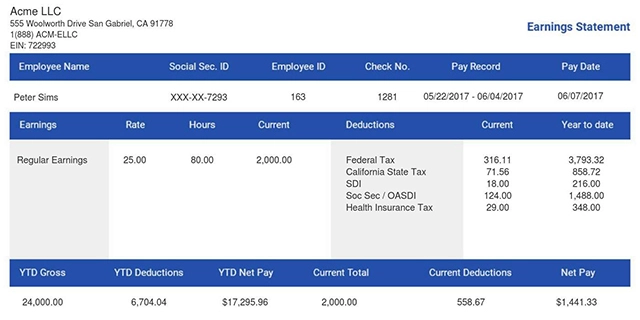
- 1. Enter Your Information

- 2. Select Your Favorite Theme

- 3. Download Your Stub!


 By
By