

How to Calculate Weekly Pay: Hourly, Salary, and Take-Home Formulas
 By
By
Maybe you just started a new job with a weekly pay schedule, or you're a small business owner setting up payroll for hourly workers. Either way, knowing how to calculate weekly pay pays off every time payday rolls around. This makes it possible to budget with confidence, catch errors on your pay stubs, and plan your finances without surprises.
In this guide, you'll learn how to calculate weekly pay for both hourly and salaried workers. You'll see how deductions shrink your gross pay to your take-home pay, how to convert weekly net pay into a monthly figure, and when to expect that first paycheck. You'll also find a full weekly wage calculator breakdown so you can run the numbers yourself.
Key Takeaways
- Hourly gross weekly pay = hourly rate x hours worked (plus 1.5x for overtime hours beyond 40)
- Salary gross weekly pay = annual salary / 52
- FICA taxes (Social Security tax + Medicare) take 7.65% from every paycheck before you get paid
- Net weekly pay = gross pay minus pre-tax deductions, payroll deductions, and income taxes
- Multiply weekly net pay by 4.33 (not 4) to find your true monthly income
- Use a paycheck calculator or detailed pay stub to verify every line and catch errors fast
What Is Weekly Pay?

Before you can calculate weekly pay accurately, it helps to understand what weekly pay actually is. It's a pay frequency in which employees receive wages once every seven days, 52 times per year, on a set day (most often Friday). It's the most frequent standard pay schedule and is common in industries with hourly workers whose hours vary week to week, including construction, hospitality, manufacturing, food service, and retail.
Here's how the major pay schedules compare:
| Pay Schedule | Checks Per Year | Common In |
|---|---|---|
| Weekly | 52 | Construction, hospitality, manufacturing |
| Biweekly | 26 | Healthcare, retail, tech, professional services |
| Semi-monthly | 24 | Finance, accounting, consulting |
| Monthly | 12 | Government, some educational institutions |
For employees, weekly pay means faster access to earnings, which is useful for managing rent, utilities, and other regular expenses. For employers, a fixed weekly payday simplifies payroll processing and removes the need to prorate new-hire paychecks. Whether you run payroll manually or use software, the same formulas below apply to every hourly employee and salaried team member on your roster.
How to Calculate Weekly Pay for Hourly Workers
To calculate weekly pay for hourly workers, you only need two numbers: your hourly rate and the number of hours worked that week. The formula is straightforward:
Gross weekly pay = Hourly rate × Hours worked
If you work a standard 40-hour week, multiply your hourly rate by 40. That's your gross pay before any deductions.
Example: Retail Associate
- Hourly rate: $18.00
- Hours worked: 40
- Gross weekly pay: $18.00 × 40 = $720.00
This gross weekly pay is what you start with before taxes and deductions are applied.
Calculating Overtime Pay
Under the Fair Labor Standards Act (FLSA), non-exempt workers earn overtime pay at 1.5 times their regular rate for any hours beyond 40 in a workweek.
Overtime formula: Overtime pay = Hours over 40 × (Hourly rate × 1.5)
Example (continuing with the retail associate):
- Overtime hours: 5
- Overtime rate: $18.00 × 1.5 = $27.00 per hour
- Overtime earnings: 5 × $27.00 = $135.00
- Total gross weekly pay: $720.00 + $135.00 = $855.00
For small business owners: always track overtime by workweek, not by pay period. HR teams often ask, how would they calculate their weekly pay? The answer is the same formula every time: actual hours that week times the hourly rate. A biweekly pay period can hide FLSA overtime if you don't track week by week.
How to Calculate Weekly Pay for Salaried Employees
If you earn a fixed annual salary, the formula is even simpler. Just divide by 52:
Weekly gross = Annual salary ÷ 52
The only variable is the annual figure. Here's a worked example:
- Annual salary: $55,000
- Gross weekly pay: $55,000 ÷ 52 = $1,057.69
The table below shows how the same $55,000 annual salary breaks down across all four common pay frequencies:
| Pay Schedule | Periods Per Year | Gross Pay Per Period |
|---|---|---|
| Weekly | 52 | $1,057.69 |
| Biweekly | 26 | $2,115.38 |
| Semi-monthly | 24 | $2,291.67 |
| Monthly | 12 | $4,583.33 |
If a salaried worker earns a bonus that week, add it to the base before deductions. A $200 bonus would raise that week's gross to $1,257.69. For more, see our guide on annual income.
What Gets Deducted from Your Weekly Paycheck?
Once you know how to calculate weekly pay at the gross level, the next step is seeing what comes out before the money hits your account. A mix of required and optional deductions shrinks that gross figure to your actual take-home pay. Here's what gets taken out.
Federal and State Income Taxes
When you factor in taxes, the biggest variable is federal income tax. Your tax withholdings come from the W-4 form you filed. This includes your filing status, number of dependents, and any extra you chose to withhold. The IRS sets annual tables that employers use each pay period.
State income tax applies in most states. Rates range from under 1% to over 13%. Nine states (Texas, Florida, Nevada, and six others) charge no state income tax at all.
FICA Taxes: 2026 Rates
FICA taxes fund Social Security and Medicare. Both the worker and employer pay half each:
| FICA Component | Employee Rate | 2026 Wage Cap |
|---|---|---|
| Social Security | 6.2% | $176,100 |
| Medicare | 1.45% | No cap |
| Total FICA | 7.65% | N/A |
Example: On $720 gross weekly pay, FICA = $720 × 7.65% = $55.08
Workers earning above $200,000 a year also pay an extra Medicare Tax of 0.9%. The employer does not match this portion.
Voluntary Deductions
These lower your taxable income, so you pay less in taxes:
- Health insurance premiums: usually pre-tax if your employer offers the plan
- 401(k) retirement contributions: up to $23,500 per year in 2026 (pre-tax)
- Flexible Spending Account (FSA) contributions (pre-tax)
Post-tax items (Roth 401(k), wage garnishments, union dues) come out after taxes. They do not lower your taxable income. See a full list of paycheck deduction codes to decode every line on your stub.
How Do I Calculate My Net Weekly Pay?
When you learn how to calculate weekly pay at the net level, the process is simple: subtract all deductions from your gross pay. Start with gross pay (hourly rate × hours, or annual salary ÷ 52). Then remove pre-tax items like 401(k) and health insurance. Next, deduct FICA (7.65%), federal income tax, and state income tax. What's left is your take-home pay.
Here's a full step-by-step breakdown for both examples:
| Step | Item | Hourly ($18/hr, 40h) | Salary ($55k/yr) |
|---|---|---|---|
| 1 | Gross weekly pay | $720.00 | $1,057.69 |
| 2 | 401(k), 6% pre-tax | −$43.20 | −$63.46 |
| 3 | Health insurance premium | −$45.00 | −$45.00 |
| 4 | Taxable income | $631.80 | $949.23 |
| 5 | FICA (7.65%) | −$55.08 | −$80.88 |
| 6 | Federal income tax (est.) | −$57.00 | −$90.00 |
| 7 | State income tax (est. 4%) | −$25.27 | −$37.97 |
| 8 | Net weekly pay | ~$494.45 | ~$740.38 |
These are estimates. Your exact net pay depends on your state, W-4 filing status, and chosen benefits. If you want to know how to calculate weekly paycheck totals with full accuracy, generate a pay stub at ThePayStubs.com. It runs all deductions based on your actual inputs.
How to Calculate Monthly Income from Your Weekly Paycheck
Knowing how to calculate monthly income from weekly paycheck figures is key for rent forms, loan apps, and budget planning. The conversion is simple, but there's one common mistake to avoid.
Monthly income formula: Weekly net pay × 4.33
Why 4.33 and not 4? There are 52 weeks in a year. Divide 52 by 12 and you get 4.33 weeks per month. Using 4 leaves out four full weeks of pay each year. That means your monthly total would be about 8% too low.
Examples using the net pay figures from above:
| Worker Type | Weekly Net Pay | Monthly Income (×4.33) | Annual Income (×52) |
|---|---|---|---|
| Hourly ($18/hr, 40h) | $494.45 | ~$2,140.97 | ~$25,711 |
| Salaried ($55k) | $740.38 | ~$3,205.85 | ~$38,500 |
Why this matters for employees: Landlords, lenders, and loan apps ask for monthly income. A weekly wage doesn't translate on its own. A pay stub with your weekly earnings and year-to-date totals is the most accepted proof of income for these forms.
Why this matters for employers: If you run payroll weekly, knowing the monthly equivalent per employee helps you project monthly labor costs accurately. Multiply each employee's gross weekly pay by 4.33 to estimate monthly payroll for that worker.
Weekly vs. Biweekly Pay: Which Is Better?
The real question behind how to calculate weekly pay vs. biweekly is which schedule fits your work pattern better. Weekly pay works best for hourly workers with shifting hours, since each check shows exactly what was earned that week. Here's a quick look:
| Factor | Weekly | Biweekly |
|---|---|---|
| Checks per year | 52 (sometimes 53) | 26 (sometimes 27) |
| Per-check amount | Smaller | Larger |
| Overtime visibility | Clear per workweek | Can span two weeks |
| Admin cost (employer) | Higher | Lower |
| Employee cash flow | Faster | Moderate |
| Best for | Hourly, variable hours | Salaried, stable hours |
One note for employers: some years produce 53 weekly paychecks instead of 52. Budget for this when it applies. A biweekly payment strategy can cut admin costs while still meeting employee cash flow needs.
For employees, weekly pay helps cash flow but needs more active budgeting since each check is smaller. The upside: overtime shows up in your pay within seven days, not two weeks. A common scenario: a part-time worker on a 30 hour biweekly variable schedule benefits most from weekly pay. Each check shows exactly what they earned that specific week.
When Will I Get My First Weekly Paycheck?
After you learn how to calculate weekly pay, the next question is when that first check shows up. Most weekly pay periods run Monday through Sunday, with payment the following Friday. Employers often hold back one to two periods for processing. If you start on a Monday, expect your first check 7 to 14 days later. Confirm the exact date with HR or payroll.
Here's how to estimate your first check date on your own:
- Confirm the pay cycle: Ask HR if the week runs Monday to Sunday, Tuesday to Monday, or another seven-day block.
- Find out the payroll lag: Most employers process payroll one to three business days after the period closes
- Identify your start date: If you start on Monday of a standard Mon–Sun cycle, your first full pay period ends the following Sunday
- Add the lag: If payroll is processed by Wednesday and paid by Friday, your first check arrives that Friday
- Check for proration: If you start mid-week, your first check may only cover the days you actually worked
- Confirm with payroll: Once you've mapped it out, verify with your HR department to catch any company-specific quirks
For small business owners: When you onboard weekly-paid staff, write down the pay cycle start date and the first expected check date. This cuts confusion and reduces payroll questions in the first few weeks.
How to Verify Your Weekly Pay With Your Pay Stub
Once you know how to calculate weekly pay, the final step is cross-checking your math against your actual pay stub. Your numbers and the stub should match, but sometimes they don't. Here are the three most common reasons:
- A mid-period bonus or commission was added that you didn't include in your manual calculation
- A benefit deduction changed: for example, your health insurance premium adjusted at the start of a new plan year
- Your tax withholding was updated: a new W-4 submission mid-year changes the federal income tax withheld per period
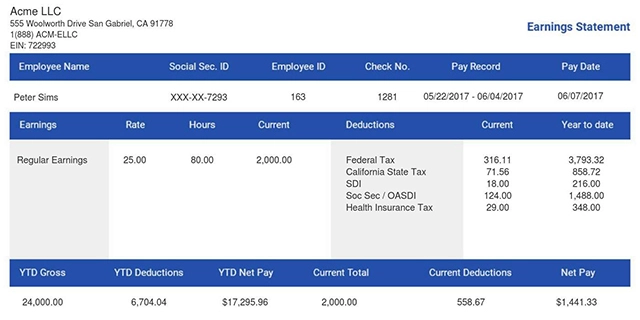
To check, look at the gross pay line, each deduction line, and the year-to-date (YTD) totals. If a number still seems off, bring your math and the stub to HR. Most issues get fixed in minutes. For a fuller guide, see our walkthrough on calculating your hourly, weekly, and monthly income.
Need a pay stub for your records or as proof of income? ThePayStubs.com creates IRS-compliant stubs based on your actual wage, hours, and deductions in under five minutes.
You Might Also Like
- How to Get a Pay Stub From Direct Deposit
- How to File Taxes With Your Last Pay Stub
- Payroll Codes Explained
- FIT Taxable Wages: What They Are and How They're Calculated
- 1099 Pay Stub: Should Independent Contractors Receive a Pay Stub?
Conclusion: Now You Know How to Calculate Weekly Pay
Now you know how to calculate weekly pay and have a clear picture of your earnings, before and after taxes. With these formulas, you can verify every stub, plan every month, and show your income when you need it. Whether you're an hourly worker, a salaried employee, or a small business owner running weekly payroll, the steps above cover every case.
The key numbers to remember when you calculate weekly pay:
- Hourly gross: Hourly rate × hours (+ 1.5× for overtime)
- Salary gross: Annual salary ÷ 52
- Net pay: Gross − pre-tax deductions − FICA (7.65%) − income taxes − post-tax deductions
- Monthly income: Weekly net × 4.33
These formulas work for any weekly pay example, from $12 an hour to $120,000 a year. The math scales the same way. Once you know how to calculate my weekly paycheck using your own numbers, verifying your pay stub takes less than two minutes.
Want to skip the manual math? ThePayStubs.com builds accurate weekly pay stubs with all federal, state, and local deductions done for you. Employees use them as proof of income. Employers use them to give workers a clear record of every payment. Create yours in under five minutes.
- 1. Enter Your Information

- 2. Select Your Favorite Theme

- 3. Download Your Stub!


 By
By