


Are Grants Taxable Income to a Business? (2026 Guide)
 By
By
Are grants taxable income to a business in 2026? In most cases, the answer is yes.
Government grants, SBA grants, and private grants are typically reported as ordinary income to a business under IRC § 61 and IRS guidance on Government Grants. There are a few important exceptions, however, that can change how (or whether) you report grant funds.
This 2026 guide explains "When are grants taxable income to a business?" and how to report them on the right form. It discusses when grant money is tax-exempt, how it affects deductions, and how much to set aside for taxes. You can also document your business income with a simple paystub generator.
Key Takeaways
- Grants are usually counted as income to your business under standard IRS rules. A few specific grant types are excluded from taxable income.
- The three main exceptions are 501(c)(3) nonprofits, COVID-19 federal relief grants, and grants paid to members of federally recognized American Indian tribes.
- Report grant income on the business owner's tax return: Schedule C (Form 1040) for a sole proprietor, Form 1120-S for an S-Corp, Form 1120 for a C-Corp, or Form 1065 for a partnership.
- Set aside 25 to 30 percent of your grant money for taxes before you spend any of it.
- Review your business license and any grant agreement for specific tax-exempt status before filing.
Are Grants Taxable Income to a Business?
Most business grants are considered ordinary income under IRC § 61. That means government grants, SBA grants, and private grants are generally reported as ordinary income on your annual tax return. In short, you will likely owe taxes on grant income received by your business in 2026.
Grants feel like free money, but smart planning means assuming 25 to 30 percent of grant funds will go to taxes before you spend the rest. Sole proprietors report grant income on Form 1040 using Schedule 1 (Line 8z for other income), while corporations report it on Form 1120 or Form 1120-S as instructed by the IRS.
When you ask, "Are grants taxable income to a business?", the size of the grant rarely matters. All grants are treated as ordinary income regardless of the dollar amount. For example, a $1,000 state award for a trade show and a $50,000 SBA award from an SBIR program are both taxed the same way. There is a trade-off here. Taxing grant funds means your business keeps less than the full amount.
Even so, since the funds were free to begin with, you still come out ahead after paying the tax. Free money offered by any agency is almost always worth accepting, and tax exposure alone is rarely a reason to decline.
If you also need to show personal income for a loan or rental application, see our guide on how to show self-employed proof of income. It pairs nicely with this overview of "When are grants taxable income to a business?".
When Are Grants Taxable Income to a Business: Key Exceptions

Some grants are tax-exempt. Federal relief grants under Revenue Procedure 2021-49, grants to members of federally recognized American Indian tribes, and grants paid to 501(c)(3) nonprofit organizations are generally treated as nontaxable income. Check your organization's governing documents, such as the articles of incorporation or organizational charter, to see whether you qualify as tax-exempt under the Internal Revenue Code.
Other exceptions include disaster-relief subsidies and capital contribution grants under specific state economic development programs. To understand the boundaries between taxable and tax-exempt income more broadly, read our explanation of FIT taxable wages.
Even with these carve-outs, most grants remain taxable. Disaster relief grants from the federal government, CARES Act funding, state grant programs, and small business grants are usually fully taxable as grant revenue. As always, review IRS Publication 525 (Taxable and Nontaxable Income) or talk to a tax professional before assuming any grant qualifies as a nontaxable grant.
Reading the grant agreement closely will also tell you whether the funds are subject to restrictions that affect how they appear on your return.
How Grants Affect Your Business Tax Deductions
In some cases, grant funds can affect the tax-deductible expenses you report on your tax return. This usually happens when a grant is given to cover specific business expenses. For example, suppose a grant is awarded to purchase new computers. Once the grantor pays for the equipment, you can no longer claim the full purchase price as a business expense, because you did not pay for it.
This same rule applies broadly. If a grant is used to pay for an expense, you cannot deduct that same expense on your return. Imagine you receive a $10,000 grant to purchase new computers. You spend the full $10,000 on the equipment. Because the grant covered the cost, you cannot also take a $10,000 deduction for those computers. Losing that deduction effectively raises your taxable income for the period. If you also have self-employment income, knowing how to calculate your tax on 1099-MISC income becomes equally important.
Research and development expenditures funded by grants are generally treated as ordinary and necessary business expenses on the return (for example, on Form 1120). Under Section 174, R&D expenditures must be capitalized and amortized, although special rules apply when the work is funded by federal grant funding.
Bonus depreciation and Section 179 may still apply to qualifying equipment purchased with non-grant dollars during the same year, so ensure you plan with your accountant.
Track Government Grants as Ordinary Income to Your Business Account

When deciding "How are grants taxable income to a business?", accurate bookkeeping is essential. All grants must be reported on the business owner's tax return, and the form depends on the entity type.
| Business Type | Where to Report |
|---|---|
| Sole proprietor or single-member LLC | Schedule C (Form 1040), Other Income, Line 6 |
| S-Corporation | Form 1120-S, ordinary income |
| C-Corporation | Form 1120 |
| Partnership | Form 1065 |
Federal grants are reportable as income whether or not a Form 1099-G arrives in the mail. Your accounting method (cash or accrual) and your books should follow GAAP wherever possible, with clear records of every dollar received and spent. As a grantee, you are responsible for keeping documentation in case of an audit. Sole proprietors can apply the same reporting rules and use their last pay stub to back up filings. This is true even when they receive multiple state grant programs in a single year.
You Might Also Like
- How to Read a W-2 Like a Pro
- How to Fill Out a 1099-MISC Form
- How to Calculate Your Hourly, Weekly, and Monthly Income
- What Is Annual Income?
- How to Acquire an Earnings Statement
Conclusion
Receiving a grant for your business is good news, but it does not mean every dollar is yours to spend. Knowing "When are grants taxable income to a business?", how to report them on the right form, and which exceptions might apply can save you from a painful tax surprise. Sole proprietors file Form 1040, partnerships file Form 1065, S-Corporations file Form 1120-S, and C-Corporations file Form 1120.
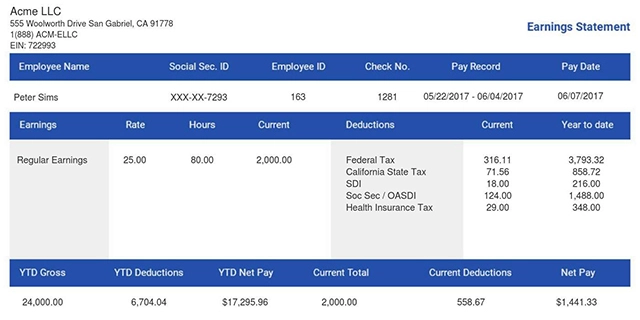
Self-employed business owners can use a recent pay stub to support tax filings and to verify income for car loans, leases, and other applications. Need clean documentation fast? Generate a professional pay stub in minutes with our paystub generator.
- 1. Enter Your Information

- 2. Select Your Favorite Theme

- 3. Download Your Stub!


 By
By