

Split Direct Deposit: How to Set It Up and Save More (2026)
 By
James Wilson
By
James Wilson Typically, a worker's entire paycheck is deposited in one bank account and the worker manages the money from there. Split direct deposit changes that by allowing your entire paycheck to be divided among multiple bank accounts at the time payroll runs. This guide explains how split direct deposit works, how to set it up through your payroll portal, what to do if your employer doesn't offer it, and how the split affects your pay stub. To keep accurate records of every paycheck, our paystub generator makes it simple.
Key Takeaways
- This payroll feature automatically divides your paycheck between two or more bank accounts (savings and checking accounts) to help reach financial goals.
- Split the pay between accounts by a fixed dollar amount (e.g. $100) or by a percentage of each paycheck (e.g. 20%).
- Most major payroll platforms (ADP, Gusto, Workday, Paychex) support it natively.
- Even without employer support, you can automate savings via recurring bank transfers.
- Your pay stub reflects full net pay regardless of how many accounts receive the split.
What Is Split Direct Deposit?
Split direct deposit is a payroll feature that allows you to divide your paycheck into more than one bank account. You can define a split by either a fixed dollar amount or a percentage of your paycheck. Most major payroll systems support this feature in the employee self-service area, including ADP Workforce Now, Gusto, Workday, Paychex Flex, and QuickBooks Payroll. Behind the scenes, these deposits move through the ACH network governed by NACHA, so each split clears on the same payroll timeline as a single deposit.
This can be a big advantage to variable-income workers, because their checks can vary from pay period to pay period. For example, if you set up a split of $100 and your paycheck is smaller than that, the remainder goes into your primary account. This is especially relevant for workers with both W-2 and 1099 income, since different employers may handle splits differently.
Benefits of Splitting Your Direct Deposit
Automate Your Savings
Split direct deposit puts the "pay yourself first" principle on autopilot. Your savings are filled before you even see your net paycheck in your checking account.
Start with 5–10% of take-home pay. To find your base, check your gross monthly income — a $3,000/month earner saves $150–$300 each month this way. A 2021 Federal Reserve report found that more than 25% of Americans were one $400 expense away from not being able to pay their bills. Splitting your deposit builds that buffer on its own, with no extra effort every payday.
In 2026, savings rates remain elevated. Send your split into a high-yield savings account (HYSA) to earn more on that money while it sits.
Budget Management and Goal Achievement
Split deposit makes the 50/30/20 budgeting rule practical. By automatically routing 20% to savings at the time of payroll, you keep your take-home checks and see exactly what's available without having to manually transfer anything.
You can create goal-based splits: one account for your emergency fund, another for a vacation fund or down payment. If you're saving toward a home or car purchase, pay stubs for loan applications show lenders a consistent savings record alongside your income. When income rises, adjust the split percent and a raise goes straight to savings instead of vanishing into lifestyle creep.
How to Set Up Split Direct Deposit

Steps for Employees
- Access your employer's online payroll portal, or ask HR for access.
- Locate the Direct Deposit or Bank Elections section. Common platforms: ADP Workforce Now, Gusto, Workday HCM, Paychex Flex, QuickBooks Payroll, Rippling.
- Choose your split method: fixed dollar amount (e.g., $500 to savings, remainder to checking) or percentage (e.g., 90%/10%).
- Enter the routing number and account number for each bank account.
- Designate the primary account where remaining funds go after splits are distributed.
- Save the changes. It will take 1–2 pay cycles for the changes to take effect.
For example, you could route $2,500 to a Chase checking account and $500 to a Marcus by Goldman Sachs high-yield savings account. Different institutions are no problem. Your W-2 still reflects full earnings; calculating your W-2 wages from a pay stub works the same regardless of how many accounts receive the split.
For HR and Employers
Split deposit setup can be included in an employee's onboarding packet alongside employment verification and proof of income documents. From payroll administration, set a default primary account for each employee. Then the employee logs into the self-service area to add additional secondary accounts. Some payroll systems (such as ADP) require the HR administrator to enable employee self-service before the employee can add secondary accounts.
Can I Split My Direct Deposit Into Two Accounts?
Yes. Most payroll systems allow for the transfer to 2 to 6 accounts or more. Each account you wish to receive funds needs the account holder's name, account number, and bank routing number.
Accounts at the same bank or credit union work just as well as accounts at different institutions. Self-employed workers and independent contractors with 1099 status can split bank transfers the same way, since they typically manage their own payroll.
What If My Employer Doesn't Offer Split Direct Deposit?
Set up a recurring bank transfer instead. Schedule it for 1–2 days after your regular payday so funds have time to clear. You can set it up online at your bank's website or through your bank's mobile app. The result is effectively the same as a payroll-level split deposit.
You can also ask your employer to enable split deposit. Payroll platforms like Gusto and QuickBooks Payroll support it, and setup takes under an hour on the employer side.
Cons of Split Direct Deposit
Split deposits work well for most workers, but a few drawbacks are worth knowing:
- Not universally available. Some smaller employers, or those using older payroll systems, may not support the split. Automatic bank transfer can be used as a workaround.
- Overdraft risk for variable-income workers. If your cash flow varies and you have fixed splits, auto-payments tied to the secondary account could still process and overdraft. Start small and monitor transactions over 2–3 pay periods.
- Initial tracking complexity. There's a short adjustment period while you learn the balances across all accounts. Apps that aggregate accounts (like Copilot or YNAB) make this much easier.
You Might Also Like
- DoorDash Pay Stubs
- How to Calculate Tax on 1099 Misc Income
- Proof of Income Documents: 6 Instances You'll Need a Pay Stub
- Self-Employed? Here's How to Show Proof of Income
- What Is Annual Income
Conclusion
The simplest way to bring order to your finances is by splitting your pay between needs and savings. Once you set up the feature in your payroll system, it works for you automatically from then on.
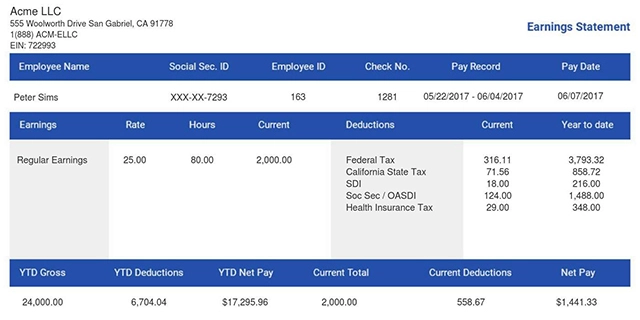
Your pay stub will always display your full gross income, all deductions, and full net pay for each pay period, regardless of how many bank accounts you have. If you need to prove your income for a loan, rental application, or HR files, you can create professional pay stubs at ThePayStubs.com instantly.
- 1. Enter Your Information

- 2. Select Your Favorite Theme

- 3. Download Your Stub!

 By
By