

How To File Taxes as a Freelancer: A Complete 2026 Guide
 By
James Wilson
By
James Wilson If you're figuring out how to file taxes as a freelancer for the first time, you're in new territory. It works very differently from a regular job.
No employer will withhold taxes from your pay or generate pay stubs for your records. No HR team sends reminders. It's all on you, and that's why getting this right matters from the start. The good news? Filing freelance taxes is manageable once you know the system.
This guide covers the forms to file, the taxes you owe, the tax deductions for freelancers you can claim, and how to stay organized year-round. It's built for solo designers, full-time independent contractors, and small business owners who pay their own contractors. You'll also learn how to keep proof of income for rental apps, loans, and financial records. Most guides skip this part.
Key Takeaways
- Freelancers pay self-employment tax of 15.3% (Social Security + Medicare) in addition to regular income tax
- Quarterly estimated tax payments are required when you expect to owe $1,000 or more for the year
- Schedule C and Form 1040 are the core documents for filing freelance income
- Dozens of deductions are available, including home office, software, and equipment, to reduce your taxable income
- Freelancers often need professional income documentation for loans, rentals, and financial applications
- What Changes When You Learn How To File Taxes as a Freelancer
- Self-Employment Tax: What It Is and How To Calculate It
- How To Pay Quarterly Estimated Taxes
- Understanding the Types of 1099 Forms
- Key Tax Deductions for How To File Taxes as a Freelancer
- Home Office Deduction: How To Calculate It
- How To File Taxes as a Freelancer: Step by Step
- LLC vs. Sole Proprietorship: Which Is Right for You?
- Record Keeping Tips for How To File Taxes as a Freelancer
- Retirement Planning Options for Freelancers
- State Tax Considerations for How To File Taxes as a Freelancer
- You Might Also Like
- Conclusion
What Changes When You Learn How To File Taxes as a Freelancer
Knowing why freelance taxes work differently is the first step to learning how to file taxes as a freelancer correctly.
W-2 vs. 1099 Income: What's the Difference?
When you work as a regular employee, your employer handles tax withholding for you. Every paycheck comes with federal income tax, Social Security, and Medicare already taken out. These are your FICA taxes. At year's end, you get a W-2 showing your total earnings and what was withheld.
When you're self-employed, none of that happens. Clients pay you in full with nothing taken out. You get a 1099-NEC instead of a W-2. The IRS treats you as both the employee and the employer. That means you must estimate, set aside, and pay your own self-employment taxes all year.
For Sarah, a freelance UX designer earning $72,000 a year, this shift means planning every payment with taxes in mind. Without planning, she could face a $12,000 tax bill in April.
The $400 Rule: When You Must File
Even small amounts of freelance income trigger a filing need. If your net earnings from self-employment hit $400 or more in a tax year, you must file a federal return and pay your taxes. This applies even if no client sent you a 1099, and even if you were paid in cash.
For small business owners like Marcus, who runs a three-person marketing agency, the threshold applies to his own net income too. He must also issue Form 1099-NEC to any contractor he pays more than $600 in a calendar year.
Reporting All Income, Even Without a 1099
A common mistake when learning how to file taxes as a freelancer is thinking that income without a 1099 doesn't need to be reported. That's wrong. Every dollar of freelance income is taxable. It doesn't matter if it came from a long-term client, a one-time project, PayPal, or Venmo.
The IRS gets copies of every 1099 sent to you. Any gaps between what's reported and what you earned will raise flags. When you file taxes as a freelancer, reporting every dollar is required. Report it all, keep records, and let your deductible expenses do the work of lowering your tax bill.
Self-Employment Tax: What It Is and How To Calculate It
Self-employment tax is 15.3% of your net earnings from freelance work: 12.4% for Social Security and 2.9% for Medicare. Regular employees split these FICA taxes with their employer. Freelancers pay both halves. In 2026, Social Security tax applies only to the first $184,500 of earnings. You can deduct the employer half on your Form 1040.
This tax exists because W-2 employees have their employers cover half of the Social Security and Medicare bill. As a self-employed individual, you are your own employer. You cover both halves. This is a key part of how to file taxes as a freelancer versus a W-2 employee.
How To Calculate Your Self-Employment Tax
- Calculate your net self-employment income (gross income minus business expenses)
- Multiply by 92.35%. This accounts for the employer-equivalent deduction.
- Multiply the result by 15.3%
Example: Sarah earns $72,000 and has $12,000 in deductible expenses.
Net income = $60,000 × 92.35% = $55,410 × 15.3% = $8,478 in self-employment tax.
You report and pay this on Schedule SE, which is attached to your Form 1040. The good news? You can deduct the employer half (about $4,239 for Sarah) as an above-the-line deduction. This lowers your adjusted gross income.
Additional Medicare surtax: An extra 0.9% Medicare tax applies to earnings above $200,000 (single) or $250,000 (married filing jointly).
How To Pay Quarterly Estimated Taxes

Freelancers who expect to owe $1,000 or more in federal taxes must make quarterly tax payments using Form 1040-ES. Payments are due four times a year:
- April 15
- June 16
- September 15
- January 15
Underpaying triggers an IRS penalty of 0.5% per month on the unpaid amount.
The 2026 Quarterly Deadline Calendar
| Quarter | Income Earned | Due Date |
|---|---|---|
| Q1 | January 1 to March 31 | April 15, 2026 |
| Q2 | April 1 to May 31 | June 16, 2026 |
| Q3 | June 1 to August 31 | September 15, 2026 |
| Q4 | September 1 to December 31 | January 15, 2027 |
How Much To Set Aside
One of the most important habits for how to file taxes as a freelancer is setting money aside right away. Don't wait until year-end. A good starting point is 25-30% of every client payment. If your total freelance income is $80,000 or above, bump that to 30 to 35% to cover higher tax brackets and the full self-employment tax burden.
Set money aside right after each payment hits your account. Open a savings account just for taxes. Every time a client pays you, move 28% into that tax account. When quarterly deadlines arrive, the money is ready.
The Safe Harbor Rule
You can avoid underpayment penalties entirely by paying either:
- 100% of last year's tax (110% if your prior-year AGI exceeded $150,000), or
- 90% of your estimated current-year tax
Whichever amount is smaller qualifies as "safe harbor." This is useful if your income changes a lot from year to year.
Paying Your Estimates
Submit payments online at "IRS Direct Pay" (irs.gov/payments) using Form 1040-ES. You can also mail a check with the 1040-ES voucher. Your state may require separate quarterly estimated payments, too, depending on where you live.
Understanding the Types of 1099 Forms
Not all 1099 forms work the same way. Part of knowing how to file taxes as a freelancer is knowing which 1099 types apply to your income. Here's a quick look at the ones you'll see most often:
| Form | When You Receive It | Key Threshold |
|---|---|---|
| 1099-NEC | Freelance services to a business | Earned more than $600 |
| 1099-K | Revenue via payment platforms (Venmo, PayPal, Etsy) | 2025: over $20,000 and 200+ transactions |
| 1099-MISC | Royalties, rent, or other miscellaneous income | Varies by income type |
On 1099-K Reporting
The One Big Beautiful Bill (passed in 2025) set the 1099-K threshold back to more than $20,000 and 200+ transactions for the 2025 tax year. This applies back to 2022 as well. It reversed the lower $5,000 threshold that was briefly in effect for 2024.
Expect your 1099s by January 31 (or February 15 for some forms). Even if a client doesn't send you a 1099, you must still report that income.
For Business Owners
If you pay contractors more than $600 in a calendar year, you're required to issue them a Form 1099-NEC by January 31. Failure to do so can result in IRS penalties.
Key Tax Deductions for How To File Taxes as a Freelancer

Learning how to file taxes as a freelancer correctly unlocks many tax deductions for freelancers. Every dollar you deduct lowers your taxable income, which means a smaller tax bill.
The Most Common Freelancer Tax Deductions
The IRS allows you to deduct expenses that are "Ordinary and necessary" for your business. In practice, this covers a wide range of everyday costs:
-
Computer, tablet, and peripherals: Full cost if used 100% for business, or prorated
-
Phone and internet service: The business-use percentage
-
Software subscriptions: Project management tools, design software, invoicing platforms
-
Office supplies: Notebooks, printer ink, paper
-
Business meals: 50% of the cost when meeting with clients or discussing business
-
Marketing and advertising: Your website, social media ads, business cards
-
Professional development: Courses, certifications, books related to your work
-
Health insurance premiums: If you pay your own insurance and are not eligible for an employer plan
-
Interest on business loans: Fully deductible
For example, Sarah deducts her Figma subscription, Slack Pro account, and the portion of her phone bill used for client calls. Marcus deducts his project management software and the health insurance he pays for himself and his family.
The QBI Deduction: 20% Off Your Business Income
Congress added this tax break in 2017 for pass-through business owners. Most freelancers qualify for this. The income limit is about $197,300 (single) or $394,600 (married). If you're under that cap, you can deduct up to 20% of your net business income. This is separate from your standard deduction.
You don't need to itemize to claim it. It applies to most freelancers under the income cap. File it on Form 8995 attached to your Form 1040. Read our full guide to the Qualified Business Income deduction for details.
Home Office Deduction: How To Calculate It
To claim the home office deduction, divide your workspace square footage by your home's total square footage. Multiply that share by your housing costs. These include rent, mortgage interest, utilities, and insurance.
For example, 200 sq ft in a 1,000 sq ft home = 20% of eligible costs deducted. The space must be used only for work.
Part of knowing how to file taxes as a freelancer is meeting the IRS exclusive-use rule, which is strict. A shared dining room table or a couch where you watch TV does not qualify. A guest bedroom where the family stays doesn't count either. You need a space dedicated solely to work, even if it's just a corner of a room.
Two Methods To Calculate the Deduction
Simplified Method
Deduct $5 per square foot of your home office, up to 300 sq ft. Maximum deduction is $1,500. This is easy to calculate with no depreciation hassles.
Regular Method
Divide your workspace area by your total home area to get the business use share. Apply that share to all eligible home costs:
Sarah's example:
200 sq ft workspace ÷ 1,000 sq ft total = 20% business use
- Annual eligible expenses: $18,000 rent + $1,800 utilities + $600 insurance = $20,400
- Deduction: 20% × $20,400 = $4,080
The regular method uses Form 8829 and can include mortgage interest and depreciation. It's more complex but often more valuable.
How To File Taxes as a Freelancer: Step by Step
To file taxes as a freelancer, fill out Form 1040 with Schedule C to report your business income and expenses. Add Schedule SE to calculate your self-employment tax. If eligible, claim the QBI deduction via Form 8995. The tax filing deadline is April 15. You can request an extension to October 15 using Form 4868.
Here's the step-by-step process for how to file taxes as a freelancer each year:
-
Gather all income records: Collect every 1099-NEC, 1099-K, and any other income documentation. Even income that isn't reported on a 1099 needs to be included.
-
Total your deductible expenses: Organize all business costs from the year. Bank statements, credit card records, and receipts are your evidence.
-
Complete Schedule C: Report your gross freelance income and all business costs. The result is your net profit (or loss), which flows to your Form 1040.
-
Calculate SE tax on Schedule SE: Use your Schedule C net profit to calculate the 15.3% self-employment tax. Note the deductible half.
-
Complete Form 1040: Report all income sources. Apply above-the-line deductions (including the SE tax deduction and IRA contributions). Then calculate your final tax bill.
-
Apply the QBI deduction: If eligible, complete Form 8995 and subtract up to 20% of qualified business income.
-
Pay any amount owed or claim your refund: Subtract estimated tax payments already made to determine the balance due.
The tax filing deadline is April 15 each year. Extensions push the filing date to October 15, but they don't extend the payment deadline. You must still pay your taxes by April 15.
Tax Software vs. a CPA
For simple freelance income, tax software like TurboTax Self-Employed or H&R Block handles Schedule C and SE well. If your case is complex (multiple entities, big assets, or income above $100,000), a CPA is worth it.
LLC vs. Sole Proprietorship: Which Is Right for You?
The default setup for how to file taxes as a freelancer is as a sole proprietor. You and your business are the same legal entity for tax purposes. No registration is needed. You simply report your income on Schedule C.
The other option is forming a Limited Liability Company (LLC). This gives you personal liability protection by keeping your business debts separate from your personal assets. An LLC doesn't change how you're taxed on its own. A single-member LLC is still treated as a sole proprietorship by the IRS.
Things get more interesting with an S-Corp election. If you earn $80,000 or more in net freelance income, an S-Corp can cut your self-employment tax bill. You pay yourself a fair salary, subject to payroll taxes. Any leftover profit passes through as a distribution, which avoids SE tax.
The trade-offs (payroll complexity, a separate tax return, and higher accounting costs) mean S-Corp status only makes sense at higher income levels. Talk to a tax professional before making the election.
Record Keeping Tips for How To File Taxes as a Freelancer
Good recordkeeping for freelancers is the basis of stress-free tax filing. Knowing how to file taxes as a freelancer means having proof for every deduction you claim. Strong records protect you if the IRS takes a closer look. The IRS can audit returns up to three years back. That jumps to six years if they think income was underreported by 25% or more.
What Records To Keep
- Income: All 1099s received, invoices issued, bank deposit records, PayPal, and Venmo transaction exports
- Expenses: Receipts, bank and credit card statements, subscription confirmation emails
- Mileage: A log of business-related driving (date, destination, purpose, miles)
- Home office: Lease or mortgage statement, utility bills, square footage documentation
The IRS requires receipts for expenses over $75. For smaller amounts, a bank or credit card statement works. Keep all records for at least three years from the filing date.
Software like QuickBooks Self-Employed or a simple spreadsheet makes tracking easier all year. At tax time, it gives you the reports you need.
Proof of Income Beyond Tax Returns
Tax returns only tell part of the story. A landlord, lender, or auto dealer wants to see current income, not last year's totals. Freelancers applying for rentals, car loans, or business credit often hit this gap. There are several ways to show proof of income as a self-employed worker that lenders accept.
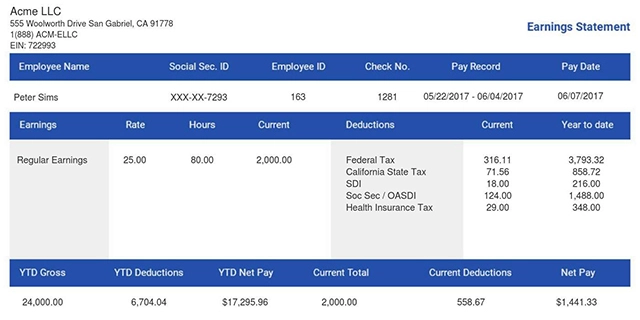
This is where professional pay stub records help. A good pay stub shows your gross income, deductions, and net pay in the format lenders expect. Instead of submitting invoices or bank statements, a paystub generator for self-employed workers lets you create pay stubs that match your actual freelance earnings. They work for rental apps, loan paperwork, and personal records.
For example, Marcus uses pay stub records for his own income and to give contractors clear payment records. Sarah keeps them on file for apartment rental applications when she moves to a new contract.
Retirement Planning Options for Freelancers
Working for yourself doesn't mean giving up on retirement savings. Choosing the right retirement plan for freelancers is an underused part of how to file taxes as a freelancer. The right account can lower your taxable income. The options for self-employed individuals are strong.
-
Solo 401(k): Open to self-employed individuals with no full-time employees (other than a spouse). In 2026, you can contribute up to $23,500 to the employee share. As the employer, you can add up to 25% of net SE income. Total annual limit is $70,000. Contributions are tax-deductible.
-
SEP IRA (Simplified Employee Pension): Easier to set up and run than a Solo 401(k). You can put in up to 25% of your net self-employment income, with a 2026 max of $70,000. No extra employee contribution option.
-
SIMPLE IRA: Designed for businesses with employees. For example, if Marcus has full-time staff, a SIMPLE IRA may be a better fit than a Solo 401(k).
All these plans let you contribute for the prior tax year up until the April 15 deadline. A 2025 SEP IRA contribution made in early 2026 still counts on your 2025 return.
For example, Sarah contributes $8,000 per year to a SEP IRA. This cuts her taxable income by $8,000 and lowers her tax bill.
State Tax Considerations for How To File Taxes as a Freelancer
Federal taxes get most of the focus when you study how to file taxes as a freelancer. But state and local taxes are just as real and vary a lot by where you live.
-
Seven states have no state income tax. These include Alaska, Florida, Nevada, South Dakota, Texas, Washington, and Wyoming. If you live in one of these states, your freelance income isn't subject to state income tax.
-
Most other states require quarterly estimated state tax payments on the same schedule as federal ones. Exact deadlines and amounts vary. File a yearly state income tax return with your state tax office.
-
Local taxes apply in roughly 5,000 cities and counties across the country. New York City, for example, has its own income tax on top of New York State's.
-
State LLC fees should also be considered. California charges LLCs a minimum annual franchise tax of $800, no matter what you earn. If you're thinking about forming an LLC, check your state's specific rules and fees.
States like Hawaii, New Mexico, South Dakota, and West Virginia charge sales tax on services. This may affect some types of freelance work. Check your state's tax agency site for current rules.
You Might Also Like
- Freelancing for Beginners: 1099 vs. W-2 Explained
- W-2 vs. 1099: How Do You File Taxes When You Have Both?
- Proof of Income If You're Paid in Cash
- Proof of Income Documents: 6 Instances You'll Need a Pay Stub
- How to Write a Proof of Income Letter for an Apartment
Conclusion
Learning how to file taxes as a freelancer the right way pays off all year, not just in April. Set aside 25-30% of every payment. Make your quarterly tax payments on time. Track every business expense. Build a record system that works for you. The more organized you stay all year, the less stressful tax season gets. You'll also claim more deductions.
ThePayStubs.com makes it easy to generate professional pay stubs that reflect your actual freelance earnings. Use them to document your income for rental applications, loans, or any financial purpose.
Disclaimer: This article is for informational purposes only and does not constitute tax or legal advice. Consult a qualified tax professional for guidance specific to your situation.
- 1. Enter Your Information

- 2. Select Your Favorite Theme

- 3. Download Your Stub!

 By
By