Is FICA the Same as Federal Income Tax? (2026 Guide)
 By
Look at any pay stub and you'll see at least two federal taxes taken out. One says FICA. The other says FIT or federal withholding. So, is FICA the same as federal income tax? No. They're two different taxes with different rates, rules, and purposes.
Below, you'll see how each works, the 2026 numbers, and how to read both lines on your stub and W-2, whether you're checking your pay or running payroll.
Key Takeaways
- FICA is a flat 7.65% for Social Security and Medicare. Your employer pays a matching 7.65%.
- Federal income tax uses brackets from 10% to 37% and depends on your W-4.
- Your W-4 changes income tax withholding, but it can't change FICA.
- A tax refund returns extra income tax, not FICA, except in a few cases.
- Is FICA the Same as Federal Income Tax?
- FICA vs Federal Income Tax: Side-by-Side
- What Does FICA Consist Of?
- How Federal Income Tax Withholding Works
- FICA Tax Rate 2026 and Wage Limits
- What Is FICA on My Paycheck?
- What Are FICA Wages?
- Can You Get a FICA Refund?
- Who Is Exempt From FICA Taxes?
- What Small Business Owners Need to Know
- Conclusion: Is FICA the Same as Federal Income Tax?
Is FICA the Same as Federal Income Tax?
No. FICA and federal income tax are two separate federal taxes taken from the same paycheck. FICA is a flat 7.65% that funds Social Security and Medicare, and your employer matches it. Federal income tax uses brackets from 10% to 37%, depends on your W-4, and gets settled when you file your return.
The mix-up makes sense. Both come out of every check and go to the IRS. But FICA is a payroll tax set aside for two programs, while income tax pays for the rest of the federal budget.
FICA vs Federal Income Tax: Side-by-Side

Here's how the two compare in 2026:
| Feature | FICA | Federal Income Tax |
|---|---|---|
| What it funds | Social Security and Medicare | General federal budget |
| Rate | Flat 7.65% (plus 0.9% on high wages) | 10% to 37% brackets |
| Wage cap | Social Security stops at $184,500 | No cap |
| Employer share | Matches 7.65% | None |
| Set by your W-4 | No | Yes |
| Refunded at tax time | Rarely | Often |
| W-2 boxes | 3, 4, 5, 6 | 1, 2 |
The biggest gap is control. A new W-4 changes income tax withholding, but FICA is fixed by law.
What Does FICA Consist Of?
FICA consists of two taxes: Social Security tax at 6.2% and Medicare tax at 1.45%. Social Security, also called OASDI, pays retirement, disability, and survivor benefits. Medicare, also called HI, pays hospital insurance for people 65 and older and some people with disabilities. High earners also pay a 0.9% Additional Medicare Tax.
FICA stands for the Federal Insurance Contributions Act. So is FICA Social Security? Partly. Social Security is the larger piece, but FICA covers both programs. And does FICA include Medicare? Yes, which is why many stubs show two lines instead of one.
How Federal Income Tax Withholding Works

Federal income tax is based on your taxable income for the whole year. Your employer estimates it from your Form W-4, which lists your filing status, other jobs, and dependents.
For 2026, the brackets run from 10% to 37%, and the standard deduction is $16,100 for single filers. Each rate applies only to the dollars inside its bracket.
What's withheld is only an estimate. At filing time, you get a refund if you paid too much or owe if you paid too little. FICA usually has no yearly true-up like that.
FICA Tax Rate 2026 and Wage Limits
The FICA tax rate for 2026 is the same 7.65% for employees, with a new Social Security wage limit:
| Tax | Employee | Employer | 2026 Limit |
|---|---|---|---|
| Social Security | 6.2% | 6.2% | First $184,500 of wages |
| Medicare | 1.45% | 1.45% | No limit |
| Additional Medicare | 0.9% | None | Wages over $200,000 |
The most an employee pays in Social Security tax this year is $11,439, based on the IRS wage base of $184,500. Once you pass the cap in a calendar year, that line drops to zero.
Who pays FICA? Both sides. Your employer handles FICA withholding for your half and adds its own matching share. Self-employed people pay both halves, 15.3%, through self-employment tax on Schedule SE.
What Is FICA on My Paycheck?
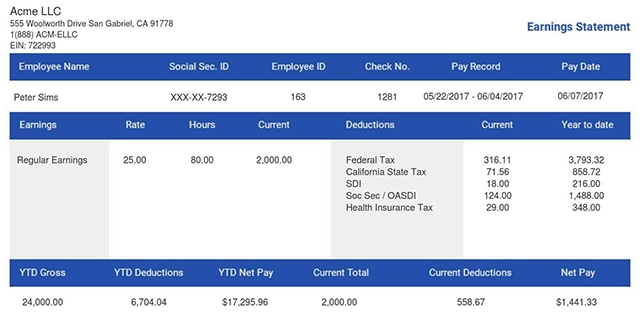
FICA on your paycheck means the 7.65% withheld for Social Security and Medicare. It's usually split into two lines, such as "FICA-SS" or "OASDI" at 6.2% and "FICA-MED" or "MED" at 1.45%. Federal income tax shows on a separate line, often labeled "FIT" or "Fed WH."
Pay Stub Labels to Know
The FICA EE meaning is simple: EE stands for employee, so it's your share. Here's what each FICA deduction on a paystub looks like, using common pay stub deduction codes:
- FICA OASDI, FICA-SS, or SS: Social Security tax at 6.2%
- FICA-MED, MED, or HI: Medicare tax at 1.45%
- FIT or Fed WH: Federal income tax, based on your W-4
Quick tip: if FIT shows $0 but FICA is still withheld, check your W-4. You may have claimed exempt or entered large credits, which could leave you owing in April.
Where FICA and FIT Show on Your W-2
Your W-2 splits them the same way, and its Social Security wages can differ from Box 1. Box 2 shows federal income tax withheld. Box 4 shows Social Security tax, and Box 6 shows Medicare tax. Together, boxes 4 and 6 are your federal FICA withheld. When a rental or benefits form asks for "FICA or FIT withheld," it means these two separate amounts.
What Are FICA Wages?
FICA wages are the pay subject to Social Security and Medicare tax. They're often higher than your FIT taxable wages, because traditional 401(k) deferrals lower income tax wages but not FICA wages. Health premiums paid through a Section 125 cafeteria plan usually lower both. That's why W-2 boxes 1, 3, and 5 differ.
So, are 401k contributions subject to FICA? Yes. The IRS treats elective deferrals as FICA wages even though they skip income tax for now.
Here's how to calculate FICA on a real check. Say you earn $52,000 a year, paid biweekly, and put 5% in a 401(k):
- Gross pay: $2,000
- Social Security (6.2%): $124.00
- Medicare (1.45%): $29.00
- Total FICA: $153.00, on the full $2,000
- Income tax wages: $1,900, after the $100 deferral
For a single filer with the standard deduction and no other income, income tax comes to roughly $144 per check. The new deductions for tips and overtime work the same way. They cut federal income tax, but FICA still applies to every dollar of tips and overtime pay.
Can You Get a FICA Refund?
Usually not. A tax refund returns extra federal income tax withholding, not FICA. The main exception: if two or more employers together withheld Social Security tax on more than $184,500 in 2026, you claim the extra on Schedule 3 of Form 1040. If one employer withheld too much, that employer must fix it.
If the employer won't correct it, you can request a FICA refund with Form 843.
Who Is Exempt From FICA Taxes?
Few workers are exempt from FICA taxes. The main groups are students working for the school they attend, many F-1 and J-1 nonresident visa holders, members of certain religious groups who file Form 4029, and some state and local government employees covered by a public pension plan instead.
The student rule is narrow: it covers jobs at your own university while you're enrolled. Most exempt workers still owe federal income tax.
What Small Business Owners Need to Know
If you run payroll, you report both taxes together. Each quarter, Form 941 lists the income tax you withheld plus both halves of FICA. Federal unemployment tax goes on Form 940.
Keep FICA and income tax as separate lines on every stub. Landlords and lenders read them to confirm real wages. If your current stubs lump taxes together, our pay stub templates break out each line clearly.
You Might Also Like
- What Is Medicare Tax?
- What Is OASDI Tax?
- Medicare Wages and Tips Meaning
- What Is Tax Withholding?
- Understanding Your W-2 Form
Conclusion: Is FICA the Same as Federal Income Tax?
The short answer is no. FICA is a flat payroll tax for Social Security and Medicare, while income tax depends on your W-4 and gets settled each spring. Need clear stubs that show every tax line? Create them in minutes with our paystub generator.
- 1. Enter Your Information

- 2. Select Your Favorite Theme

- 3. Download Your Stub!

 By