

What Is Salary Range? Min, Midpoint and Max (2026)
 By
By
A job posting says $60,000 to $90,000. Your manager says you're "in the middle of your range." So what is salary range, exactly?
It's the band of pay an employer attaches to a job: a floor, a ceiling, and a midpoint the whole thing is built around. There's also math that pins down where any salary sits inside it, and that's the part almost nobody explains. If you already know your number and just need it on paper, our pay stub generator handles that part.
This guide covers the three parts of a range, how to calculate range spread, where a salary falls inside the band, and what a posted pay range means when you're the one negotiating.
Key Takeaways
- A salary range has three parts: a minimum, a midpoint set from market data, and a maximum.
- Range spread measures how wide the band is: (maximum minus minimum) divided by the minimum.
- Compa ratio and range penetration both locate a salary inside the band, but they answer different questions.
- Several states now require employers to publish the pay range in job postings.
- What Is a Salary Range?
- The Three Parts of a Pay Range: Minimum, Midpoint and Maximum
- How to Calculate Salary Range Spread
- Where a Salary Sits in the Range: Penetration and Compa Ratio
- How Employers Build a Salary Range Structure
- What a Posted Pay Range Means for You
- Salary Ranges and Your Pay Documents
What Is a Salary Range?
A salary range is the span of pay an employer will offer for a specific role, from a minimum to a maximum, with a midpoint that reflects the market rate. A posting listing $60,000 to $90,000 is showing you its range. Employers use ranges to keep pay consistent across people doing the same job.
So what is pay range, and is it something different? No. That term and "salary range" describe the same structure, and most employers use them interchangeably.
Salary bands are where it gets muddier. Some employers use a band as a narrow, level-specific slice; others use it as a wide container holding several jobs at once. Published definitions genuinely contradict each other on this, which makes more sense once you see how compensation is structured overall. The useful test isn't the label, it's the scope: ask whether the band covers one job or many. If it covers many, you're looking at a broader structure with individual salary ranges nested inside it.
The Three Parts of a Pay Range: Minimum, Midpoint and Maximum

Every range is really three numbers doing three different jobs.
Minimum
This is your entry point, the figure an employer expects to pay someone who meets the basic requirements but is still growing into the role. It can't drop below the legal wage floor set under the Fair Labor Standards Act and any stricter state minimum.
Midpoint
Everything else gets built around this number. It represents the market rate for a fully competent person in the job, which is why employers usually set the salary midpoint first and derive the other two from it. Most compensation teams peg it to survey data or published wage percentiles.
Maximum
This is the ceiling for the role as scoped. Hitting it doesn't mean you stop earning more, but it does mean further increases usually require a promotion into a higher range rather than a raise inside this one.
Here's how they reconcile. Take a $75,000 midpoint and a 50% spread. Divide the midpoint by 1.25 (one plus half the spread) for a $60,000 minimum, then multiply that by 1.5 (one plus the spread) for a $90,000 maximum. The midpoint of $60,000 and $90,000 is $75,000, back where you started.
How to Calculate Salary Range Spread
Range spread tells you how wide the band is, expressed as a percentage of the minimum. Here's the calculation:
Range Spread = (Maximum - Minimum) / Minimum x 100
That's the entire range spread formula. Run our example through it: ($90,000 minus $60,000) divided by $60,000 gives you 0.5, so the spread is 50%. The top of the band pays half again as much as the bottom.
Width tracks job level, since senior roles have more room for performance to show up in pay. These are the spreads cited most often:
| Role type | Commonly cited spread |
|---|---|
| Hourly and contract roles | 30% to 40% |
| Entry to mid-level professional and managerial | 40% to 60% |
| Executive | 60% to 70% |
Treat those as orientation, not doctrine. Published sources disagree on the exact bands, and a software engineer range at a large tech employer looks nothing like one at a 30-person company.
Where a Salary Sits in the Range: Penetration and Compa Ratio

Knowing the range is one thing. Knowing where a specific salary sits inside it is what drives raise conversations. Two metrics do that, and they aren't interchangeable.
Range Penetration Formula
Range penetration measures how far a salary has traveled from the floor toward the ceiling.
(Salary - Minimum) / (Maximum - Minimum) x 100
That's the range penetration formula in full. Someone earning $70,000 in our example band works out to 33%, since $10,000 above the floor divided by the $30,000 of total width gives 0.33. Read it as a position on a track: zero percent is the floor, 50% is the midpoint, 100% is the ceiling. A range penetration calculator just automates that arithmetic, though salary range penetration is simple enough to work out by hand in seconds.
How to Calculate Compa Ratio
So what is compa ratio? It compares a salary against the midpoint alone, ignoring the floor and the ceiling entirely. Here's how to calculate compa ratio:
Compa Ratio = Base Salary / Midpoint
That same $70,000 annual salary, divided by the $75,000 midpoint, gives 0.93. A result of 1.00 means the salary sits exactly on the midpoint, 0.90 means 10% below it, and 1.10 means 10% above.
The difference matters more than it looks. Compa ratio ignores how wide the band is, so two people with an identical 0.93 can be in completely different positions if one sits in a narrow range and the other in a wide one. Penetration accounts for that width. Use compa ratio to compare against the market rate, and penetration to see how much runway is left.
How Employers Build a Salary Range Structure
A salary structure is the full set of ranges an organization uses, stacked so that pay levels connect sensibly from junior roles up to senior ones. It sits alongside the other types of compensation an employer offers.
Building one starts with market data. Compensation teams price roles against survey sources and public wage data, set midpoints from that evidence, then group comparable jobs into the same range so people doing similar work land in the same band. That grouping protects internal equity and makes pay equity auditable, and it's the difference between defensible pay and a spreadsheet of one-off decisions. Whether an employer aims at the midpoint or deliberately pays above it is what compensation teams call its compensation philosophy.
Structure types vary. A traditional salary structure uses many narrow grades with small steps between them, which suits organizations with clear hierarchies. Broadbanding collapses those into fewer, wider bands and leans on manager judgment instead. Anyone researching how to develop a salary structure will find a salary structure template useful as scaffolding, though the midpoints still have to come from your own market data.
Four factors move a range more than anything else: geography, industry, company size, and how scarce the skill is. The same job title can carry very different internal pay depending on which apply, which is one reason payroll and compensation aren't the same thing.
What a Posted Pay Range Means for You
A posted range is a negotiating frame, not a menu. Employers rarely open at the maximum, because the top of the band is generally held for people already performing deep in the role. Expect an initial offer somewhere between the minimum and midpoint unless you're arriving with unusually strong credentials.
When a recruiter asks for your desired pay range before showing you theirs, give a band whose bottom you'd genuinely accept. If the range is quoted hourly, convert it to weekly and monthly income before you answer. Hiring managers tend to anchor on the lower number, so naming a floor below your real target quietly caps the outcome. Salary negotiation goes better when your range overlaps the top half of theirs.
Pay Transparency Laws in 2026
Some of this is no longer optional for employers. The California pay range law, SB 1162, requires employers with 15 or more employees to include the pay scale in every job posting, with penalties running from $100 to $10,000 per violation. A follow-on amendment, SB 642, took effect on January 1, 2026 and redefines "pay scale" as a good-faith estimate of what the employer actually expects to pay. Colorado, New York, and Washington have comparable requirements.
Salary Ranges and Your Pay Documents
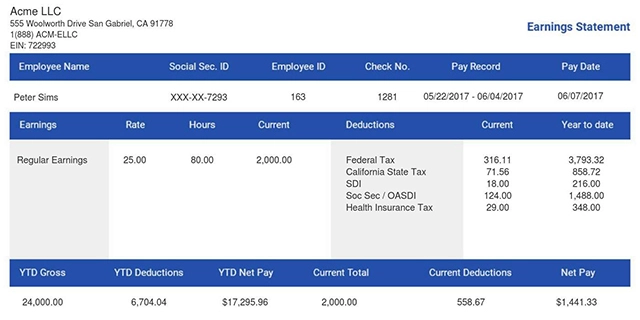
Here's the disconnect nobody mentions. All that range structure shapes the offer, then vanishes. Your pay stub shows the rate you actually landed on, never the band it came from. No lender, landlord, or verification service sees your compa ratio.
That matters when you need to prove income. What gets scrutinized is documented earnings: gross pay, payroll deduction codes, and year-to-date totals in a consistent format. If your employer's records are thin, or you're self-employed and setting your own rate against market data, our pay stub templates produce documentation that holds up to that scrutiny.
You Might Also Like
- What Is Annual Income?
- What Is a Compensation Strategy?
- Federal Minimum Wage Explained
- How to Calculate W-2 Wages From a Pay Stub
- What Is Net Salary?
Conclusion
A salary range is three numbers with a logic behind them: a minimum, a market-anchored midpoint, and a maximum. The spread tells you how wide the band is, while compa ratio and range penetration tell you where a salary sits inside it. Once you can run those calculations, a posted pay range stops being a mystery and starts being information you can negotiate against.
Once your number is settled, documenting it is the easy part. Use our paystub generator to create professional pay stubs in minutes.
- 1. Enter Your Information

- 2. Select Your Favorite Theme

- 3. Download Your Stub!


 By
By