

After Tax Cost of Debt Formula: How to Calculate It (2026)
 By
By
If your business carries an SBA loan, an equipment note, and a credit card balance, you don't have one interest rate. You have three. And none of them is the number you should be using when you decide whether that debt is worth carrying. The after tax cost of debt formula gives you that number. Lenders will want your financials and pay stubs when you refinance, but deciding whether to refinance at all starts with a figure you work out yourself.
The rate that actually matters is what borrowing costs you after the tax deduction. Business interest is deductible, and that deduction quietly hands part of the money back. Below you'll get the formula itself and a full walkthrough using a typical small-business debt mix. You'll also get a straight answer on which tax rate to plug in, plus the one IRS rule that can make the whole calculation wrong.
Key Takeaways
- The after tax cost of debt formula is Pre-Tax Cost of Debt x (1 - Tax Rate).
- Your pre-tax rate is total annual interest divided by total debt, not the APR on any single loan.
- Use your effective tax rate from last year's return, not your top marginal bracket.
- Interest is deductible, which is why the after-tax number always lands below the rate you pay.
- Section 163(j) can cap that deduction, though most small businesses are exempt.
- What Is the After Tax Cost of Debt Formula?
- How Do You Calculate the After Tax Cost of Debt?
- Which Tax Rate Goes Into the After Tax Cost of Debt Formula?
- Using a Cost of Debt Calculator for Multiple Loans
- What the After Tax Cost of Debt Formula Misses
- Mistakes That Break the After Tax Cost of Debt Formula
- How to Lower Your After-Tax Cost of Debt
What Is the After Tax Cost of Debt Formula?
The after tax cost of debt formula is Pre-Tax Cost of Debt x (1 - Tax Rate). Your pre-tax cost of debt is total annual interest divided by total debt. Because business interest is a deductible expense, the after-tax figure is always lower. A 9% blended rate at a 24% tax rate costs 6.84%.
There are really two formulas here, and you run them in order.
First, find what you're paying lenders across everything you owe:
Pre-Tax Cost of Debt = Total Annual Interest / Total Debt
Then adjust that rate for the tax break:
After Tax Cost of Debt = Pre-Tax Cost of Debt x (1 - Tax Rate)
That second step is the whole point. Interest on business debt is an ordinary deductible expense, so every dollar you pay in interest shrinks your taxable income by a dollar. The IRS covers this in Topic No. 505, Interest Expense. If you're in a 24% bracket, the government effectively absorbs 24 cents of every interest dollar, and your real cost drops accordingly.
This matters to a self-employed contractor running a single business credit card. It matters just as much to a small employer carrying a term loan to smooth out payroll. Both are paying a sticker rate that overstates what the debt truly costs.
How Do You Calculate the After Tax Cost of Debt?

Calculate the after tax cost of debt in three steps. First, add up every dollar of interest your business paid this year from your profit and loss statement. Second, total your outstanding loan balances. Third, divide interest by debt to get your pre-tax rate, then multiply that rate by one minus your effective tax rate.
Most guides hand you the after tax cost of debt formula and assume the numbers are already sitting on your desk. They aren't. Here's where each one actually lives.
Step 1: Add Up Your Annual Interest Expense
Start with the interest expense line on your profit and loss statement. If your books aren't that tidy, pull the year-end statement from each lender instead. Every one of them reports total interest paid for the year. For a mortgage on business property, that figure shows up on Form 1098. For a term loan, your amortization schedule splits each payment into principal and interest, so you'll want the interest column only.
Step 2: Total Your Outstanding Debt
Take the loan balances off your balance sheet. If you paid down principal during the year, don't use the December 31 balance on its own; average the opening and closing balances instead. A loan you cut in half over twelve months carried far more debt than the year-end snapshot suggests. Using that snapshot inflates your calculated rate.
Step 3: Apply Your Tax Rate
Divide, then tax-adjust. Say a small business ends the year with these balances (illustrative figures, not current market rates):
| Debt | Balance | Interest Paid | Rate |
|---|---|---|---|
| SBA 7(a) term loan | $100,000 | $7,000 | 7.0% |
| Equipment financing | $30,000 | $2,700 | 9.0% |
| Business credit card | $20,000 | $3,800 | 19.0% |
| Total | $150,000 | $13,500 | 9.0% |
The pre-tax cost of debt is $13,500 / $150,000, or 9.0%. At a 24% effective tax rate, you multiply by 0.76 to finish: 9.0% x 0.76 = 6.84%. That business isn't paying 19% or 7%. It's paying 6.84%.
Which Tax Rate Goes Into the After Tax Cost of Debt Formula?
Use your effective tax rate, not your top marginal bracket. A C corporation uses the 21% federal corporate rate plus any state corporate tax. A sole proprietor, partnership, LLC, or S corporation has no corporate rate at all. The owner uses their own effective rate instead: total tax divided by taxable income from last year's return.
The after-tax cost of debt formula is only as good as the rate you feed it, and this is where most owners go wrong. They grab a headline percentage off a search result and plug it in. But a 21% corporate rate has nothing to do with a Schedule C business. Your top bracket also isn't what you actually paid across your whole income.
Build the number instead of guessing at it. Pull last year's return, divide total tax by taxable income, and you have your effective rate. Add state income tax where it applies. That single substitution can move your answer by several percentage points. On a typical small business, that's enough to flip a refinancing decision.
Using a Cost of Debt Calculator for Multiple Loans

Any online tool will do the arithmetic, but the version worth having is one you build yourself and keep. Set up four columns: lender, outstanding balance, interest paid this year, and implied rate. Add a row per debt.
Total the balance column, total the interest column, and divide. That's your weighted average, which is simply the pre-tax rate weighted by how much you actually owe on each loan. A $100,000 loan at 7% pulls the blend far harder than a $2,000 card at 25%. That's exactly why averaging your rates instead of your dollars gives a wrong answer.
Then run it again every quarter. An after-tax cost of debt calculator is only accurate on the day you build it. The number moves every time you draw on a line of credit or pay off a balance. A freelancer juggling two cards and a small employer carrying equipment financing both benefit from the same habit. Rebuild the number, don't estimate it.
Clean records make this painless. If your pay and income documentation is scattered, our pay stub templates give you a consistent format to work from.
What the After Tax Cost of Debt Formula Misses
That formula quietly assumes every dollar of interest you pay is deductible. Section 163(j) is where the assumption can break.
Under that rule, your deductible business interest can't exceed the sum of three things:
- Your business interest income
- 30% of your adjusted taxable income (ATI)
- Any floor plan financing interest
Anything above that line isn't deductible this year. Your real after-tax cost is then higher than the formula returns.
Most small businesses never come close to this limit. Businesses that meet the section 448(c) gross receipts test are exempt. The IRS set that threshold at $30 million for 2024 and $31 million for 2025, adjusted annually for inflation. If your business is nowhere near that, the standard formula holds.
Two things worth knowing if you're subject to the cap. Disallowed interest carries forward to the next tax year, so it's deferred rather than lost. For tax years beginning after December 31, 2024, depreciation, amortization, and depletion get added back into ATI again. That raises ATI and lets more interest through the cap than the 2022 through 2024 rules allowed. The calculation itself happens on Form 8990, and the IRS lays out the details in its section 163(j) questions and answers.
Mistakes That Break the After Tax Cost of Debt Formula
The after tax cost of debt formula only works if the inputs are right. Five errors account for most wrong answers:
- Using APR instead of interest actually paid. APR is a quoted price. Your calculation needs the dollars that left your account.
- Using your top marginal bracket. Your effective rate is lower, and using the bracket overstates the tax benefit.
- Mixing in personal debt. A personal auto loan isn't business interest and doesn't belong in the total.
- Using the year-end balance on an amortizing loan. Average the opening and closing balances instead.
- Ignoring fees and factor rates. Origination fees are part of your cost. Merchant cash advances quote a factor rate, which hides an effective annual cost far higher than that number suggests.
How to Lower Your After-Tax Cost of Debt
The tax rate side of the equation isn't a lever you'd want to pull, since a higher tax rate costs you far more than it saves you on this one number. Every real improvement comes from the pre-tax side:
- Refinance or consolidate. Rolling a 19% card balance into a term loan moves the blend more than anything else on this list.
- Attack the highest rate first. Paying down your most expensive balance shifts the weighted average fastest.
- Build business credit. A business credit builder account means better pricing on the next loan agreement you sign.
- Negotiate all three levers. Rate, term, and fees are all negotiable, and lenders would rather adjust terms than lose the relationship.
One distinction that trips people up: APR and cost of debt aren't the same tool. APR helps you choose a loan before you borrow, and pay stubs for loan applications are part of what a lender reviews at that stage. The after-tax cost of debt tells you what the debt financing you already hold is really costing you.
You Might Also Like
- How to Calculate Tax on 1099-MISC Income
- Freelancing for Beginners: 1099 vs W-2
- How to Calculate Your Hourly, Weekly, and Monthly Income
- What Is Annual Income?
- Employment Verification and Proof of Income Documents
Conclusion
The after tax cost of debt formula is the easy part. Where owners lose accuracy is in the inputs. They pull interest from the wrong document, average rates instead of dollars, or guess at a tax rate that doesn't match their entity type. Build the four-column table once this quarter and you'll have a number you can actually act on.
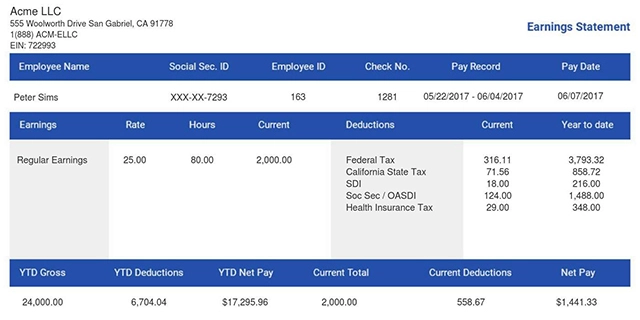
All of it runs on clean records. If you need accurate, professional pay documentation for your own books or for your team, our pay stub generator creates it in minutes.
- 1. Enter Your Information

- 2. Select Your Favorite Theme

- 3. Download Your Stub!

 By
By