

How Much PTO Do You Get? Average Days by Tenure (2026)
 By
By
Your offer letter says two weeks. Is that generous, standard, or thin? Search this question and you'll land in Reddit threads where strangers swap numbers. That tells you what people say they get, not what's actually typical. How much PTO do you get compared with everyone else in the country? There's a real answer, and it comes from federal survey data rather than anecdotes.
Your pay stub can even tell you your own accrual rate, and we'll cover how to read it. Below you'll also find the average days off by tenure, who gets paid leave at all, and the accrual math for hourly and part-time staff.
Key Takeaways
- Private-industry workers average 11 paid vacation days after one year, rising to 20 days after 20 years (BLS, March 2025)
- 80% of private-industry workers have paid vacation, but only 40% of part-time workers do
- Hourly PTO usually accrues per hour worked, roughly 0.0385 hours for a two-week annual grant
- No federal law requires employers to provide any paid time off
- Your pay stub is the fastest place to confirm what you've actually banked
How Much PTO Do You Get? The 2026 Averages
Private-industry workers average 11 paid vacation days after one year of service, 15 days after five years, 18 after ten, and 20 after twenty. That comes from Bureau of Labor Statistics data for March 2025. Add roughly 7 paid sick days. State and local government workers average slightly more, starting at 13 vacation days.
Those are the benchmarks, but they only make sense once you know what's being counted.
What Counts as PTO
Paid time off is an umbrella term, and employers build it two different ways. Some keep separate buckets: vacation days, sick days, personal days, and paid holidays, each with its own rules. Others pool everything into a single consolidated bank you draw from for any reason: a beach week, the flu, or a mental health day.
About 51% of private-industry workers have a consolidated plan. The distinction matters more than it sounds. A "15 days of PTO" offer from a company with a single bank is thinner than it looks. Fifteen vacation days plus separate sick leave is the better deal.
How Much PTO Do You Get After 1, 5, 10 and 20 Years?
Tenure is the single biggest lever on your allotment. Here's what the Bureau of Labor Statistics found in March 2025:
| Years of service | Vacation days (private industry) | Vacation days (state and local government) |
|---|---|---|
| After 1 year | 11 | 13 |
| After 5 years | 15 | 16 |
| After 10 years | 18 | 19 |
| After 20 years | 20 | 22 |
Sick leave works differently. Private-industry workers get about 7 sick days per year and that number barely moves with tenure. Government workers start at 11 and climb to 12. So while your vacation allotment nearly doubles over a career, your sick leave mostly stays put.
Why the Average Hides a Wide Range
An average of 11 days is a midpoint between very different deals. Look at how first-year vacation grants actually spread out across private industry:
| Vacation days after 1 year | Share of workers |
|---|---|
| Fewer than 5 days | 7% |
| 5 to 9 days | 31% |
| 10 to 14 days | 31% |
| 15 to 19 days | 21% |
| 20 to 24 days | 8% |
| More than 24 days | 2% |
Nearly four in ten workers start with under 10 days. Another third land in the 10-to-14 range. If you're at 15 days in year one, you're already in the top 31% of first-year offers.
By year ten the curve shifts hard: 31% get 15 to 19 days, 24% get 20 to 24, and 20% get more than 24. Sticking around is what moves you up.
How Much PTO Do You Get by Industry and Employer Size?

Industry matters more than tenure for whether you get PTO at all. Paid vacation reaches 96% of manufacturing and financial-activities workers but only 46% in leisure and hospitality. Employer size compounds it: 91% of workers at companies with 500-plus employees have paid vacation, versus 71% at employers with under 50.
| Industry | Share with paid vacation access |
|---|---|
| Manufacturing | 96% |
| Financial activities | 96% |
| Information | 95% |
| Education and health services | 83% |
| Professional and business services | 83% |
| Construction | 81% |
| Trade, transportation, and utilities | 81% |
| Leisure and hospitality | 46% |
How much PTO do you get waiting tables or working a hotel front desk? Often none, and that coin flip has nothing to do with your performance. If you run a small business, that 71% figure is the one to sit with. Nearly three in ten small employers offer no paid vacation at all, so offering it is a real hiring advantage.
How Does PTO Work for Hourly Employees?
Hourly employees typically earn PTO per hour worked rather than as a yearly lump sum. Divide the annual grant by 2,080 working hours: an 80-hour grant accrues 0.0385 PTO hours for every hour on the clock, about 3.08 hours each biweekly pay period. Work fewer hours, and you bank proportionally less.
Do Hourly Employees Get PTO?
Being paid hourly doesn't disqualify you. Plenty of hourly staff earn paid time off on exactly the same terms as salaried coworkers. What usually decides it is your classification as full-time or part-time, plus your employer's written policy. How your pay is quoted matters far less.
How PTO Accrual Is Calculated
The standard full-time year is 2,080 hours, which is 52 weeks at 40 hours. The same arithmetic drives how you calculate hourly, weekly, and monthly income. Your accrual rate is simply the annual grant divided by those hours:
- 80 hours of PTO (two weeks): 80 / 2,080 = 0.0385 hours earned per hour worked
- 120 hours of PTO (three weeks): 120 / 2,080 = 0.0577 hours per hour worked
How much PTO do you get per pay period under that first rate? On a biweekly schedule with 80 hours worked, you'd bank 3.08 hours. Weekly it's 1.54 hours, and monthly it's about 6.67 hours. Salaried employees are more often front-loaded instead, receiving the full grant on day one of the year.
What Changes Your Accrual Rate
Four things commonly shift the number, and the last one catches people out:
- Tenure tiers. Most policies bump your rate at 1, 3, 5, and 10 years.
- Part-time proration. Fewer hours worked means fewer PTO hours earned.
- Waiting periods. You may accrue from day one but be blocked from using anything for 90 days.
- Accrual caps. Many policies stop accrual entirely once your balance hits a ceiling, often one to one and a half times the annual grant.
That last point is worth checking today. If you've been saving PTO for a big trip and assuming it keeps stacking, you may have quietly stopped earning months ago.
Need pay documentation for a rental application or loan while you sort out your leave? Our pay stub templates make it easy.
Does Part Time Get PTO?

Sometimes, but far less often than full-time staff. Just 40% of part-time private-industry workers have access to paid vacation, compared with 93% of full-time workers, per BLS March 2025 data. Paid sick leave is more common at 56%. When part-timers do qualify, employers usually prorate the accrual rate.
Part-time workers often ask a simpler version of the same question: how much PTO do you get when you're not full-time? If your employer prorates, the math follows your hours. Someone working 25 hours a week would earn roughly 50 of those 80 hours a year. That's because 25 hours is about 62% of a 40-hour week.
Worth knowing: "full-time" is a policy choice, not a legal definition. Employers vary widely on how many hours count as part time, and many draw the line at 30 or 32 hours, so picking up a few extra shifts a week can flip your eligibility. Small business owners setting a threshold should write it down explicitly, because ambiguity here is a common source of payroll disputes.
How Much PTO Do You Get With an Unlimited PTO Policy?
There is no set number, which is the point and the catch. Unlimited PTO grants no fixed allotment, so no balance accrues on your books. That means nothing accumulates for a payout when you leave, and approval still rests with your manager. Every day off requires a yes.
Here's how the four common plan structures compare:
| Plan type | How you get it | Balance accrues? |
|---|---|---|
| Accrual | Earned gradually per hour or pay period | Yes |
| Front-loaded | Full grant as a lump sum at year start | Yes |
| Consolidated bank | One pool for vacation, sick, and personal use | Yes |
| Unlimited | No allotment; requests approved case by case | No |
Unlimited PTO gets marketed as the most generous option, and for some people it is. But because there's no balance, there's typically nothing to cash out at termination, and no number to point to when you request time. Before treating it as an upgrade, find out how many days colleagues actually took last year.
Is PTO Required by Law?
No federal law requires employers to provide any paid vacation, paid holidays, or PTO. The Fair Labor Standards Act sets wage and overtime rules but does not mandate paid leave. A growing number of states and cities do require paid sick leave specifically, and several require unused vacation to be paid out.
The Department of Labor is explicit that the FLSA does not require payment for time not worked, including vacations, sick leave, and holidays. Those are matters of agreement between you and your employer.
State law is where it gets interesting, and it splits two ways:
- Paid sick leave mandates. Many states and cities now require employers to provide paid sick time, often accrued at a set rate per hours worked.
- Payout of unused PTO. A number of states treat accrued vacation as earned wages, meaning your employer must pay out the balance when you leave. Others, including Texas and Florida, leave it entirely to company policy.
Two details people get wrong. First, what governs is the state where you work, not where your company is headquartered. Second, several states that require payout also prohibit use-it-or-lose-it policies, though they still permit reasonable accrual caps. Check your state labor department before assuming a carryover or rollover rule applies to you.
How Much PTO Do You Get at Your Own Job?
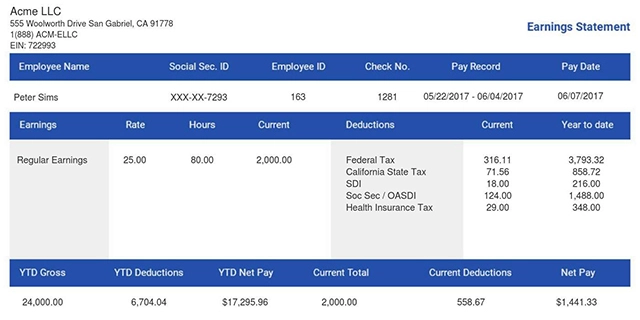
Your latest pay stub probably already answers that question. Many payroll systems print a leave block showing accrued, used, and available hours for the current period, usually shortened into payroll abbreviation codes.
Here's the fastest way to confirm your real rate:
- Pull your two most recent pay stubs. Find the PTO or leave section.
- Subtract the older available balance from the newer one. That difference is your true accrual per pay period.
- Multiply by your periods per year. 26 for biweekly, 24 for semi-monthly, 52 for weekly.
- Compare it to your handbook. A gap usually means you've hit an accrual cap or a tenure tier didn't apply.
No PTO line on your stub? Check the employee handbook first, then ask HR for a written balance. Paperless employers can be slower here, so it helps to know how to get a pay stub from direct deposit. Keep your own copies either way. If you leave a job in a state that requires payout, your stubs are the evidence of what you're owed. Chasing records from a former employer is far harder than saving them as you go. Small business owners should make sure the stubs they issue show PTO balances too, since it heads off most leave disputes before they start.
You Might Also Like
- Does PTO Count Towards Overtime?
- Is PTO Taxed?
- What Negative PTO Means for Your Balance
- Unpaid PTO: How It Works
- Understanding Paycheck Stubs
Conclusion
So, how much PTO do you get? If you're in private industry, expect around 11 vacation days after your first year and roughly 20 once you hit two decades. Add about a week of sick leave. Your industry and employer size shift those odds more than anything you control, and your own accrual rate is knowable from two consecutive pay stubs.
One last thing worth acting on: in several states, your unused balance is money you're owed when you leave, and your stubs are the proof. If you're self-employed or need clean pay documentation fast, our paystub generator creates professional pay stubs in minutes.
- 1. Enter Your Information

- 2. Select Your Favorite Theme

- 3. Download Your Stub!

 By
By